
 Náhľad v interiéri
 Odoslať ako digitálnu kartu
 Zdieľať
 Podrobnosti o dielo
 Príručka

 Stiahnuť obraz
 Podobné položky
 RTG skúška
 Prehliadanie diapozoje
 Otázky a odpovede
 Štatistiky
Cutting up a Plane Wing

- 30.0 x 57.0 cm


 Zobraziť viac
Umelecké dielo zobrazené na tejto stránke je chránené autorským zákonom, čo znamená, že nemôžeme legálne vytvárať ani predávať jeho identickú reprodukciu. Táto ochrana je vymáhaná na základe medzinárodných dohôd, ako napríklad Bernská konvencia a národnými zákonmi, vrátane tých, ktoré sú stanovené v Autorské právo USA – Title 17. Všetky práva vyhradené.
Táto metóda plne dodržiava autorské práva, pretože nezahŕňa kopírovanie ani duplikovanie chráneného diela. Ide skôr o kreatívnu reinterpretáciu – nový obraz, ktorý je ovplybnený originálom, no nie je s ním identický.
Giclée / Umenotlač
Giclée tlač alebo plátno múzeálnej kvality s rýchlou výrobou a rôznymi možnosťami povrchovej úpravy. ( Kúpiť ručne maľovaný obraz Prepnúť na digitálny obraz)




P118B €10

P118H €10

P118W €10

P438Z €10

P508JH €12

P508YH €12

P805H €10

P805Z €10

P919BZ €10

P919G €10

P919XJ €10

P959ZH €10

P968JZ €12

W106C €8

W218G €10

W218JH €8

W218Y €10

W307PJ €10

W316G €10

W316PJ €8

W316Y €10

W398PJ €8

W4111J €10

W500HY €15

W500JH €15

W692G €12

W849H €8

W940BG €15

W953PJ €8




Vyberte si z našich preddefinovaných rozmerov, ktoré zodpovedajú pôvodným pomeroḿ diela.

Zadajte šírku a výšku, ktoré potrebujete, aby sa reprodukcia hodila k vášmu rámu alebo stene. Print možno len orezávať, nikdy však nemennú veľkosť zvětšiť oproti pôvodnému obrázku, preto pri inom formáte stráca časť obrazu. Pred samotným vytlačiacím procesom vám pošleme digitálny náhľad na schválenie. Obrázok zobrazený na tejto stránke nezobrazuje reálny rez — len digitálny náhľad ukazuje presný výsledok.
Celosvetová doprava () do 2 týždňov namiesto štandardných 4 až 5 týždňov. (9 november)

Bezplatná expresná doprava po celom svete

Vysokokvalitné lnianske plátno

Kompletné poistenie prepravy

Záruka vrátenia colného poplatku

Záruka presného farebného zhodnutia

100-dená politika vrátenia tovaru (iba pri vadách)

100% záruka vrátenia peňazí

Zľava pri väčšom množstve
 Možnosť skla je dostupná len pri rozmeroch pod 110 cm

Cutting up a Plane Wing
Giclée / Umenotlač
Veľkosť reprodukcie
-


Celková cena
€ 72
Biografia umelca
A Life Captured in Light and Line
Rupert Norman Shephard emerged from the vibrant artistic landscape of London as a painter whose work served as a profound witness to the shifting tides of the twentieth century. Born in Islington, the son of an engineer and a charity worker, his early environment was steeped in the quiet creativity of Quaker life. This foundation of observation and meticulous care would later manifest in his disciplined approach to the canvas. After attending Repton School, Shephard sought formal refinement at the illustrious Slade School of Fine Art, studying under the legendary Professor Henry Tonks. It was within these hallowed halls that he developed a formidable tenacity and a mastery of draftsmanship, qualities that would define his professional identity alongside contemporaries such as William Coldstream and Victor Pasmore.
His early career was marked by a tireless dedication to both pedagogy and practice. While teaching at Raynes Park County School, Shephard spent his nights and even his hours in pubs and music halls capturing the essence of British life. By 1929, he had begun to establish himself within the London art scene, exhibiting with the London Group at galleries such as Wertheim and Coolings. His early stylistic tendencies were noted for a certain bleak linearity, yet as the decades progressed, his hand moved toward a more painterly, tonal approach. This evolution, deeply rooted in the Euston Road tradition derived from Sickert, allowed him to balance a rigorous realism with an evocative, atmospheric suggestion that breathed life into his subjects.
Witness to an Era of Change
The turbulence of the Second World War provided Shephard with a unique canvas upon which to document the industrial and human spirit of Britain. During the war years, he transitioned from pure studio practice to working as an industrial draughtsman, a role that allowed him to observe the mechanics of wartime production firsthand. His contributions to the War Artists' Advisory Committee (WAAC) are particularly significant, as they capture the grit and collaboration of the era. Through works such as A Penicillin Factory Girls Filling Bottles and Cutting up a Plane Wing, Shephard utilized a blend of realism and impressionism to portray the bustling workshops and the vital role of women in industry. These paintings are more than mere historical records; they are powerful glimpses into a moment of collective national effort, rendered with a keen eye for both the mechanical and the human.
Following his wartime service with the Ministry of War Transport, Shephard’s journey took him far beyond the streets of London. A period of fifteen years in South Africa, where he served as the director of the Michaelis Art School at the University of Cape Town, expanded his horizons and allowed him to share his expertise on an international stage. This chapter of his life, characterized by numerous solo exhibitions, demonstrated his ability to adapt his British sensibilities to new landscapes and perspectives. Upon returning to Britain, he continued to leave a lasting mark on the art community through teaching and his enduring commitment to the craft of painting and illustration.
The Intimacy of the Painted Moment
Beyond the grand narratives of war and industry, Shephard possessed a remarkable ability to find profound beauty in the quietest corners of existence. His portraits and genre scenes often invite the viewer into an intimate space of contemplation. In works like Woman Writing a Letter, he masterfully constructs an atmosphere of focused creation, using soft, natural light to illuminate the intellectual endeavor of his subject. The delicate dance between thought and tangible form is captured through his careful handling of texture—the weight of aged paper, the glow of light on polished wood, and the stillness of a room caught in a moment of grace.
Shephard’s legacy resides in this duality: his ability to document the monumental shifts of history while simultaneously celebrating the delicate, ephemeral moments of domestic life. His work remains a testament to the power of observation, bridging the gap between the external world of industry and the internal world of the human spirit through a sophisticated mastery of light, tone, and line.

Rupert Shephard
1909 - 1992 , United Kingdom
Základné informácie
- Artistic Movement Or Style: Euston Road School tradition
- Full Name: Rupert Norman Shephard
- Nationality: English
- Notable Artworks:
- Woman Writing a Letter
- A Penicillin Factory Girls Filling Bottles
- Councillor Mrs Sue Bartlett
- Cutting up a Plane Wing
- Place Of Birth: Islington, United Kingdom
- Date Of Birth: 1909
- Date Of Death: 1992
Súvisiace články

Philip Wilson Steer: Capturing Modern Life & British Impressionism's Essence
Explore the life & art of Philip Wilson Steer, a leading British Impressionist painter. Discover his coastal scenes, influences, and legacy. Expert analysis & high-quality reproductions at OriginalUniqueArt.

Top 25 umeleckých diel Britského múzea: História, krása a dekor pre váš domov
Objavte top 25 umeleckých diel Britského múzea! Prežite príbehy slávnych majstrov ako Leonardo da Vinci, Van Gogh a Rembrandt. Reprodukcie obrazov pre váš domov – nájdite inšpiráciu a luxusné dekorácie na OriginalUniqueArt.com

Sir George Clausen: Capturing Edwardian Life & British Impressionism's Nuances
Explore the luminous world of Sir George Clausen, a leading British Impressionist painter. Discover his captivating scenes of Edwardian life, rural England & poignant war art. Learn about his legacy and find high-quality reproductions at OriginalUniqueArt.
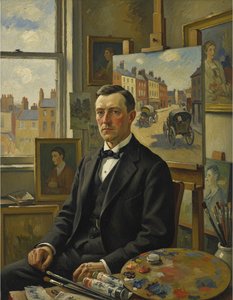
Robert Bevan: Pioneering British Post-Impressionism & the Camden Town Group's Intimate Vision
Explore the life & work of Robert Bevan, a pioneer of British Post-Impressionism and founding member of the Camden Town Group. Discover his vibrant landscapes and lasting impact on early 20th-century art.
Frank Brangwyn: A Life Immersed in Colour, Craft & the Spirit of Modern British Art
Explore the vibrant life & prolific work of Frank Brangwyn, a master of British art. Discover his stunning paintings, designs, and monumental Empire Panels – a celebration of colour, craft, and artistic innovation.