

 Zobraziť v interiéri
 Odoslať
 Zdieľať
 Podrobnosti
 Príručka

 Stiahnuť
 Podobné položky
 RTG skúška
 Prehliadanie diapo\]
 Štatistiky
Seated Man
 Oil On Canvas
- WallArt
- Cubism
 1913
1913- Modern
 130.0 x 165.0 cm
 Musée National d’Art Moderne Centre Georges Pompidou
 Prečítať si viac
Giclée / Umenotlač
Giclée tlač alebo plátno múzeálnej kvality s rýchlou výrobou a rôznymi možnosťami povrchovej úpravy. ( Objednať ručne maľovanú reprodukciu Prepnúť na digitálnu verziu obrazu)




P118B $10

P118H $10

P118W $10

P438Z $10

P508JH $12

P508YH $12

P805H $10

P805Z $10

P919BZ $10

P919G $10

P919XJ $10

P959ZH $10

P968JZ $12

W106C $8

W218G $10

W218JH $8

W218Y $10

W307PJ $10

W316G $10

W316PJ $8

W316Y $10

W398PJ $8

W4111J $10

W500HY $15

W500JH $15

W692G $12

W849H $8

W940BG $15

W953PJ $8




Vyberte si z našich preddefinovaných rozmerov, ktoré zodpovedajú pôvodným pomeroḿ diela.

Môžete zadať vlastné rozmery, aby sa reprodukcia prispôsobila konkrétnemu rámu alebo priestoru. Ak zvolená veľkosť nebude zodpovedať proporciám originálu, dielo buď orežeme, alebo obraz rozšírime pomocou zrkadlenia či farebného doplnenia okrajov. Pred začatím výroby vám pošleme digitálnu ukážku na schválenie.
Máte na vedomí, že náhľad na obrazovke neodzrkadľuje skutočné orezanie alebo rozšírenie. Len digitálna ukážka presne zobrazí finálnu kompozíciu.
Hoci sú k dispozícii vlastné rozmery, pre zachovanie pôvodných proporcií odporúčame vybrať si rozmer z vopred definovaného zoznamu.
Celosvetová doprava () do 2 týždňov namiesto štandardných 4 až 5 týždňov. (25 september)

Bezplatná expresná doprava po celom svete

Vysokokvalitné lnianske plátno

Úplné poistenie prepravy

Záruka vrátenia colného poplatku

Záruka presného farebného zhodnutia

100-dená politika vrátenia tovaru (iba pri vadách)

100% záruka vrátenia peňazí

Ponuka množstevnej zľavy
 Možnosť skla je dostupná len pri rozmeroch pod 110 cm

Seated Man
Giclée / Umenotlač
Veľkosť reprodukcie
-


Celková cena
$ 80
A Study in Cubist Stillness
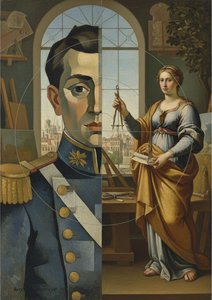
In the vibrant, experimental atmosphere of 1913 Paris, Roger de La Fresnaye captured a moment of profound quietude that would become a cornerstone of early modernism. Seated Man is far more than a simple portrait; it is a masterful exploration of how the human form can be reimagined through the lens of Cubist fragmentation. At first glance, the viewer encounters a solitary figure, seated with an air of dignified composure, his hands resting calmly upon his lap. Yet, as one lingers on the canvas, the traditional boundaries of the subject begin to dissolve. The man’s presence is anchored by a serious, contemplative expression, suggesting a psychological depth that transcends the mere physical depiction of a sitter. This is a portrait not just of a person, but of an internal state—a moment of intellectual repose captured amidst the shifting planes of a modernizing world.
The composition serves as a brilliant dialogue between structure and spontaneity. De La Fresnaye employs the core tenets of Cubism, utilizing geometric shapes and overlapping planes to reconstruct the subject from multiple perspectives simultaneously. This technique dismantles the illusion of traditional realism, replacing it with a rhythmic arrangement of cubes and facets that challenge our perception of space. The background is a tapestry of bold, prismatic hues—striking blues, deep reds, and luminous yellows—that dance against stark whites. These colors do not merely decorate the scene; they actively participate in the construction of form, creating a sense of movement within the stillness. Scattered throughout this fractured landscape are subtle symbols of intellectual life: books lie near the figure, hinting at a thirst for knowledge, while a solitary bottle on the periphery adds a touch of domestic tranquility to the avant-garde arrangement.
A Legacy of Color and Form
To understand the emotional resonance of Seated Man, one must consider the historical currents that shaped De La Fresnaye’s hand. As a member of the Puteaux Group, the artist sought to move beyond the purely structural experiments of Picasso and Braque, infusing Cubism with a more decorative and luminous quality. His work reflects the influence of Orphism, where color becomes a primary vehicle for light and energy. This makes the painting an exceptional choice for those looking to introduce a sense of sophisticated dynamism into a contemporary space. The interplay between the heavy, grounded presence of the seated figure and the ethereal, fragmented background creates a tension that is both intellectually stimulating and visually soothing.
For the discerning collector or interior designer, this artwork offers a unique opportunity to anchor a room with a piece of art history. Its large-scale presence (130 x 165 cm) allows its intricate details—the texture of the suit, the sharp edges of the geometric planes, and the rich saturation of the palette—to command attention. Whether placed in a minimalist gallery setting or a richly textured study, a high-quality reproduction of this masterpiece brings with it an aura of cultured elegance. It is a work that invites continuous rediscovery, offering new layers of meaning and visual delight every time the eye wanders across its fractured, beautiful surface.
Biografia umelca
Roger de La Fresnaye – Symbolism, Cubism, and the Pursuit of Prismatic Beauty
Roger de La Fresnaye, born into the aristocratic lineage of the La Fresnayes in 1885, was a painter whose brief but incandescent career illuminated the burgeoning landscape of early 20th-century art. His story is one of inherited privilege tempered by artistic ambition, classical training disrupted by avant-garde fervor, and ultimately, a life tragically cut short by illness. The Château de la Fresnaye in Falaise, ancestral home to his family with its long history of military service, provided an early backdrop for a life that would eventually blend tradition with radical innovation. Though steeped in the values of his upbringing, young Roger found himself drawn not to the battlefield but to the canvas, embarking on a journey that would see him navigate the complex currents of Symbolism, Cubism, and beyond. His initial education was classically grounded, yet it quickly evolved as he sought artistic instruction at the Académie Julian and later the École des Beaux-Arts in Paris – institutions where the seeds of his future stylistic explorations were sown.From Nabis Dreams to Cubist Geometry
The formative years of de La Fresnaye’s artistic development were profoundly shaped by the *Nabis*, a group of Post-Impressionist painters who prioritized subjective experience and symbolic meaning over strict representation. Studying under Maurice Denis and Paul Sérusier at the Académie Ranson, he absorbed their emphasis on flattened forms, decorative patterns, and evocative color palettes – qualities evident in works like Woman with Chrysanthemums. This period reveals a dreamlike quality, a stylistic echo of the Nabis’ pursuit of spiritual resonance through art. The influence of Denis's meticulous attention to detail and Sérusier’s expressive use of color instilled in him a foundational understanding of how to convey emotion and atmosphere—principles that would continue to inform his artistic endeavors throughout his career. He wasn’t merely copying; he was absorbing, internalizing, and transforming their techniques into something uniquely his own. The shimmering hues and subtly textured surfaces of these early paintings foreshadowed the bolder chromatic explorations that would characterize his later work.The Embrace of Cubism: A Revolutionary Shift
Around 1912, de La Fresnaye decisively embraced the revolutionary ideas of Cubism pioneered by Pablo Picasso and Georges Braque—a pivotal moment that irrevocably altered his artistic trajectory. Recognizing the limitations of Impressionistic representation, he sought a new visual language capable of capturing the complexities of perception and challenging conventional notions of space and form. This wasn’t simply an aesthetic preference; it was a philosophical imperative—a desire to engage with the intellectual currents shaping the era. Like Picasso and Braque, de La Fresnaye dissected objects into geometric fragments, presenting multiple viewpoints simultaneously on a single canvas. However, unlike his peers who often adhered rigidly to Cubist principles, he infused his compositions with vibrant color and textural richness – a distinctive stylistic hallmark that distinguished him from the mainstream movement. This fusion of geometric abstraction and chromatic intensity is brilliantly exemplified in The Conquest of the Air—a monumental painting depicting a squadron of aircraft soaring through the sky, rendered in bold shades of crimson, ochre, and turquoise. The fractured planes of the fuselage and wings are juxtaposed against a luminous background, creating an arresting visual experience that captures both the dynamism of flight and the artist’s fascination with technological innovation.War's Impact and Artistic Transformation
The outbreak of World War I profoundly impacted de La Fresnaye’s life and artistic output. He enlisted in the French army, experiencing firsthand the horrors of trench warfare—a formative experience that instilled in him a deep appreciation for human suffering and resilience. However, his military service was tragically curtailed by tuberculosis, forcing his discharge in 1918. The debilitating illness took its toll on his physical health and significantly diminished his creative energy—resulting in a noticeable stylistic shift away from the energetic dynamism of his Cubist period. Recognizing that he could no longer achieve the same level of expressive intensity as before, he adopted a more restrained approach—focusing on linear precision and subtle tonal variations. This decision wasn’t driven by despair; rather, it represented a conscious effort to distill his artistic vision into its purest form—a testament to his unwavering commitment to art despite personal adversity. The resulting paintings – notably Undergrowth – are characterized by delicate brushstrokes and muted colors—reflecting the artist's introspective gaze and conveying a sense of quiet contemplation.Legacy: A Singular Voice Amidst Modern Innovation
Roger de La Fresnaye died in 1925 at the young age of forty, leaving behind a relatively small but remarkably significant body of work. Though his career was tragically curtailed, his contribution to the development of modern art remains undeniable. He successfully bridged the gap between the decorative sensibilities of the Nabis and the radical experimentation of Cubism—creating a unique visual language that continues to captivate audiences today. His paintings can be found in prestigious museums such as the Musée d'Art Moderne de Troyes and the Centre Pompidou (Paris), testaments to his enduring artistic merit. The record-breaking sale of La Conquête de l’Air at Christie’s in 2017 – fetching over €2.3 million – serves as a powerful affirmation of his place within the canon of modern masters. De La Fresnaye's legacy lies not only in his individual artistic achievements but also in his ability to synthesize diverse influences into a cohesive and compelling vision—a singular voice amidst the burgeoning chorus of modernist innovation that cemented his position as one of the most distinctive figures of his time.
Roger de La Fresnaye
1885 - 1925 , Francúzsko
Rýchle fakty
- Artistic Movement Or Style: Symbolizmus, Kubizmus
- Artists Or Movements Influenced By This Artist: ['Kubizmus']
- Artists Who Influenced This Artist:
- Maurice Denis
- Paul Sérusier
- Georges Braque
- Date Of Birth: 11. júla 1885
- Date Of Death: 27. novembra 1925
- Full Name: Roger de La Fresnaye
- Nationality: Francúzsky
- Notable Artworks:
- Konštruktúra
- Madelón
- Čiapka
- Place Of Birth: Le Mans, Francúzsko
Súvisiace články

Neo-Abstract Art: The High-Impact Evolution of Modern Visual Energy and Geometric Sophistication
Discover the power of Neo-Abstract art. Explore how bold geometric forms and high-impact visual energy are redefining modern design. Learn to curate sophisticated, high-energy spaces with the latest trends in contemporary abstraction and structural color.
Roger de la Fresnaye: Cubism, Tradition & the Search for Order in Early 20th-Century French Painting
Explore the captivating world of Roger de la Fresnaye, a pivotal French Cubist painter. Discover his unique blend of tradition & modernity, influences, and lasting legacy with OriginalUniqueArt.

Beyond Form & Color: Geometric Abstraction's Evolution in 20th/21st Century Art
Explore the evolution of geometric abstraction from Cubism to contemporary art. Discover key artists like Malevich & Mondrian, investment insights, and expert collecting advice at OriginalUniqueArt.

Top 10 majstrov geometrickej abstrakcie: Umění pre váš domov s OriginalUniqueArt.com
Ponorte sa do sveta geometrickej abstrakcie! Objavte 10 majstrovských diel od Mondriana, Kandinského a ďalších. História umenia, techniky a farebné kompozície na OriginalUniqueArt.com – reprodukcie obrazov pre váš domov.

Francisco Goya: Top 25 Majstrovských Diel pre Váš Domov | OriginalUniqueArt.com
Ponorte sa do sveta Francisca Goya a jeho 25 najvýznamnejších diel. Objavte príbehy za ikonickými obrazmi romantizmu, portrétmi a Čiernymi maľbami. Reprodukcie obrazov pre váš interiér na OriginalUniqueArt.com – luxusné dekorácie s umením.

