Menu
BEZPLATNÁ KONSULTÁCIA O UMENÍ
Kúpiť tlač Kúpiť tlačKúpiť digitálnu verziu Kúpiť digitálnu verziu OdoslaťOdoslať
Podrobnosti o dieloPodrobnosti o dielo Pridať do obľúbených Pridať do obľúbených StiahnuťStiahnuť Podobné dielaPodobné diela RTG skúškaRTG skúška PrezentáciaPrezentácia

Under the Hammer

Robert Polhill Bevan’s ‘Under the Hammer,’ a captivating 1914 black and white scene of an auction gathering, showcases a pioneering spirit in British Modernism. This evocative artwork captures a moment of intense observation with its detailed figures and dynamic composition – discover this unique piece.

Robert Polhill Bevan (1865–1925): Britský malíř a zakladatel skupiny Camden Town. Pionýr fauvizmu, známý výraznými krajinami a scénami každodenního života.

Ručne maľovaná olejová reprodukcia

Ručne maľovaný olej na plátne vo vašej zvolenej veľkosti a v ráme, vyrobený na mieru našimi umelcami.

P118B $10
P118H $10
P118W $10
P438Z $10
P508JH $12
P508YH $12
P805H $10
P805Z $10
P919BZ $10
P919G $10
P919XJ $10
P959ZH $10
P968JZ $12
W106C $8
W218G $10
W218JH $8
W218Y $10
W307PJ $10
W316G $10
W316PJ $8
W316Y $10
W398PJ $8
W4111J $10
W500HY $15
W500JH $15
W692G $12
W849H $8
W940BG $15
W953PJ $8

Standard
custom
CM
INCH

Vyberte si z našich preddefinovaných rozmerov, ktoré zodpovedajú pôvodným pomeroḿ diela.

šírka
výška

Môžete zadať vlastné rozmery tak, aby sa hodili do konkrétneho rámu alebo priestoru. Ak sa váš zvolený rozmer nezhoduje s pôvodnými proporciami obrazu, dielo buď orezáme, alebo ho doplníme ručne maľovanými prvkami. Pred začiatkom výroby vám zašleme digitálny náhľad na schválenie.
Upozorňujeme, že ukážka na obrazovke neodráža skutočné orezanie alebo doplnenie. Skutočnú finálnu kompozíciu zobrazuje iba digitálny náhľad.
Hoci sú k dispozícii vlastné rozmery, odporúčame vybrať rozmer z preddefinovaného zoznamu, aby sme zachovali pôvodné proporcie.

Príklady možných zmien: nahradiť tvár fotografiou zákazníka; pridať domáce zviera (napr. nahradiť mačku psom); vložiť skryté posolstvo do pozadia; zmeniť krajinu alebo prvky pozadia.
Po odoslaní objednávky vám tím OriginalUniqueArt.com pošle e-mail s pokynmi a poskytne náhľad na návrh.

Celosvetová doprava () za 3 až 4 týždne namiesto štandardných 5 týždňov. (23 júl). Bez kompromisov v kvalite.

why_choose_icon
Bezplatná expresná doprava po celom svete
why_choose_icon
Prémiové lnianske plátno
why_choose_icon
Kompletné poistenie prepravy
why_choose_icon
Záruka vrátenia colného poplatku
why_choose_icon
Záruka presného farebného zhodnutia
why_choose_icon
60-dňá politika vrátenia (iba pri defektoch)
why_choose_icon
100% záruka vrátenia peňazí
why_choose_icon
Výhodná množstevná zľava

Celková cena

-

reproduction

Under the Hammer

Technika reprodukcie

Veľkosť reprodukcie

-

Celková cena za vybrané možnosti

-

Základné informácie

  • Movement: British Modernism
  • Dimensions: 637 x 637 cm
  • Influences: European artists
  • Year: 1914
  • Notable elements: Auction scene
  • Title: Under the Hammer
  • Artist: Robert Polhill Bevan

Popis diela

Robert Polhill Bevan’s ‘Under the Hammer’: A Window into Early Modern British Art

Under the Hammer, painted in 1914 by Robert Polhill Bevan, is more than just a depiction of a crowded room; it's a meticulously observed snapshot of a pivotal moment in British art history. Measuring an impressive 637 x 637 cm, this black and white composition captures a scene brimming with quiet intensity – a gathering seemingly centered around a horse, likely within the context of an auction or appraisal. Bevan’s work stands as a crucial bridge between the Impressionistic tendencies prevalent at the turn of the century and the burgeoning radicalism that would define British Modernism.

  • Subject Matter: The central focus is undeniably the horse, positioned with deliberate prominence within the room's architecture. However, it’s the surrounding figures – a diverse group of men, many in formal attire suggesting an upper-class setting – that truly imbue the painting with its narrative weight.
  • Style & Technique: Bevan employs a restrained yet remarkably detailed technique, characteristic of his time. The tonal range is carefully controlled, utilizing subtle gradations of gray to create depth and volume. His brushwork is precise, particularly evident in the rendering of clothing textures and the horse’s musculature, reflecting a commitment to observational accuracy rather than purely expressive color.

A Quaker Banker's Artistic Rebellion

Robert Polhill Bevan’s biography itself is fascinating. Born into a banking family – his parents were Richard Alexander Bevan and Laura Maria Polhill – he initially seemed destined for a life of finance, influenced by his Quaker upbringing. Yet, defying expectations, Bevan embraced an artistic path, fueled by a restless intellectual curiosity and a desire to push the boundaries of representation. His formative years in Paris at the Académie Julian proved transformative, exposing him to the innovative ideas circulating amongst artists like P.

This influence is palpable in ‘Under the Hammer’. The composition’s slightly awkward perspective, the deliberate lack of idealized beauty, and the focus on capturing a specific moment in time – rather than presenting an allegorical or romanticized scene – are hallmarks of Bevan's engagement with European modernism. He wasn't simply copying trends; he was actively participating in a dialogue about how art could represent the world around him.

Symbolic Layers and Emotional Resonance

While seemingly straightforward, ‘Under the Hammer’ is rich in symbolic potential. The horse itself can be interpreted as representing wealth, status, and perhaps even judgment – fitting for an auction setting. The figures surrounding it are equally significant; their expressions, postures, and interactions suggest a complex interplay of observation, speculation, and negotiation. The inclusion of details like books and cups adds layers of domesticity and intellectual engagement to the scene.

Bevan’s ability to evoke a sense of quiet contemplation is remarkable. Despite the bustling activity implied by the gathering, there's an underlying stillness that draws the viewer in. This emotional resonance, combined with the artist’s masterful technical skill, elevates ‘Under the Hammer’ beyond a mere depiction of a scene; it becomes a poignant meditation on observation, value, and the human condition.

A Legacy for Collectors & Interior Design

This hand-painted reproduction captures not only the visual elements of Bevan's original work but also its historical significance and artistic merit. Its size (637 x 637 cm) makes it a commanding presence, suitable for grand spaces or as a focal point within a sophisticated interior design scheme. The monochrome palette lends itself beautifully to a variety of styles – from classic British interiors to contemporary minimalist settings. ‘Under the Hammer’ is an investment in art history and a testament to Bevan's pioneering role in shaping modern British art.


Biografia umelca

Robert Polhill Bevan (1865–1925): British painter & Camden Town Group founder

Robert Polhill Bevan, born in Hove in 1865, occupies a pivotal yet often understated position within the narrative of early 20th-century British art. Emerging from a Quaker background steeped in banking connections – his parents were Richard Alexander Bevan and Laura Maria Polhill – he defied conventional expectations to become a daring innovator, a key figure in the transition from Impressionism towards more radical explorations of color and form. His journey was one of constant experimentation, absorbing influences from across Europe while forging a distinctly personal artistic vision that would profoundly impact the development of modern art in Britain. Bevan’s early education at Westminster School of Art under Fred Brown provided a solid foundation, but it was his subsequent studies at the Académie Julian in Paris that truly ignited his creative spark. There, he encountered a constellation of rising stars – Paul Sérusier, Pierre Bonnard, Édouard Vuillard, and Maurice Denis – artists who were challenging academic conventions and embracing new approaches to painting. These encounters proved formative, exposing Bevan to the principles of synthetism and laying the groundwork for his future explorations.

Early Influences & Parisian Awakening

Bevan’s artistic sensibilities were profoundly shaped by his formative years in Paris. The Académie Julian served as a crucible for innovation, immersing him in the vibrant intellectual atmosphere of the Belle Époque and fostering connections with artists who championed groundbreaking ideas. He was particularly captivated by the work of Gauguin and Cézanne, whose expressive use of color and simplified forms resonated deeply within his artistic sensibilities. These encounters instilled in Bevan a conviction that art should transcend mere representation, prioritizing emotional impact and conveying subjective experience—a stance that would become central to his subsequent artistic endeavors. The influence of Brittany is undeniable; two significant journeys undertaken between 1890 and 1891 cemented his fascination with the region’s dramatic landscapes and bold chromatic palette. Observing Gauguin's pioneering approach to depicting indigenous cultures and simplifying forms captivated Bevan, prompting him to translate these principles into his own artistic practice. His sketchbook pages from this period—now housed in the Ashmolean Museum—offer invaluable insight into the genesis of his distinctive visual language.

The Fauvist Breakthrough & Divisionist Technique

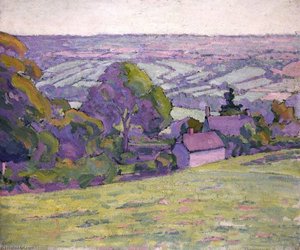
Around 1904 Bevan embarked on a transformative path of experimentation with pure color, anticipating the emergence of Fauvism on the continent and marking a decisive break from Impressionistic conventions. His painting “Courtyard” exemplifies this audacious stylistic choice—a deliberate rejection of naturalistic hues in favor of vibrant, emotionally charged pigments—demonstrating a willingness to prioritize expressive intensity over accurate depiction. This bold move wasn’t merely aesthetic; it reflected Bevan's belief that color possessed inherent power to communicate emotion and convey psychological states—a conviction that would inform his artistic vision throughout his career. Furthermore, Bevan honed his technique by adopting divisionist or pointillist principles, evident in masterpieces such as “Ploughing on the Downs” and “The Chestnut Tree.” This meticulous method involved applying tiny dots of color onto a canvas surface, allowing for subtle blending effects and creating luminous textures—a stylistic innovation that distinguished Bevan from many of his contemporaries. He drew inspiration from masters like Velázquez and Goya, recognizing their masterful use of chiaroscuro and capturing the essence of human emotion through nuanced tonal variations.

Collective Artistic Endeavors & Recognition

Bevan’s artistic pursuits weren't confined to solitary contemplation; he actively engaged in collaborative projects that propelled him into the forefront of British modern art. He was a founding member of the Camden Town Group, alongside artists like Walter Sickert and Frank Auerbach, who sought to depict urban life with uncompromising honesty and expressive fervor—challenging academic traditions and forging a new visual language rooted in direct observation. This collective spirit extended to his involvement with the London Group and the Cumberland Market Group, fostering an exchange of ideas that enriched his artistic repertoire. Notably, Bevan joined Walter Sickert’s Fitzroy Street group in 1908, where he encountered encouragement from Sickert to explore themes of everyday life—a pivotal moment that steered Bevan towards a more socially conscious aesthetic. His membership in the New English Art Club and participation in exhibitions underscored his commitment to disseminating innovative artistic concepts and engaging with broader cultural dialogues.

Legacy & Enduring Influence

Robert Polhill Bevan’s contribution to British art history is undeniable, securing his place as a pioneer of Fauvist principles and shaping the trajectory of modern British painting. His landscapes—particularly those depicting Sussex and Brittany—remain celebrated for their luminous color palettes and expressive brushwork—capturing the spirit of rural life with remarkable sensitivity. Works like “In the Downs near Lewes” and “The Chestnut Tree” exemplify Bevan’s ability to convey both visual beauty and emotional resonance—a testament to his artistic mastery and enduring influence on subsequent generations of painters. A retrospective exhibition at Colnaghi’s in 1961 served as a crucial moment of recognition, solidifying Bevan's legacy and ensuring that his innovative spirit continues to inspire artists today. His unwavering dedication to experimentation and his profound engagement with the visual arts cemented his position as one of Britain’s foremost artistic figures—a visionary who dared to challenge conventions and forge a path toward a radically new aesthetic horizon.
Robert Polhill Bevan

Robert Polhill Bevan

1865 - 1925 , Spojené kráľovskosti

Základné informácie

  • Artistic Movement Or Style: Fauvizmus, Divizionizmus
  • Artists Or Movements Influenced By This Artist: ['Modern Británska umenie']
  • Artists Who Influenced This Artist:
    • Paul Gauguin
    • Velázquez
    • Goya
    • Renoir
  • Date Of Birth: 1865
  • Date Of Death: 1925
  • Full Name: Robert Polhill Bevan
  • Nationality: Británia
  • Notable Artworks:
    • The Farmhouse
    • Ploughing on the Downs
    • Queen's Grove
    • The Cab Horse
  • Place Of Birth: Hove, Veľká Británia
Preskúmajte umelecká diela usporiadané podľa tém, štýlov a charakteristík.