Vrcholná renesancia
Disputa (Raffael)
Disputa je dielo od Raffael (1483–1520). Patrí k umeleckému smeru Vrcholná renesancia. Je vyrobené z Freska.
- Freska

 Ručne maľovaná olejná reprodukcia
 Odoslať ako digitálnu kartu
 Zdieľať
 Príručka


 Stiahnuť obraz
 Podobné položky
 Prehliadanie diapozoje
 Otázky a odpovede

 Štatistiky
Disputa: základné informácie
- Názov
- Disputa
- Umelec
- Raffael (1483–1520)
- Narodený v roku
- Urbino, Taliansko
- Technika
- Freska
- Pohyb
- Vrcholná renesancia
- Obdobie
- Renesancia
Pohľad na Disputa
A Divine Dialogue: Unveiling Raphael’s *Disputa*
Raphael's *Disputa*, painted between 1509 and 1510, is a cornerstone of High Renaissance art, residing within the breathtaking Stanze di Raffaello in the Apostolic Palace at Vatican City. This monumental fresco isn’t merely a painting; it’s a theological statement rendered with unparalleled grace and intellectual depth, inviting viewers into a visual discourse on faith, reason, and divine truth.Subject & Composition: Heaven Meets Earth
The *Disputa* presents a complex yet harmonious composition divided into two distinct realms. The upper portion depicts a celestial gathering of theologians, saints, prophets, and martyrs arranged in a semi-circular formation around Christ and the Virgin Mary. They engage in animated discussion, their gestures conveying reverence and intellectual fervor. Below, on an architectural platform resembling a classical temple apse, earthly theologians – recognizable figures like Saint Augustine, Saint Thomas Aquinas, and Saint Gregory – continue the debate concerning the Holy Sacrament. This deliberate juxtaposition visually represents the convergence of heavenly wisdom and human inquiry. The composition is masterfully structured with a pyramidal form culminating in Christ, drawing the eye upwards towards the divine source.Style & Technique: The High Renaissance Ideal
*Disputa* exemplifies the hallmarks of the High Renaissance: balance, clarity, and idealized beauty. Raphael’s mastery of perspective creates a convincing sense of depth, while his use of *sfumato* – subtle gradations of light and shadow – lends an ethereal quality to the figures. Executed as a fresco, the painting demonstrates Raphael's technical brilliance in applying pigments to wet plaster, resulting in vibrant colors that have endured for centuries. The figures are not static; they possess dynamic poses and expressive faces, conveying a sense of lively intellectual exchange.Historical Context & Symbolism
Commissioned by Pope Julius II as part of the decoration of his private library (the *Stanza della Segnatura*), *Disputa* reflects the humanist spirit of the Renaissance – a renewed interest in classical learning and philosophical inquiry alongside religious faith. The room itself was intended to represent different branches of human knowledge: theology, law, poetry, and philosophy. The painting’s symbolism is rich and layered. The Holy Spirit, represented as a dove emanating light, signifies divine inspiration. The inclusion of prominent theologians underscores the importance of reason and scholarship in understanding religious doctrine. The architectural setting evokes the grandeur of ancient Rome, linking Christian theology to classical tradition.Emotional Impact & Lasting Legacy
*Disputa* transcends its theological subject matter to evoke a profound sense of awe, reverence, and intellectual curiosity. The painting’s harmonious composition and idealized figures inspire contemplation on the nature of truth, faith, and knowledge. It is not merely a depiction of a debate but an invitation to participate in it – to engage with the eternal questions that have occupied humanity for centuries. Raphael's *Disputa* remains a testament to his artistic genius and continues to captivate viewers with its beauty, intellectual depth, and enduring spiritual power.- Explore high-quality reproductions of *The Disputation of the Holy Sacrament* to bring Renaissance grandeur into your space.
- Discover more about Raphael’s life and artistic contributions within the context of the High Renaissance movement.
Disputa vo vysokom rozlíšení

Raffael, Disputa. Verejné vlastníctvo
Otázky k Disputa
Ktorý priestor sa hodí k farbe diela „Disputa“ od Raffael?
Vzhľadom na jeho Zemité tóny farebnú paletu sa dielo „Disputa“ odporúča do miestnosti typu Obývací izba.
Na čo sa odporúča reprodukcia diela „Disputa“ od Raffael?
Do ktorého umeleckého smeru a do ktorej éry spadá dielo „Disputa“ od Raffael?
Dielo „Disputa“ patrí do smeru Vrcholná renesancia a jeho autor tvoril v období Renesancia.
Obsahuje „Disputa“ výrazné svetlo-tmavé kontrasty?
Ako "Disputa" vyvažuje svetlo a tieň?
Akú emóciu vyjadruje dielo z obdobia Vrcholná renesancia s názvom „Disputa“?
Duchovná emócia diela „Disputa“ dopĺňa jeho štýl, ktorý patrí do smeru Vrcholná renesancia.
Aké umiestnenie sa hodí k formátu diela „Disputa“ od Raffael?
Z akého materiálu je vyrobené dielo „Disputa“ a v akom je štýle?
„Disputa“ je vytvorené v technike Freska v štýle Vrcholná renesancia.
Pre koho je „Disputa“ od Raffael vhodným darčekom?
„Disputa“ sa odporúča ako darček pre Výročie.
O umelcovi, Raffael

1483–1520, Taliansko
Raffael
Ranné roky a formovanie v Urbine Raffaello Sanzio da Urbino, známy svetu ako Rafael, sa narodil v roku 1483 v malej, no intelektuálne pulzujúcej mestskej štáte Urbino. Jeho prvé roky boli hlboko ponorené do atmosféry, ktorá si cenila umeleckú zručnosť a humanistické vzdelanie. Jeho otec, Giovanni Santi, nebol len maliar zamestnaný vojvodom Federicom da Montefeltrom – bol to človek hlboko zapojený do prúdov renesančnej myšlienky, básnik, ktorý kronikoval život vojvodu a aktívne vyhľadával inovatívne umelecké nápady z celého Talianska. Toto ponorenie sa do dvorského prostredia, ktoré si cenilo rafinovanosť a intelektuálnu diskusiu, hlboko formovalo citlivosť mladého Rafaela.
Aj od Raffael
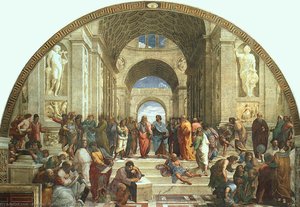 Aténska akadémia1511
 Sistinská Madona1513
 Transfigurácia1520
 Zväzovanie Panny Márie1504

Essays around Disputa
 Giotto di Bondone: Revolutionizing Late Medieval Painting through Narrative InnovationExplore the revolutionary art of Giotto di Bondone! Discover his groundbreaking techniques, iconic frescoes like those in the Arena Chapel,…
 Masterpieces of Light: The Top 25 Artworks by Duccio di BuoninsegnaJourney through the divine elegance of Duccio di Buoninsegna. Explore 25 iconic Sienese masterpieces, from the Maestà to the Rucellai Madon…
 Raphaelove majstrovské diela: Top 25 obrazov pre váš domov | OriginalUniqueArt.skObjavte top 25 majstrovských diel Raffaela Sanzia! Pútavé príbehy, renesančné umenie a techniky slávnych obrazov. Reprodukcie pre luxusný i…