Prepnúť na tlač
 Zobraziť viac







































 V prípade umeleckých diel alebo reprodukcií, ktorých ktorákoľvek strana je väčšia ako 105 cm (cca 41 palcov), sa rám dodáva v rozloženom stave ako sada. Táto metóda zabezpečuje bezpečnú доставu a chráni pred poškodením počas prepravy.


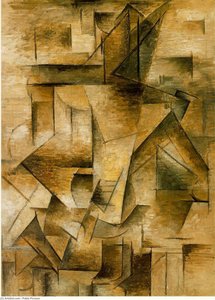
Nude and Still Life: A Cubist Intimacy
Pablo Picasso’s “Nude and Still Life” stands as a cornerstone of his artistic evolution and a pivotal moment in the genesis of Cubism, an avant-garde movement that irrevocably altered perceptions of visual representation. While definitive dating remains elusive—scholars debate its creation between 1929 and 1930—the painting embodies the analytical essence of Picasso’s Cubist period: a deliberate dismantling of conventional perspective to reconstruct reality from multiple viewpoints simultaneously. Presented with meticulous care, it juxtaposes a seated nude figure alongside elements suggestive of domestic tranquility – specifically a feline companion – employing a fractured aesthetic that mirrors Picasso's groundbreaking approach. Deconstructing Reality: Style & Technique Immediately recognizable as Cubist due to its bold rejection of traditional spatial illusion, “Nude and Still Life” prioritizes conceptual exploration over faithful reproduction. Picasso abandons the pursuit of accurate depiction; instead, he strives to convey a multiplicity of perspectives—a core principle championed by Cézanne’s pioneering investigations into form’s underlying geometric structure. The artwork is dominated by angular lines and sharply defined geometric shapes – rectangles and triangles – generating a dynamic sense of movement and abstraction that defies naturalistic conventions. Neither the nude nor the cat are portrayed as solid forms but rather as collections of planes intersecting and overlapping, reflecting Picasso's meticulous dissection of visual elements. Picasso’s technique is characterized by precise outlining and the application of flat areas of color—a stylistic hallmark influenced by Cézanne’s emphasis on structural simplification. Minimal shading contributes to a flattened picture plane that amplifies the graphic quality of the work, emphasizing Picasso’s commitment to conveying form rather than illusion. The stark lighting further accentuates these geometric planes, casting pronounced shadows that underscore the fragmentation inherent in Cubist representation. Color & Composition: A Bold Visual Statement The painting's chromatic palette is vibrant yet deliberately jarring—a calculated contrast designed to captivate the viewer’s gaze and heighten visual interest. Picasso eschews harmonious blending; rather, he employs colors as independent entities, mirroring the movement’s rejection of tonal gradations. The dominant hues include reds, yellows, blues, and whites—each color strategically positioned to create a dynamic interplay that defies conventional compositional rules. Black serves as a grounding element, intensifying the brilliance of the figures and fostering a sense of depth despite the flattened perspective. The composition leans predominantly vertically, directing attention towards the nude figure’s posture and subtly incorporating the presence of the cat – suggesting an intimate moment within a domestic interior. This deliberate arrangement reinforces Picasso's exploration of spatial relationships and contributes to the painting’s overall contemplative mood. Historical Context: Picasso & The Birth of Cubism To grasp “Nude and Still Life,” it is crucial to situate it within Picasso’s broader artistic trajectory and the transformative context of early 20th-century art history. Born in Málaga, Spain, in 1881, Picasso demonstrated exceptional talent from a young age—a predisposition nurtured by his father José Ruiz y Blasco, who instilled in him a profound appreciation for traditional academic painting. However, Picasso’s true revolution commenced around 1907 with his collaborative venture with Georges Braque—a partnership that birthed Cubism as a defiant response to prevailing artistic conventions and an ardent desire to represent the complexities of modern experience. Influenced by Cézanne's groundbreaking explorations into form’s underlying geometric structure, Picasso and Braque sought to liberate art from illusionistic representation, prioritizing conceptual integrity over visual accuracy. This pivotal period marked a seismic shift in art history, paving the way for subsequent abstract movements that would reshape artistic discourse. Symbolism & Emotional Resonance Despite its overt abstraction—a deliberate departure from representational painting— “Nude and Still Life” harbors subtle symbolic layers. The nude figure, recurring throughout Picasso’s oeuvre, often embodies vulnerability, sensuality, or the human condition itself—themes that resonate powerfully across cultures and eras. The inclusion of the cat adds an element of domestic tranquility and perhaps symbolizes comfort, independence, or enigmatic contemplation. However, Picasso resists easy interpretation; instead, he invites viewers to engage in a dialogue with the artwork’s visual language—a testament to his mastery of conveying emotion and psychological nuance through form and color. “Nude and Still Life” remains an enduring masterpiece—a captivating exploration of perception and reality that continues to inspire admiration and provoke contemplation.Otázky a odpovede
Aká veľkosť tlače diela „Nude a stále život“ od Pablo Picasso sa hodí do odporúčanej miestnosti?
Pre miestnosť typu Obývací izba sa pre dielo „Nude a stále život“ odporúča veľkosť tlače Veľký formát.
Na čo sa odporúča použiť „Nude a stále život“ od Pablo Picasso?
Odporúčané použitie pre „Nude a stále život“ od Pablo Picasso je Dominanta. Môže však slúžiť aj na iné účely.
Patrí dielo „Nude a stále život“ medzi najobľúbenejšie práce autora Pablo Picasso?
Dielo „Nude a stále život“ od Pablo Picasso má úroveň popularity Ikonické. Táto klasifikácia odráža mier, do akej miery je toto dielo uznávané.
 Náhľad v interiéri
 Odoslať ako digitálnu kartu
 Zdieľať
 Podrobnosti o dielo
 Príručka

 Stiahnuť obraz
 Podobné položky
 RTG skúška
 Prehliadanie diapozoje
 Q&A
Q&A Štatistiky