Cubist Sculpture · 1914
Bottlerack (Marcel Duchamp, 1914)
Marcel Duchamp (1887–1968) vytvoril Bottlerack. Pochádza z roku 1914. Patrí k umeleckému smeru Cubist Sculpture. Je vyrobené z Found Object Art. Rozmery sú 59 × 37 cm.
- 1914
- Found Object Art
- 59 × 37 cm

 Ručne maľovaná olejná reprodukcia
 Odoslať ako digitálnu kartu
 Zdieľať
 Informačný list


 Stiahnuť obraz
 Podobné položky
 Prehliadanie diapozoje
 Otázky a odpovede

 Štatistiky
Bottlerack v krátkosti
- Názov
- Bottlerack
- Umelec
- Marcel Duchamp (1887–1968)
- Narodený v roku
- Blainville-Crevon, Francúzsko
- Dátum
- 1914
- Technika
- Found Object Art
- Rozmery
- 59 × 37 cm
- Pohyb
- Cubist Sculpture
- Obdobie
- Modern
- Motív
- metal sculpture, industrial art, geometric form, conceptual art, shelf structure, hook arrangement
Čo zobrazuje Bottlerack?
The Radical Simplicity of the Everyday
In the early twentieth century, a profound shift occurred in the landscape of modern art, one that moved away from the pursuit of traditional beauty toward a deeper, more intellectual engagement with reality. At the heart of this revolution stands Marcel Duchamp’s Bottlerack, a work created in 1914 that continues to challenge our very definition of what an artwork can be. On its surface, the piece presents a deceptively simple subject: a stack of metal shelves or racks, reminiscent of industrial utility rather than high art. Yet, within this mundane structure lies the seed of a conceptual explosion. By selecting a mass-produced object and elevating it to the status of sculpture, Duchamp bypassed the need for traditional virtuosity, instead inviting us to find profound meaning in the most commonplace of items.
The sculpture embodies the rebellious spirit of Dadaism, an avant-garde movement that emerged as a visceral reaction against the chaos and perceived irrationality of the era. Through the lens of this piece, we see the rejection of established aesthetic conventions in favor of a new, provocative logic. The technique employed—primarily the use of steel tubing and hooks—emphasizes a stark, industrial materiality. There is no attempt to hide the object's utilitarian origins; rather, Duchamp celebrates its geometric precision and structural honesty. This deliberate choice underscores his rejection of "retinal art"—art intended only to please the eye—and instead directs our attention toward the intellectual act of selection and the transformative power of the artist's gaze.
Symbolism and the Birth of the Readymade
Beyond its physical presence, Bottlerack carries a heavy symbolic weight that resonates through the decades. It serves as a primary example of the "readymade," a term Duchamp used to describe ordinary manufactured goods that become art through the mere act of choice and repositioning. The stack of hooks acts as a metaphor for the artist’s intervention into the realm of the everyday, asserting that creativity can be found in appropriation and conceptual thought rather than just skillful execution. This piece is not merely a rack; it is a declaration of independence from the constraints of representation, a monument to the idea that art can exist entirely outside the boundaries of beauty or narrative.
For the modern collector or interior designer, a high-quality reproduction of Bottlerack offers more than just a visual accent; it provides a conversation piece that evokes feelings of detachment, curiosity, and intellectual rigor. The sculpture’s stark lines and industrial aesthetic lend themselves beautifully to contemporary spaces, where they can act as a focal point of minimalist sophistication. To display this work is to invite the spirit of Duchamp into one's environment—to celebrate the beauty of structure and to honor the revolutionary moment when the boundaries between life and art were forever dissolved.
Vysoko rozlíšené fotografie diela Bottlerack
Protected by copyright: these files are for personal reference, not a licence to republish.
Marcel Duchamp, Bottlerack (1914).
Otázky k dielu Bottlerack, odpovede
Kedy bolo vytvorené dielo „Bottlerack“ od Marcel Duchamp?
Dielo „Bottlerack“ pochádza z roku 1914, čo umožňuje zaradiť ho do tvorby umelca Marcel Duchamp aj do jeho éry.
V akom médiu je vytvorené dielo „Bottlerack“ od Marcel Duchamp?
„Bottlerack“ je realizované v technike Found Object Art.
Aké sú rozmery originálu „Bottlerack"?
Pôvodné rozmery diela "Bottlerack" sú 59 x 37 cm. Pôvodné rozmery sú užitočným vodidlom pri výbere veľkosti reprodukcie.
Čo zobrazuje dielo „Bottlerack“ od Marcel Duchamp?
„Bottlerack“ od Marcel Duchamp zobrazuje: metal sculpture, industrial art, geometric form, conceptual art, shelf structure, hook arrangement, dada aesthetic.
Patrí „Bottlerack“ od Marcel Duchamp do verejnej domény?
Čo sa týka autorských práv, „Bottlerack“ je v stále chránené autorským právom.
Kto vytvoril "Bottlerack"?
Dielo „Bottlerack“ vytvoril/a Marcel Duchamp. Informácie na tejto stránke opisujú originálne dielo umelca/ky Marcel Duchamp.
Do ktorého umeleckého smeru patrí „Bottlerack“ od Marcel Duchamp?
„Bottlerack“ od Marcel Duchamp patrí do smeru Cubist Sculpture. Tento smer poskytuje štylistický kontext diela.
K ktorej fáze tvorivého rozvoja Marcel Duchamp patrí dielo „Bottlerack“?
"Bottlerack" predstavuje Dada Era umelca Marcel Duchamp.
Koľko rokov mal/a Marcel Duchamp, keď vytvoril/a „Bottlerack“ v roku 1914?
Keď bolo dielo „Bottlerack“ vytvorené v roku 1914, umelec Marcel Duchamp – narodený v roku 1887 – mal 27 rokov.
O umelcovi, Marcel Duchamp
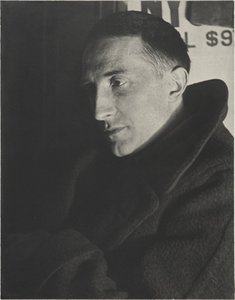
1887–1968, Francúzsko
Marcel Duchamp
The Life and Art of Marcel Duchamp Born on July 28, 1887, in Blainville, Normandy, France, Marcel Duchamp entered a world where the impulse to create was deeply embedded in his very blood. He was the fourth of seven children born to Eugene and Lucie Duchamp. This was a household of makers and thinkers; his siblings shared this creative restlessness, as his brothers Jacques Villon and Raymond Duchamp-Villon, along with his sister Suzanne Duchamp-Crotti, all pursued lives as artists. While he would eventually become a French American figure of immense complexity, his origins remained rooted in the quietude of Normandy.
O umelci Marcel Duchamp Významné diela umelca Marcel Duchamp
Aj od Marcel Duchamp
 Nude Descending a Staircase, No.21912
 Smutný mladý muž v rýchladoši1911
 Dané: 1. Vodopád, 2. Iluminačný plyn1966
 Fontána1917
Eseje k dielu Bottlerack
 Priemyselná estetika v umení: 10 diel pre moderný interiér | OriginalUniqueArtPonorte sa do sveta priemyselnej estetiky s 10 ikonickými dielami od Moneta po Pollocka. Objavte príbehy, techniky a farebné motívy industr…
 Marcel Duchamp: Challenging Conventions & Redefining Art in the 20th CenturyExplore the revolutionary art of Marcel Duchamp! Discover how his Dadaist readymades challenged artistic conventions & redefined modern art…
 The Radical Evolution of the Bottle in Still Life: From Cubist Deconstruction to Pop Art BoldnessTrace the evolution of bottle still life from Cubism to Pop Art with expert insight. Explore how masters redefined everyday objects now.