 Náhľad
 Odoslať
 Zdieľať
 Podrobnosti o dielo

 Stiahnuť
 Podobné diela
 RTG skúška
 Prezentácia
Clown in Love
 Lithograph
- WallArt
- Expressionism
 1963
1963- High Medieval
 32.0 x 25.0 cm
 Zobraziť viac
Ručne maľovaná olejová reprodukcia
Ručne maľovaný olej na plátne vo vašej zvolenej veľkosti a v ráme, vyrobený na mieru našimi umelcami. ( Kúpiť tlač Kúpiť obrázok)




P118B $10

P118H $10

P118W $10

P438Z $10

P508JH $12

P508YH $12

P805H $10

P805Z $10

P919BZ $10

P919G $10

P919XJ $10

P959ZH $10

P968JZ $12

W106C $8

W218G $10

W218JH $8

W218Y $10

W307PJ $10

W316G $10

W316PJ $8

W316Y $10

W398PJ $8

W4111J $10

W500HY $15

W500JH $15

W692G $12

W849H $8

W940BG $15

W953PJ $8




Vyberte si z našich preddefinovaných rozmerov, ktoré zodpovedajú pôvodným pomeroḿ diela.

Môžete zadať vlastné rozmery tak, aby sa hodili do konkrétneho rámu alebo priestoru. Ak sa váš zvolený rozmer nezhoduje s pôvodnými proporciami obrazu, dielo buď orezáme, alebo ho doplníme ručne maľovanými prvkami. Pred začiatkom výroby vám zašleme digitálny náhľad na schválenie.
Upozorňujeme, že ukážka na obrazovke neodráža skutočné orezanie alebo doplnenie. Skutočnú finálnu kompozíciu zobrazuje iba digitálny náhľad.
Hoci sú k dispozícii vlastné rozmery, odporúčame vybrať rozmer z preddefinovaného zoznamu, aby sme zachovali pôvodné proporcie.
Po odoslaní objednávky vám tím OriginalUniqueArt.com pošle e-mail s pokynmi a poskytne náhľad na návrh.
Celosvetová doprava () za 3 až 4 týždne namiesto štandardných 5 týždňov. (18 august). Bez kompromisov v kvalite.

Bezplatná expresná doprava po celom svete

Prémiové lnianske plátno

Kompletné poistenie prepravy

Záruka vrátenia colného poplatku

Záruka presného farebného zhodnutia

60-dňá politika vrátenia (iba pri defektoch)

100% záruka vrátenia peňazí

Výhodná množstevná zľava
 Možnosť skla je dostupná len pri rozmeroch pod 110 cm

Clown in Love
Technika reprodukcie
Veľkosť reprodukcie
-


Celková cena za vybrané možnosti
$ 325
Popis diela
Marc Chagall’s “Clown in Love”: A Descent into Surrealist Emotion
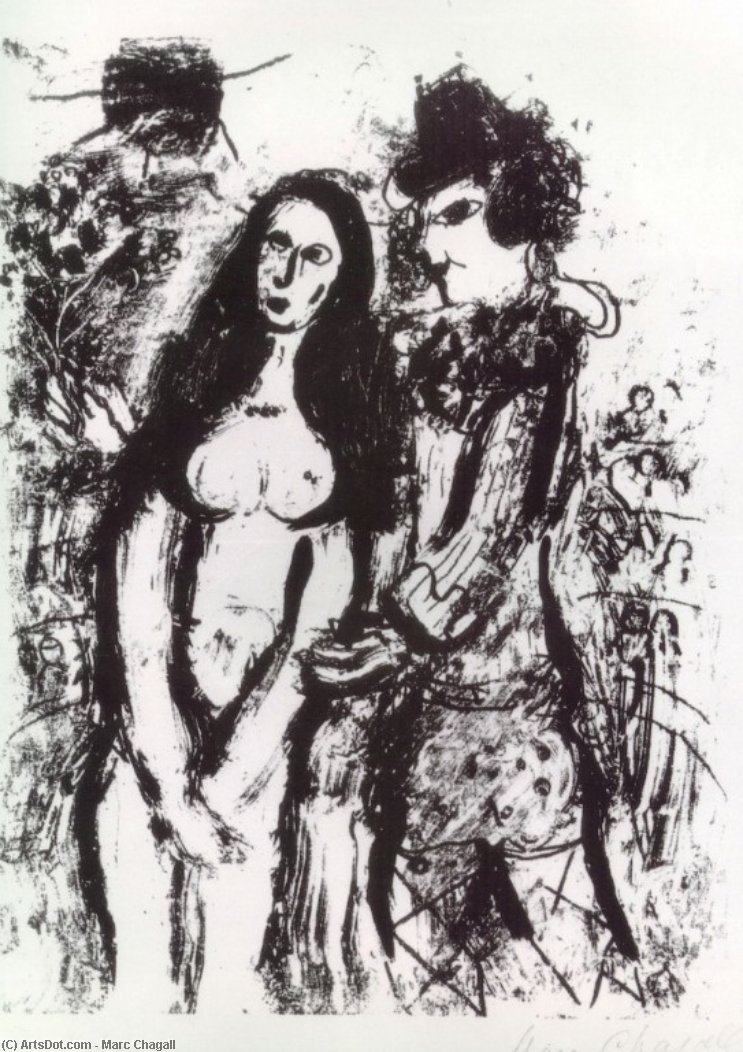
Marc Chagall's "Clown in Love," created in 1963, isn’t merely a depiction of two figures; it’s an immersion into a world where the familiar dissolves and primal emotions take center stage. This lithograph, rendered in stark black and white against a deceptively simple background, pulsates with an unsettling energy—a testament to Chagall's mastery of Expressionism and his ability to distill profound psychological states onto paper. The image immediately commands attention, not through overt beauty, but through its inherent tension: a nude woman and a clown, positioned off-center, locked in what appears to be a fraught interaction. It’s a scene that feels both intensely personal and universally resonant, inviting viewers into a realm of vulnerability, power dynamics, and perhaps even unspoken anxieties.
The work's foundation lies firmly within Chagall’s established style, yet “Clown in Love” possesses a unique intensity. He was deeply influenced by the Naïve Art movement, characterized by its directness, lack of illusionism, and focus on emotional expression. This is evident in the simplified forms, bold lines, and almost childlike quality of the figures. However, unlike the purely decorative elements often associated with Naïve Art, Chagall imbues his work with a complex psychological depth. The lithographic process itself—utilizing stone etching to transfer ink onto paper—contributes significantly to this effect. The grainy texture, the strong contrasts between light and shadow, and the deliberate roughness of the lines create a palpable sense of immediacy and rawness, mirroring the emotional turmoil at the heart of the scene.
The Clown: A Symbol of Paradox
The figure of the clown is central to understanding “Clown in Love.” Chagall frequently employed clowns as potent symbols within his work—not simply as comic figures, but as representations of human duality. The clown embodies both joy and sorrow, vulnerability and strength, innocence and experience. In this particular lithograph, the clown’s posture – a slight lean forward, a hand tentatively reaching out – suggests a hesitant attempt at connection, perhaps even a plea for understanding. His exaggerated features—a wide-eyed expression, a slightly downturned mouth—heighten his emotional vulnerability, transforming him from a traditional comedic character into a figure of profound pathos.
The woman’s position is equally significant. Her nudity isn't presented as overtly sexual; rather, it evokes a sense of exposed vulnerability and raw emotion. She appears to be both receptive and wary, her gaze fixed on the clown with a mixture of curiosity and apprehension. The lack of context—the absence of any discernible setting or narrative—further amplifies this feeling of ambiguity and invites viewers to project their own interpretations onto the scene.
Historical Context & Artistic Technique
Created in 1963, “Clown in Love” reflects a period of significant artistic experimentation and social upheaval. Chagall was already an established master by this point, having navigated the tumultuous years of World War II and the rise of totalitarianism. His art became increasingly introspective and emotionally charged during this time, grappling with themes of displacement, loss, and the enduring power of memory. The lithograph technique itself—a process he frequently employed—allowed for precise control over line and tone, while retaining a sense of spontaneity and immediacy.
The use of black and white further emphasizes the work’s emotional intensity. Color, in Chagall's earlier works, often served to heighten the dreamlike quality of his scenes; here, the absence of color forces viewers to confront the raw emotions at play without distraction. The stark contrast between light and shadow creates a dramatic effect, drawing attention to the figures’ faces and gestures and intensifying their psychological impact.
A Timeless Exploration of Human Connection
“Clown in Love” transcends its specific historical context to offer a timeless meditation on human connection—or perhaps, the absence thereof. It's a work that lingers in the mind long after it’s been viewed, prompting reflection on themes of vulnerability, intimacy, and the complexities of relationships. Reproductions of this powerful lithograph can serve as striking additions to interior spaces, injecting a dose of emotional depth and artistic intrigue into any room. Its evocative imagery and masterful technique make it a compelling choice for collectors and art enthusiasts alike—a testament to Marc Chagall’s enduring legacy as one of the 20th century's most visionary artists.
Biografia umelca
A Life Painted in Dreams: The World of Marc Chagall
Marc Chagall, born Moishe Shagal in 1887 in the small Belarussian town of Liozna near Vitebsk, wasn’t merely a painter; he was a poet of color, a weaver of dreams, and a chronicler of memory. His life, spanning nearly a century, mirrored the tumultuous currents of the 20th century, yet his art remained steadfastly rooted in a deeply personal vision—one infused with the folklore of his Hasidic Jewish upbringing and an unwavering belief in the power of imagination. Vitebsk itself was more than just a birthplace; it became the emotional core of his artistic universe, a recurring motif populated by flying figures, whimsical animals, and the vibrant hues of remembered landscapes. The town’s unique blend of cultures—Russian Orthodox churches alongside bustling Jewish marketplaces—forged an aesthetic sensibility that would defy easy categorization throughout his long career. Though he sought formal training first with a local sign painter and later in St. Petersburg under Léon Bakst, and then in Paris at the Académie de la Grande Chaumière, Chagall never fully embraced any single artistic movement. He absorbed elements of Cubism, Symbolism, and Fauvism, but always filtered them through his own intensely personal lens, creating a style that was uniquely, unmistakably Chagall.Early Years and Artistic Formation
Chagall’s formative years were marked by hardship and displacement. Born into a Jewish family in Vitebsk—a town steeped in Orthodox tradition—he experienced firsthand the challenges faced by Jews living under Tsarist rule. Despite limited formal education, he possessed an innate artistic talent that quickly blossomed. His initial training began with a local sign painter, honing his skills in draftsmanship and color theory. Subsequently, he pursued studies at St. Petersburg’s Zvantseva School of Drawing and Painting, where he encountered the influential teachings of Léon Bakst—a pioneer of theatrical design who championed avant-garde aesthetics. This exposure to Bakst's ideas profoundly shaped Chagall’s artistic sensibilities, introducing him to the principles of Cubism and fostering his fascination with geometric abstraction. Recognizing the importance of broadening his horizons, he traveled to Paris in 1908, immersing himself in the vibrant intellectual and artistic milieu of the École de Paris—a collective of artists who rejected academic conventions and embraced experimentation. During this period, he befriended fellow artists like Pablo Picasso and André Derain, absorbing their stylistic innovations and refining his own visual language.The Symbolist Vision
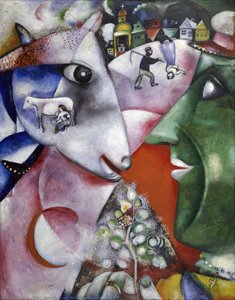
Chagall’s early paintings—such as I and the Village (1911)—demonstrate a distinctive preoccupation with symbolism and memory. Unlike traditional landscapes that strive for objective representation, Chagall's depictions of Vitebsk are fragmented recollections imbued with emotional significance. Figures float amidst stylized forms, conveying feelings of longing and nostalgia—a characteristic trait that would define his artistic style throughout his career. The artist’s palette is bold and expressive, employing vibrant hues to communicate emotion rather than literal accuracy. This stylistic approach reflects Chagall's deep connection to Jewish folklore and mythology, as well as his profound engagement with the spiritual traditions of his upbringing. His use of color—particularly yellows, blues, and reds—is deliberately unconventional, creating a dreamlike atmosphere that transcends rational perception.The Turbulent Years: Revolution and Exile
The Russian Revolution dramatically altered Chagall’s life trajectory. Returning to Vitebsk in 1917 amidst the upheaval of Bolshevik rule, he became involved in cultural initiatives aimed at revitalizing Belarusian art and culture. He established an Art School in Vitebsk—a bold experiment in artistic education that briefly flourished before succumbing to political pressures. During this period, Chagall wrestled with conflicting ideological impulses—embracing socialist ideals while simultaneously cherishing his Jewish heritage. The outbreak of World War I forced him into exile, disrupting his creative pursuits and propelling him back to Paris. Despite the hardships endured during wartime, Chagall continued to produce artwork that reflected the anxieties and uncertainties of the era. His painting White Crucifixion (1938)—a poignant meditation on suffering and persecution—stands as a testament to this period’s emotional intensity.International Recognition and Artistic Legacy
Chagall achieved international acclaim during World War II, escaping occupied France with his wife in May 1941. He found refuge in New York City, where he resided for seven years, fostering collaborations with fellow artists and engaging in prolific creative activity. His work gained prominence during the Abstract Expressionist movement, cementing his reputation as one of the most influential figures in modern art. Following the war, Chagall returned to France, continuing to paint until his death in 1985 at Saint-Paul-de-Vence—a picturesque Provençal village that served as his artistic sanctuary for decades. His enduring legacy resides not only in his stunning paintings and stained glass windows but also in his unwavering commitment to artistic integrity and imaginative vision—a vision that continues to inspire artists and audiences alike. Chagall’s art transcends cultural boundaries, conveying universal themes of love, loss, faith, and remembrance—a testament to the transformative power of creativity and the enduring beauty of dreams.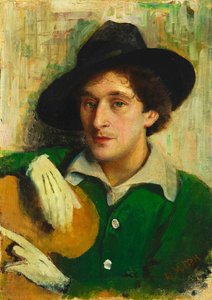
Marc Chagall
1887 - 1985 , Bielorusko
Základné informácie
- Artistic Movement Or Style: Modernizmus, Kubizmus
- Artists Or Movements Influenced By This Artist:
- Surrealizmus
- Cubizmus
- Artists Who Influenced This Artist:
- Leon Bakst
- Pablo Picasso
- Jean Metzinger
- Date Of Birth: 7. júl 1887
- Date Of Death: 28. marec 1985
- Full Name: Marc Chagall
- Nationality: Rusínsky-Francúzsky
- Notable Artworks:
- I a dedina
- Žltý osol
- Kôň s tiennikom
- Place Of Birth: Ľozna, Bielorusko
Súvisiace články
Marc Chagall: Top 25 diel majstra snov a farieb | OriginalUniqueArt.sk
Ponorte sa do sveta Marca Chagalla s OriginalUniqueArt.sk! Objavte top 25 diel majstra snov, plných farieb a židovskej symboliky. Reprodukcie obrazov, životopis umelca a inšpirácia pre váš interiér. Explore the full collection online!

Top 10 slávnych obrazov v odtieňoch bielej: Krása, história a dekor pre váš domov
Objavte top 10 slávnych obrazov v odtieňoch bielej – Monet, Renoir a ďalší majstri. História umenia, techniky a inšpirácia pre váš interiér. Reprodukcie obrazov najvyššej kvality na OriginalUniqueArt.com.

Top 10 majstrovských diel nemeckého expresionizmu pre váš domov | OriginalUniqueArt
Ponorte sa do sveta nemeckého expresionizmu s OriginalUniqueArt! Objavte 10 majstrovských diel Kandinského, Muncha a ďalších. Luxusné reprodukcie obrazov pre váš domov – emotívne umenie online. Explore the full collection on OriginalUniqueArt.com

Top 10 slávnych obrazov s dominantnou čiernou farbou | OriginalUniqueArt.sk
Objavte top 10 slávnych obrazov s dominantnou čiernou farbou od Rembrandta, Goya a ďalších majstrov. Prežite príbehy umenia, techniky a nadčasovej krásy. Reprodukcie obrazov pre váš interiér na OriginalUniqueArt.sk – múzejná kvalita!

Monochrome Visions: Exploring the Aesthetic & Historical Significance of Black & White Photography
Explore the rich history & artistic power of black and white photography. From early techniques to iconic masters like Ansel Adams, discover why monochrome continues to captivate art lovers today. Expert insights for collectors.