Náhľad v interiéri
 Odoslať ako digitálnu kartu
 Zdieľať
 Podrobnosti o dielo
 Príručka

 Stiahnuť obraz
 Podobné položky
 RTG skúška
 Prehliadanie diapozoje
 Q&A
Q&A Štatistiky
Mujer delante del sol


 Zobraziť viac
Umelecké dielo zobrazené na tejto stránke je chránené autorským zákonom, čo znamená, že nemôžeme legálne vytvárať ani predávať jeho identickú reprodukciu. Táto ochrana je vymáhaná na základe medzinárodných dohôd, ako napríklad Bernská konvencia a národnými zákonmi, vrátane tých, ktoré sú stanovené v Autorské právo USA – Title 17. Všetky práva vyhradené.
Táto metóda plne dodržiava autorské práva, pretože nezahŕňa kopírovanie ani duplikovanie chráneného diela. Ide skôr o kreatívnu reinterpretáciu – nový obraz, ktorý je ovplybnený originálom, no nie je s ním identický.
Giclée / Umenotlač
Giclée tlač alebo plátno múzeálnej kvality s rýchlou výrobou a rôznymi možnosťami povrchovej úpravy. ( Kúpiť ručne maľovaný obraz Prepnúť na digitálny obraz)




P118B €10

P118H €10

P118W €10

P438Z €10

P508JH €12

P508YH €12

P805H €10

P805Z €10

P919BZ €10

P919G €10

P919XJ €10

P959ZH €10

P968JZ €12

W106C €8

W218G €10

W218JH €8

W218Y €10

W307PJ €10

W316G €10

W316PJ €8

W316Y €10

W398PJ €8

W4111J €10

W500HY €15

W500JH €15

W692G €12

W849H €8

W940BG €15

W953PJ €8




Vyberte si z našich preddefinovaných rozmerov, ktoré zodpovedajú pôvodným pomeroḿ diela.

Zadajte šírku a výšku, ktoré potrebujete, aby sa reprodukcia hodila k vášmu rámu alebo stene. Print možno len orezávať, nikdy však nemennú veľkosť zvětšiť oproti pôvodnému obrázku, preto pri inom formáte stráca časť obrazu. Pred samotným vytlačiacím procesom vám pošleme digitálny náhľad na schválenie. Obrázok zobrazený na tejto stránke nezobrazuje reálny rez — len digitálny náhľad ukazuje presný výsledok.
Celosvetová doprava () do 2 týždňov namiesto štandardných 4 až 5 týždňov. (1 november)

Bezplatná expresná doprava po celom svete

Vysokokvalitné lnianske plátno

Kompletné poistenie prepravy

Záruka vrátenia colného poplatku

Záruka presného farebného zhodnutia

100-dená politika vrátenia tovaru (iba pri vadách)

100% záruka vrátenia peňazí

Zľava pri väčšom množstve
 Možnosť skla je dostupná len pri rozmeroch pod 110 cm

Mujer delante del sol
Giclée / Umenotlač
Veľkosť reprodukcie
-


Celková cena
€ 71
A Symphony of Dreams and Catalan Identity
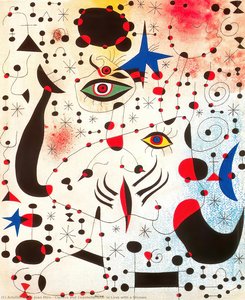
In the profound visual language of Joan Miró, certain works emerge not merely as paintings, but as portals into the subconscious. Mujer delante del sol (“Woman Before the Sun”), executed in 1962, stands as a breathtaking testament to this ability. This striking black and white abstract masterpiece transcends mere representation, offering instead a poetic exploration of the inner mind and a poignant emblem of Catalan cultural heritage. At its heart, the composition presents a woman positioned before a radiant sun, yet this seemingly simple tableau is far from static. It is a living, breathing universe populated by a constellation of figures—stylified human forms, geometric shapes, and vibrant red balls that swirl around the central figure in a rhythmic dance of light and shadow.
The painting’s power lies in its deliberate use of contrast and symbolic weight. As the woman holds two red balls in her hands, she becomes a vessel for fertility and vitality, mirroring the sun’s own energy to illuminate the surrounding space. This interplay between the monochromatic depth of the background and the sudden, visceral impact of the red elements creates a sense of profound intrigue. For the discerning collector or interior designer, this piece offers a captivating focal point that balances the starkness of abstraction with a deeply human emotional core.
Surrealist Technique and Symbolic Resonance
Miró’s approach in Mujer delante del sol exemplifies his role as a pioneer of Surrealism. Eschewing the rigid constraints of academic convention, the artist employs spontaneous brushstrokes and fragmented forms to disrupt rational thought and invite contemplation. The meticulous attention to detail is revealed through subtle gradations of tone achieved via layering paint, resulting in a textured surface that feels almost tactile. This technique allows the viewer to embark on an emotional journey, navigating a landscape where the boundaries between memory, dream, and reality begin to dissolve.
Beyond its formal brilliance, the work is laden with symbolic significance that speaks to the very soul of Catalonia. The woman serves as a representation of feminine strength and resilience—a figure often interpreted as embodying the enduring Catalan spirit—while the sun symbolizes enlightenment and renewal. The red balls, echoing the fiery hues of the Catalan landscape, represent passion and life force. In an era of uncertainty, these symbols coalesce to convey a message of hope and affirmation. To possess a reproduction of such a work is to bring into one's space a piece of history that celebrates the boundless power of imagination and the enduring strength of cultural identity.
Otázky a odpovede
Aká je vnímaná svetlostnosť diela „Mujer delante del sol“ od Joan Miró?
Celkovo je dielo „Mujer delante del sol“ zaznamenané ako deep_shadow. Vnímaná jasnosť popisuje, aký svetlý alebo tmavý sa tento kus zdá byť.
Patrí dielo „Mujer delante del sol“ od Joan Miró do verejnej vlastnícky sféry a prečo?
„Mujer delante del sol“ od Joan Miró sa nachádza v oblasti stále chránené autorským právom. Doba trvania autorského práva sa začína dňom smrti umelca, ktorého smrť nastala v roku 1983.
Hacia ktorej farbe sa naklonilo dielo "Mujer delante del sol"?
„Mujer delante del sol“ skloní sa k Golden Yellow Range odtieňu.
Biografia umelca
A Catalan Visionary: The Life and Art of Joan Miró
Joan Miró i Ferrà, born in Barcelona in 1893, stands as one of the most significant figures in 20th-century art. His journey was not merely a progression through styles but an exploration of inner worlds, translating dreams, memories, and Catalan identity onto canvas with a uniquely poetic visual language. From humble beginnings marked by illness and initial parental reservations about his artistic pursuits, Miró persevered, driven by an innate need to express the intangible—the emotions, sensations, and subconscious currents that lie beneath the surface of reality. His early life was steeped in the traditions of Barcelona, a city brimming with architectural marvels thanks to Antoni Gaudí, whose organic forms would subtly influence Miró’s later abstractions. The goldsmithing profession of his father instilled an appreciation for meticulous craftsmanship, while the rugged Catalan landscape became a recurring motif and source of inspiration throughout his career.Early Influences and the Path to Surrealism
Miró's formal artistic training began at La Llotja in Barcelona, where he honed his skills in traditional techniques. However, it was exposure to the avant-garde movements sweeping through Paris that truly ignited his creative evolution. The vibrant colors of Fauvism and the fragmented forms of Cubism resonated deeply, prompting him to move to Paris in 1920. This period proved pivotal as he encountered artists like Pablo Picasso and began experimenting with increasingly abstract compositions. Yet, Miró didn’t simply adopt these styles; he synthesized them, forging a path toward his own distinctive aesthetic. He sought to distill forms to their essence, stripping away representational details in favor of symbolic shapes and evocative colors. This exploration led him to the Surrealist group in 1924, aligning him with artists such as Max Ernst and Salvador Dalí. While embracing the Surrealist interest in the subconscious, Miró maintained a unique sensibility—his work was less about shocking imagery or Freudian symbolism than it was about creating a world of playful forms and poetic suggestion.The Language of Symbols: Key Works and Artistic Innovations
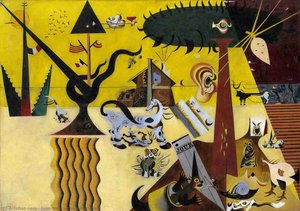
Throughout the 1920s and 30s, Miró developed his signature visual vocabulary—a universe populated by biomorphic shapes, floating forms, and vibrant colors. The Farm (1922), often considered a cornerstone of his oeuvre, exemplifies this transition. It’s not merely a depiction of rural life but an evocation of Catalan identity and a symbolic representation of the natural world. His collaborative spirit led to innovative techniques like *grattage*, pioneered with Max Ernst in 1926 for designs intended for Sergei Diaghilev's ballet, where textures were revealed by scraping paint across canvas. The Dutch Interiors (1928) series demonstrated his ability to reinterpret the Old Masters through a distinctly modern lens, transforming domestic scenes into dreamlike abstractions. Painting (1933), with its bold colors and simplified forms, encapsulates Miró’s exploration of the subconscious and his rejection of conventional artistic boundaries. Beyond painting, Miró fearlessly experimented with sculpture, ceramics, and printmaking, expanding his creative horizons and demonstrating a remarkable versatility.Legacy and Enduring Influence
Joan Miró's impact on 20th-century art is undeniable. He wasn’t simply a painter; he was a visionary who challenged the very definition of artistic expression. His work paved the way for abstract expressionism and continues to inspire artists across disciplines. He established two foundations—the Fundació Joan Miró in Barcelona (1975) and the Fundació Pilar i Joan Miró in Palma de Mallorca (1981)—ensuring that his legacy would endure, providing spaces for artistic exploration and education. Throughout his long career, he remained committed to pushing boundaries, questioning conventions, and exploring the depths of human imagination. Miró’s art is a testament to the power of abstraction, symbolism, and poetic expression—a vibrant celebration of life, dreams, and the enduring spirit of Catalan culture. His work continues to resonate with audiences worldwide, inviting us to enter a world where anything is possible and the boundaries between reality and fantasy blur into a captivating dance of color and form.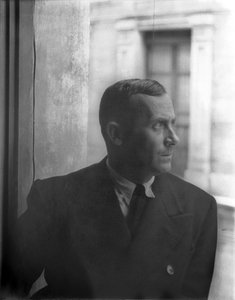
Joan Miró
1893 - 1983 , Španielsko
Základné informácie
- Artistic Movement Or Style: Surrealizmus, Abstrakčná tvorba
- Artists Who Influenced This Artist:
- Pablo Picasso
- Salvador Dalí
- Date Of Birth: 20 Apr 1893
- Date Of Death: 25 Dec 1983
- Full Name: Joan Miró i Ferrà
- Nationality: Španielsko
- Notable Artworks:
- The Farm
- Dutch Interiors
- Painting
- Place Of Birth: Barcelona, Španielsko
Súvisiace články

Wassily Kandinsky: Top 25 diel pre milovníkov umenia a dokonalý dizajn interiéru
Ponorte sa do sveta Wassilyho Kandinského s OriginalUniqueArt.com! Objavte top 25 diel abstraktného umenia, expresionizmu a farebných kompozícií. Kúpiť reprodukcie obrazov pre dokonalý dizajn interiéru. Explore the full collection online.

Joan Miró: Top 25 diel pre milovníkov umenia a dokonalý dizajn interiéru
Ponorte sa do sveta Joana Miróa s našou exkluzívnou kolekciou 25 ikonických diel. Objavte príbehy za abstraktnými kompozíciami, surrealistickými motívmi a katalánskou farebnosťou. Reprodukcie obrazov pre váš dokonalý interiér na OriginalUniqueArt.com.

Top 10 majstrov geometrickej abstrakcie: Umění pre váš domov s OriginalUniqueArt.com
Ponorte sa do sveta geometrickej abstrakcie! Objavte 10 majstrovských diel od Mondriana, Kandinského a ďalších. História umenia, techniky a farebné kompozície na OriginalUniqueArt.com – reprodukcie obrazov pre váš domov.

Top 10 majstrovských diel abstraktného expresionizmu pre váš domov | OriginalUniqueArt.com
Ponorte sa do sveta abstraktného expresionizmu s Pollockom, Rothkom a ďalšími majstrami. Objavte príbehy za 10 ikonických diel, techniky a farby, ktoré definovali toto revolučné umenie. Kvalitné reprodukcie na OriginalUniqueArt.com.

Top 10 slávnych obrazov s dominantnou čiernou farbou | OriginalUniqueArt.sk
Objavte top 10 slávnych obrazov s dominantnou čiernou farbou od Rembrandta, Goya a ďalších majstrov. Prežite príbehy umenia, techniky a nadčasovej krásy. Reprodukcie obrazov pre váš interiér na OriginalUniqueArt.sk – múzejná kvalita!