Prepnúť na tlač
 Zobraziť viac







































 V prípade umeleckých diel alebo reprodukcií, ktorých ktorákoľvek strana je väčšia ako 105 cm (cca 41 palcov), sa rám dodáva v rozloženom stave ako sada. Táto metóda zabezpečuje bezpečnú доставu a chráni pred poškodením počas prepravy.


Jacques-Louis David: A Brushstroke Across Revolution
Jacques-Louis David (1748–1825) was more than just a painter; he was a visual chronicler of an era defined by upheaval, idealism, and the relentless pursuit of new orders. His life mirrored the dramatic shifts unfolding across France – from the waning opulence of the Rococo to the austere clarity of Neoclassicism, and ultimately, through the tumultuous years of revolution and Napoleonic glory. A childhood marked by the early loss of his father and a facial impediment that initially hindered his speech seemed only to sharpen his observational skills and fuel an unwavering dedication to artistic mastery.
David’s artistic journey began with an apprenticeship under François Boucher, the leading Rococo painter of his time, who championed decorative elegance and playful fantasy. However, David swiftly recognized the limitations of this style—its frivolity and detachment from moral seriousness—and sought inspiration in the more principled work of Joseph-Marie Vien, whose emphasis on history painting and classical themes resonated with a burgeoning sense of purpose.
The Royal Academy awarded him the Prix de Rome annually, which funded a three-to five-year stay in Rome. This trip provided its winners the opportunity to study the remains of classical antiquity and the works of the Italian Renaissance masters at first hand—a formative experience that profoundly shaped David’s artistic vision.
David's embrace of Neoclassicism represented a decisive break from Rococo, aligning with the moral climate of the final years of the Ancien Régime. He championed austerity, clarity, and intellectual rigor—values reflected in his monumental history paintings and portraits. His influence extended far beyond his studio, establishing the Académie des Beaux-Arts in Paris and shaping artistic standards for generations to come.
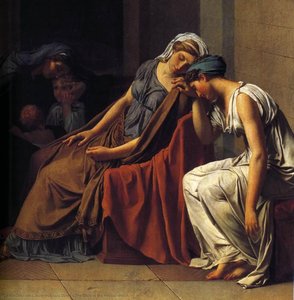
“The Anger of Achilles,” painted in 1819, exemplifies David’s mastery of Neoclassical style. It depicts a pivotal moment from Greek mythology—Agamemnon revealing to Achilles that he intends to sacrifice Iphigenia to appease Artemis—and captures the raw emotion of defiance and grief.
David skillfully employed chiaroscuro—the dramatic contrast between light and shadow—to sculpt the figures and heighten their emotional impact. The deep shadows enveloping Achilles’ face and body emphasize his rage, while the carefully rendered folds of his drapery create a sense of dynamism and movement. Notice, too, the subtle details: the glint of steel on the swords, the delicate rendering of Iphigenia’s youthful features, oblivious to the unfolding tragedy.
The painting's composition is meticulously constructed to draw the viewer into the drama—Agamemnon stands as a figure of authority, his gaze fixed upon Achilles with an expression of controlled disappointment. Behind him, Clytemnestra embodies grief and sorrow, her hand instinctively reaching towards her daughter – a poignant symbol of maternal anguish.
David’s technical brilliance is immediately apparent. He meticulously studied the works of Raphael Mengs, who advocated for rigorous study of classical sources and adherence to ancient models—a conviction that informed his artistic practice throughout his career.
“The Anger of Achilles” remains a testament to David's enduring legacy as one of France’s greatest artists. Its monumental scale, dramatic lighting, and profound psychological insight continue to inspire admiration and contemplation.
Otázky a odpovede
Z akého historického obdobia pochádza „Rozhnev Achillea“ od Jacques-Louis David?
„Rozhnev Achillea“ pochádza z obdobia ..
Akú náladu a emóciu v sebe spája dielo „Rozhnev Achillea“?
Zaznamenaná nálada diela „Rozhnev Achillea“ od Jacques-Louis David je Dramatické a jeho emocionálny tón je Melancholický.
Ako by sa malo opísať nálada diela „Rozhnev Achillea“ od Jacques-Louis David?
„Rozhnev Achillea“ od Jacques-Louis David má v nálade charakterizovanú ako Dramatické. Táto klasifikácia môže pomôcť pri vhodnom umiestnení diela.
 Náhľad v interiéri
 Odoslať ako digitálnu kartu
 Zdieľať
 Podrobnosti o dielo
 Príručka

 Stiahnuť obraz
 Podobné položky
 RTG skúška
 Prehliadanie diapozoje
 Otázky a odpovede
 Štatistiky