

 Zobraziť v interiéri
 Odoslať
 Zdieľať
 Podrobnosti
 Príručkovo

 Stiahnuť
 Podobné položky
 RTG skúška
 Prehliadanie diapo\]
 Štatistiky
Monforte Altarpiece (10)
 Oil On Canvas
- WallArt
- Early Netherlandish Renaissance
 1470
1470 150.0 x 247.0 cm
 Staatliche Museen zu Berlin
 Prečítať si viac
Giclée / Umenotlač
Giclée tlač alebo plátno múzeálnej kvality s rýchlou výrobou a rôznymi možnosťami povrchovej úpravy. ( Objednať ručne maľovanú reprodukciu Prepnúť na digitálnu verziu obrazu)




P118B $10

P118H $10

P118W $10

P438Z $10

P508JH $12

P508YH $12

P805H $10

P805Z $10

P919BZ $10

P919G $10

P919XJ $10

P959ZH $10

P968JZ $12

W106C $8

W218G $10

W218JH $8

W218Y $10

W307PJ $10

W316G $10

W316PJ $8

W316Y $10

W398PJ $8

W4111J $10

W500HY $15

W500JH $15

W692G $12

W849H $8

W940BG $15

W953PJ $8




Vyberte si z našich preddefinovaných rozmerov, ktoré zodpovedajú pôvodným pomeroḿ diela.

Môžete zadať vlastné rozmery, aby sa reprodukcia prispôsobila konkrétnemu rámu alebo priestoru. Ak zvolená veľkosť nebude zodpovedať proporciám originálu, dielo buď orežeme, alebo obraz rozšírime pomocou zrkadlenia či farebného doplnenia okrajov. Pred začatím výroby vám pošleme digitálnu ukážku na schválenie.
Máte na vedomí, že náhľad na obrazovke neodzrkadľuje skutočné orezanie alebo rozšírenie. Len digitálna ukážka presne zobrazí finálnu kompozíciu.
Hoci sú k dispozícii vlastné rozmery, pre zachovanie pôvodných proporcií odporúčame vybrať si rozmer z vopred definovaného zoznamu.
Celosvetová doprava () do 2 týždňov namiesto štandardných 4 až 5 týždňov. (21 september)

Bezplatná expresná doprava po celom svete

Vysokokvalitné lnianske plátno

Úplné poistenie prepravy

Záruka vrátenia colného poplatku

Záruka presného farebného zhodnutia

100-dená politika vrátenia tovaru (iba pri vadách)

100% záruka vrátenia peňazí

Ponuka množstevnej zľavy
 Možnosť skla je dostupná len pri rozmeroch pod 110 cm

Monforte Altarpiece (10)
Giclée / Umenotlač
Veľkosť reprodukcie
-


Celková cena
$ 80
A Masterpiece of Emotional Depth: The Monforte Altarpiece by Hugo van der Goes
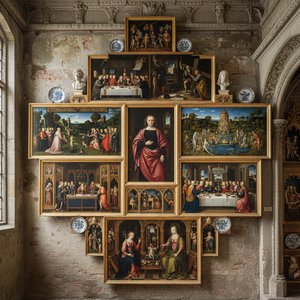
The Monforte Altarpiece, painted around 1470 by the pioneering Flemish artist Hugo van der Goes, is more than just a religious depiction; it’s a profound exploration of human emotion and spiritual yearning. This monumental work, currently housed in the Gemäldegalerie in Berlin, stands as a testament to Van der Goes' revolutionary approach to painting – one that moved beyond the stylized formality of earlier Netherlandish art towards a startlingly realistic and psychologically astute portrayal of figures. The altarpiece’s power lies not just in its technical brilliance but also in its ability to evoke a deep sense of empathy and contemplation, inviting viewers into a world where faith, humanity, and the divine converge.
A Revolutionary Style: Van der Goes' Artistic Innovations
Hugo van der Goes was a true innovator, pushing the boundaries of artistic expression during a pivotal period in European art history. Unlike his contemporaries who often adhered to established conventions, Van der Goes embraced a dramatic realism that imbued his paintings with an unprecedented sense of immediacy and emotional depth. His use of color is particularly striking – rich, vibrant hues layered with subtle gradations create a luminous quality that seems to emanate from the canvas itself. He meticulously rendered textures, from the velvet folds of royal garments to the rough grain of wood, demonstrating a remarkable attention to detail. But perhaps his most significant contribution was his ability to capture the psychological states of his subjects. The figures in the Monforte Altarpiece are not simply representations of biblical characters; they are individuals grappling with profound emotions – awe, reverence, and even a hint of sorrow.
Symbolism and Narrative: Unpacking the Depiction
The altarpiece’s narrative unfolds with captivating detail. At its heart is the adoration of the infant Jesus by the Magi, representing the three wise men from the East who followed a star to bring gifts. The composition is carefully structured, drawing the viewer's eye through a complex interplay of figures and gestures. Note the deliberate positioning of Joseph, holding out his hands in a gesture of protection and guidance; Mary, radiating maternal love as she cradles her child; and the Magi themselves, each offering their unique treasures – gold, frankincense, and myrrh – symbolizing spiritual wisdom, purity, and earthly riches. The inclusion of a horse in the background adds an intriguing layer of symbolism, potentially representing royalty, power, or even the connection between humanity and the divine.
The Emotional Resonance: A Window into the Human Soul
What truly distinguishes the Monforte Altarpiece is its profound emotional resonance. Van der Goes masterfully captures the vulnerability and tenderness of the Virgin Mary, her gaze filled with a mixture of love, concern, and quiet contemplation. The faces of the Magi are etched with reverence and humility, reflecting their awe at witnessing the birth of Christ. The painting’s luminous quality and masterful use of light further enhance its emotional impact, creating an atmosphere of serenity and spiritual grace. It's a work that invites viewers to connect with the story on a deeply personal level, prompting reflection on themes of faith, family, and the enduring mysteries of life.
Reproductions of this masterpiece offer a remarkable opportunity to bring its beauty and emotional depth into any space. Consider commissioning a hand-painted reproduction – a faithful recreation that captures the essence of Van der Goes’ revolutionary style and ensures that this iconic artwork continues to inspire for generations to come.
Biografia umelca
Hugo van der Goes: A Revolutionary Vision of the Northern Renaissance
Hugo van der Goes, born around 1440 in Ghent, Belgium – a city renowned for its artistic vibrancy during the late Middle Ages – stands as one of the most pivotal and enigmatic figures in the history of Flemish painting. While details of his early life remain shrouded in mystery, his impact on the development of art during the latter half of the 15th century is undeniable. He wasn’t merely a painter; he was an innovator who fundamentally altered the course of artistic expression, influencing generations of masters both within Flanders and across the burgeoning Italian Renaissance. Van der Goes entered the Ghent painters' guild in 1467, marking his formal establishment as a master craftsman, yet it was his unique vision – a potent blend of intense realism, profound psychological depth, and dramatic composition – that truly distinguished him from his contemporaries. Before Van der Goes, Flemish painting, while technically brilliant, often adhered to established conventions; he dared to break free from these traditions, imbuing his work with an unprecedented level of human emotion and tangible reality.Early Life and Artistic Training
The precise circumstances surrounding Hugo van der Goes’s birth are not entirely clear, though it is generally accepted that he was born in Ghent or its immediate surroundings. What *is* known is that he received a rigorous artistic education, likely under the tutelage of Jan van Eyck, the undisputed master of Early Netherlandish painting. Van Eyck's meticulous attention to detail, his mastery of oil paint, and his ability to capture light and shadow with astonishing accuracy undoubtedly shaped Van der Goes’s early style. However, unlike many artists who simply imitated their predecessors, Van der Goes quickly developed a distinctive voice – one characterized by an unprecedented level of emotional intensity and psychological insight. He spent time in Bruges, working on commissions for the Burgundian court and the wealthy merchant class, honing his skills and experimenting with new techniques. His early works demonstrate a growing confidence and a willingness to push the boundaries of traditional painting conventions.A Revolutionary Style: Realism, Emotion, and Drama
Van der Goes’s artistic signature lies in his ability to infuse religious scenes – particularly those depicting the Virgin Mary and Christ Child – with a startling sense of immediacy and emotional weight. He moved beyond the stylized, often idealized representations common in earlier Flemish painting, imbuing his figures with a weighty presence and individualized character. His use of color was deliberate and often somber, creating a sense of gravity and spiritual intensity. This wasn’t simply about replicating appearances; it was about conveying inner states – awe, sorrow, reverence – through subtle gestures, expressive faces, and the careful manipulation of light and shadow. His monumental style, characterized by large-scale compositions and imposing figures, further amplified this emotional impact. He didn't shy away from portraying imperfections; his figures often possess a raw, almost unsettling realism that distinguishes them from the more polished representations favored by some of his contemporaries. This commitment to depicting humanity in all its complexity – with its vulnerabilities, struggles, and triumphs – was revolutionary for its time. The influence of Jan van Eyck’s meticulous detail is evident, but Van der Goes transcends imitation, forging a style uniquely his own.Major Works and Lasting Influence
Perhaps Van der Goes’s most celebrated work is the Portinari Triptych, commissioned by Tommaso Portinari, an Italian banker residing in Bruges. Completed around 1475, this magnificent triptych – now housed in the Uffizi Gallery in Florence – is a testament to his mastery of composition, color, and psychological insight. The scene depicting the Nativity is particularly striking, with its dramatic lighting, realistic portrayal of humble figures, and palpable sense of wonder. The altarpiece’s arrival in Florence had a profound effect on Florentine artists, including Domenico Ghirlandaio, who were captivated by its innovative realism and emotional power. Another significant work is the Adoration of the Magi (Monforte Altarpiece), currently residing in Berlin's Gemäldegalerie. This piece showcases his skill in creating dynamic scenes filled with intricate detail and symbolic meaning. Beyond these iconic works, Van der Goes contributed to numerous civic projects, including heraldic decorations for Charles the Bold’s ceremonial entries into Ghent, demonstrating his versatility as an artist.A Life Transformed: From Workshop to Monastery
In a surprising turn of events, at the height of his artistic success in 1477, Van der Goes abruptly closed his bustling workshop and entered the Roode Klooster monastery near Auderghem. This decision remains something of an enigma, though it’s believed to have been driven by a deep spiritual yearning or perhaps a struggle with mental health. Despite taking religious vows as a lay brother, he continued to accept painting commissions, even undertaking the task of evaluating unfinished works by Dieric Bouts for the city of Leuven. However, his final years were marked by increasing bouts of depression and psychological distress. Accounts suggest that he suffered a severe breakdown in 1482, tragically taking his own life shortly thereafter. This poignant end to a brilliant career adds another layer of complexity to the legacy of Hugo van der Goes – a man whose art explored the depths of human emotion while grappling with inner turmoil. The circumstances surrounding his death have fueled speculation for centuries, adding to the mystique that surrounds this remarkable artist.A Legacy Enduring Through Time
Hugo van der Goes’s influence extended far beyond his relatively short lifetime. His innovative techniques and profound psychological insights paved the way for future generations of artists, both in Flanders and Italy. His work can be found today in prestigious museums such as the Musées royaux des Beaux-Arts in Brussels, offering a glimpse into the genius of this pioneering Flemish master. He remains a compelling figure—a testament to the power of art to capture the complexities of the human condition and to transcend cultural boundaries. His legacy continues to inspire awe and admiration, solidifying his place as one of the most important artists of the Northern Renaissance.- His emphasis on realism influenced subsequent generations.
- The Portinari Altarpiece remains a landmark achievement in art history.
- His exploration of psychological depth set a new standard for portraiture and religious painting.

Hugo van der Goes
1440 - 1482 , Belgie
Rýchle fakty
- Artistic Movement Or Style: Raná netherlandish maľba
- Artists Or Movements Influenced By This Artist:
- Domenico Ghirlandaio
- Talianá renesancia
- Artists Who Influenced This Artist:
- Jan van Eyck
- Dirk Bouts
- Date Of Birth: c. 1440
- Date Of Death: 1482
- Full Name: Hugo van der Goes
- Nationality: Holandský
- Notable Artworks:
- Portinari Altarpiece
- Monforte Altarpiece
- Place Of Birth: Ghent, Belgicko
Súvisiace články

Rogier van der Weyden: Emotion, Innovation & the Early Netherlandish Renaissance
Explore the revolutionary art of Rogier van der Weyden, a pivotal figure of the Early Netherlandish Renaissance. Discover his emotional realism, innovative compositions, and lasting impact on painting history.

Rembrandt van Rijn: Top 25 Majstrovských Diel pre Váš Domov | OriginalUniqueArt
Ponorte sa do sveta Rembrandta van Rijna s OriginalUniqueArt.com! Objavte 25 majstrovských diel holandského baroka, portrétov a ikonických obrazov plných svetla a tieňa. Kúpiť kvalitné reprodukcie pre váš interiér. Preskúmajte celú kolekciu online!

Top 10 majstrov raného nizozemského maliarstva: Diela, ktoré zmenili dejiny umenia | OriginalUniqueArt
Objavte 10 majstrov raného nizozemského maliarstva – Jan van Eyck, Rogier van der Weyden a ďalší. Prežite príbehy ikonických diel renesancie a inšpirujte sa pre váš interiér s kvalitnými reprodukciami na OriginalUniqueArt.com.
Top 10 majstrov ranej holandskej renesancie: Obrazy, ktoré zmenili umenie | OriginalUniqueArt
Objavte 10 ikonických majstrov raného holandskej renesancie – Jan van Eyck, Rogier van der Weyden a ďalší. Prežite príbehy umenia, techniky a symbolizmu. Reprodukcie obrazov pre váš interiér na OriginalUniqueArt.com.

Hugo van der Goes: Devotion, Innovation & the Psychological Depth of Early Netherlandish Painting
Explore the revolutionary art of Hugo van der Goes – a master of Early Netherlandish painting renowned for his dramatic realism, psychological depth & profound influence on Renaissance artists. Discover his iconic works and lasting legacy.


