Náhľad
 Odoslať
 Zdieľať
 Podrobnosti o dielo

 Stiahnuť
 Podobné diela
 RTG skúška
 Prezentácia
untitled (595)


 Zobraziť viac
Giclée / Umenotlač
Giclée tlač alebo plátno múzeálnej kvality s rýchlou výrobou a flexibilnými možnosťami povrchovej úpravy. ( Kúpiť ručne maľovaný obraz Kúpiť obrázok)




P118B $10

P118H $10

P118W $10

P438Z $10

P508JH $12

P508YH $12

P805H $10

P805Z $10

P919BZ $10

P919G $10

P919XJ $10

P959ZH $10

P968JZ $12

W106C $8

W218G $10

W218JH $8

W218Y $10

W307PJ $10

W316G $10

W316PJ $8

W316Y $10

W398PJ $8

W4111J $10

W500HY $15

W500JH $15

W692G $12

W849H $8

W940BG $15

W953PJ $8




Vyberte si z našich preddefinovaných rozmerov, ktoré zodpovedajú pôvodným pomeroḿ diela.

Môžete zadať vlastné rozmery, aby sa reprodukcia prispôsobila konkrétnemu rámu alebo priestoru. Ak zvolená veľkosť nebude zodpovedať proporciám originálu, dielo buď orežeme, alebo obraz rozšírime pomocou zrkadlenia či farebného doplnenia okrajov. Pred začatím výroby vám pošleme digitálnu ukážku na schválenie.
Máte na vedomí, že náhľad na obrazovke neodzrkadľuje skutočné orezanie alebo rozšírenie. Len digitálna ukážka presne zobrazí finálnu kompozíciu.
Hoci sú k dispozícii vlastné rozmery, pre zachovanie pôvodných proporcií odporúčame vybrať si rozmer z vopred definovaného zoznamu.
Celosvetová doprava () do 2 týždňov namiesto štandardných 4/5 týždňov. (18 august)

Bezplatná expresná doprava po celom svete

Prémiové lnianske plátno

Kompletné poistenie prepravy

Záruka vrátenia colného poplatku

Záruka presného farebného zhodnutia

60-dňá politika vrátenia (iba pri defektoch)

100% záruka vrátenia peňazí

Výhodná množstevná zľava
 Možnosť skla je dostupná len pri rozmeroch pod 110 cm

untitled (595)
Giclée / Umenotlač
Veľkosť reprodukcie
-


Celková cena za vybrané možnosti
$ 80
Popis predmetu
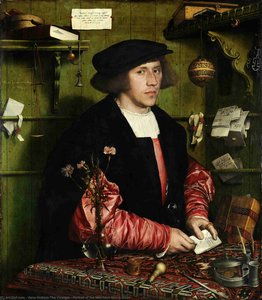
A Masterful Portrait by Hans Holbein the Younger
This striking portrait, *untitled (595)*, offers a compelling glimpse into the artistic prowess of Hans Holbein the Younger, a leading figure of the Northern Renaissance. The work exemplifies Holbein’s remarkable ability to capture not just likeness, but also character and status through meticulous detail and masterful technique.Subject & Composition
The painting presents a tightly framed portrait of an elderly man, likely a nobleman or individual of significant standing during the Renaissance or early Baroque period. The composition focuses intently on the sitter’s face and upper body, creating an intimate yet formal portrayal. This directness emphasizes his authority and dignity. The subject's gaze is commanding, drawing the viewer into a silent dialogue across centuries.Style & Technique
Holbein’s style is characterized by exceptional realism, evident in every brushstroke. He achieves this through dramatic chiaroscuro – a strong contrast between light and shadow – which sculpts the face and hands, lending them volume and presence. The artist's technique showcases his skill in rendering texture; one can almost feel the weight of the fur-trimmed hat, the smoothness of the skin, and the intricate weave of the sleeves. The layering of oil paints on canvas is meticulous, creating a rich and nuanced surface. Geometric patterns within the sleeves contrast beautifully with the organic forms of the man’s features and beard.Historical Context & Symbolism
Hans Holbein the Younger (1497-1543) flourished during a period of significant political and artistic change. He served as a court painter to King Henry VIII, becoming renowned for his portraits of the English aristocracy. This work reflects the conventions of Renaissance portraiture – an art form often used to commemorate individuals and project their power and wealth. The sitter’s attire is laden with symbolism: the fur-trimmed hat, elaborate sleeves, and visible sword all suggest a position of authority, affluence, and potentially military prowess. The name “Hans” itself, derived from Johannes meaning "God is gracious," adds another layer of cultural context.Emotional Impact & Interpretation
The painting evokes a sense of solemnity and gravitas. The somber color palette – dominated by browns, ochres, and blacks – contributes to this mood, while subtle highlights on the collar and hands draw attention to key details. There’s an undercurrent of introspection in the sitter's expression, inviting viewers to contemplate his life, experiences, and place within society. This is not merely a depiction of appearance; it’s a psychological portrait that reveals something of the man’s inner world.For Collectors & Designers
This artwork – or a high-quality reproduction thereof – would be a stunning addition to any collection, bringing a touch of Renaissance elegance and intellectual depth to a space. Its rich color palette and dramatic lighting make it suitable for both traditional and contemporary interiors. The portrait’s commanding presence will undoubtedly serve as a focal point, sparking conversation and inspiring admiration. It is a testament to Holbein's enduring legacy as one of the greatest portraitists in history.Biografia umelca
A Life Etched in Detail: The World of Hans Holbein the Younger
Born around 1497 in Augsburg, Germany, Hans Holbein the Younger emerged as a defining figure of the Northern Renaissance—a master portraitist whose work continues to resonate with breathtaking realism and psychological depth. His upbringing within an artistically gifted family laid the foundation for his exceptional talent; his father, Hans Holbein the Elder, was a respected painter and printmaker who instilled in young Hans a meticulous approach to observation and technique. This early training wasn’t merely about mastering brushstrokes or mixing pigments—it was about learning to *see*, to capture not just likeness but the very essence of a subject. Holbein's initial artistic explorations occurred within his father’s workshop, where he honed his skills before embarking on a journey that would lead him through Switzerland and ultimately to the heart of the English court.From Basel to the Tudor Court: A Rising Star
After completing his apprenticeship, Holbein traveled extensively throughout Switzerland, establishing himself as an independent artist with a growing reputation. He spent several formative years in Basel, creating not only striking portraits but also religious works and intricate woodcut designs—most notably the haunting series depicting the *Dance of Death*. These early pieces reveal a burgeoning mastery of composition and a developing fascination with capturing the complexities of human emotion. He admired the work of Albrecht Dürer and other German masters while also studying Italian art during his travels, absorbing their techniques and incorporating them into his own unique style. His innovative compositions further enhanced the impact of his work, often employing symbolic objects or backgrounds to convey deeper meaning. It was in 1526 that fate intervened, drawing Holbein towards England, an event that would irrevocably alter his artistic trajectory. He arrived bearing a letter of introduction from Erasmus, the renowned humanist scholar, which opened doors to the influential circles of English society. His talent quickly captivated prominent figures like Sir Thomas More, who became both a patron and a subject for several compelling portraits. This connection proved pivotal, leading to Holbein’s appointment as a court painter to King Henry VIII in 1536—a position he held, with some interruptions, until his untimely death in 1543.The Art of Perception: Style and Masterpieces
Holbein's artistic style is characterized by an extraordinary commitment to realism, achieved through painstaking attention to detail in rendering textures, fabrics, and the subtle nuances of facial features. He didn’t simply *paint* portraits; he meticulously constructed them, layer upon layer, capturing not just physical appearances but also the personality and inner life of his sitters. His innovative compositions further enhanced the impact of his work, often employing symbolic objects or backgrounds to convey deeper meaning. The Ambassadors (1533) stands as a testament to this approach—a complex and symbolically rich double portrait showcasing both Holbein’s technical brilliance and intellectual depth. The anamorphic skull subtly embedded within the painting serves as a stark *memento mori*, reminding viewers of the inevitability of death. His numerous portraits of Henry VIII established a lasting image of Tudor power, while his depiction of Erasmus of Rotterdam captures the scholar's profound intellectual gravitas. Other notable works include the stunning *Portrait of Nikolaus Kratzer* (1528), a masterpiece of realism and scientific detail.- His depictions of Henry VIII became iconic representations of royal power.
- His portraiture provides a window into the lives of prominent humanists like Erasmus and More.
- His innovative use of symbolism adds layers of meaning to his work, inviting viewers to contemplate deeper themes.
Legacy and Influence: A Lasting Impression
Holbein’s influence extended far beyond his own lifetime, shaping the course of portraiture for decades to come. His meticulous observation and masterful technique established a new standard for realism, inspiring artists across Europe to emulate his approach. He demonstrated that art could convey not only visual likeness but also psychological insight—a breakthrough that fundamentally altered how portraits were conceived and executed. He didn't merely record appearances—he captured moments in time, preserving them for posterity. His work serves as a powerful testament to the enduring power of art to document, interpret, and illuminate the past.
Hans Holbein mladší
1497 - 1543 , Nemecko
Základné informácie
- Artistic Movement Or Style: Norddeutsche Renaissance
- Artists Or Movements Influenced By This Artist: ['Spätere Porträtmaler']
- Artists Who Influenced This Artist: ['Albrecht Dürer']
- Date Of Birth: c. 1497
- Date Of Death: 1543
- Full Name: Hans Holbein der Jüngere
- Nationality: Deutsch-Schweizer
- Notable Artworks:
- Die Botschafter
- Porträt Heinrich VIII.
- Porträt Erasmus von Rotterdam
- Place Of Birth: Augsburg, Deutschland
Súvisiace články

The Enduring Legacy of Oil on Canvas: Technique, History & Aesthetic Impact
Explore the rich history & techniques of oil painting – from Renaissance masters to Impressionism. Discover pigments, layering methods, and why this timeless medium endures. Expert insights for artists & art enthusiasts.

Oil on Canvas: A Historical & Technical Exploration of a Timeless Artistic Medium
Explore the rich history & enduring techniques of oil painting on canvas. Discover the science behind its longevity, conservation practices, and contemporary relevance. Expert insights for art enthusiasts.

Trvalé dedičstvo olejomaľby: Technika, história a súčasná prax
Objavte trvalé dedičstvo olejomaľby! Prehľad techník, histórie a súčasnej praxe. Naučte sa o majstrovských postupoch a kvalitných reprodukciách diel od renesancie po súčasnosť.

Hans Holbein the Younger: A Renaissance Portraitist's Mastery of Realism & Psychological Insight
Explore the life & art of Hans Holbein the Younger, a Renaissance master renowned for his strikingly realistic portraits and psychological insight. Discover iconic works like 'The Ambassadors' and delve into his lasting legacy.
The Soul of Impressionism: Why Oil on Canvas Captures Eternal Light and Timeless Emotion
Discover the enchanting alchemy of Impressionism. Explore how the mastery of oil on canvas, through glazing and impasto, captures eternal light and emotion. Perfect for lovers of Monet and Van Gogh seeking the profound depth of hand-painted fine art.