Prepnúť na tlač
 Zobraziť viac







































 V prípade umeleckých diel alebo reprodukcií, ktorých ktorákoľvek strana je väčšia ako 105 cm (cca 41 palcov), sa rám dodáva v rozloženom stave ako sada. Táto metóda zabezpečuje bezpečnú доставu a chráni pred poškodením počas prepravy.


A Symphony of Geometry and Progress
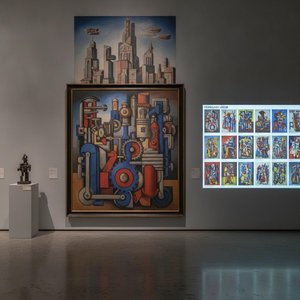
In the vast landscape of twentieth-century modernism, few works capture the rhythmic pulse of the machine age as vibrantly as Fernand Léger’s "Project for a mural." Completed in 1952, this monumental canvas serves as an arresting testament to Orphism, a movement that sought to bridge the gap between pure abstraction and the tangible, mechanical realities of industrial life. To gaze upon this work is to step into a world where the boundaries between organic harmony and industrial efficiency dissolve into a singular, dynamic vision. The painting presents an expansive geometric landscape, a meticulously constructed universe dominated by interlocking circles, squares, and triangles that seem to vibrate with an internal energy.
Léger’s mastery lies in his ability to transform cold, geometric forms into a breathing, emotive experience. Through a palette of striking blues and whites, punctuated by sudden, energetic accents of red, the artist creates a visual dialogue that is both structured and spontaneous. At the upper right corner, a subtly positioned stylized clock face acts as a silent protagonist, symbolizing time’s relentless march forward and mirroring the pervasive influence of industrial precision on the modern human condition. This interplay of shapes does not merely sit upon the canvas; it engineers a visual experience that celebrates the strength and the unapologetic beauty of a world in motion.
The Soul of the Machine Age
The technique employed in this masterpiece is as robust as the subject matter itself. Rooted in the Orphist tradition, Léger eschewed the delicate shadows of traditional representational art in favor of bold outlines and thick, textured brushstrokes. This approach conveys a profound sense of solidity and weight, capturing the essence of heavy machinery while simultaneously evoking an organic, almost musical harmony. The artist’s background—moving from the pastoral, rhythmic landscapes of his youth in Normandy to the high-voltage hum of the Parisian avant-garde—is etched into every stroke. He does not merely depict progress; he embodies it through a technique that feels both architectural and fluid.
For the discerning collector or interior designer, "Project for a mural" offers more than just aesthetic appeal; it provides a profound historical resonance. Emerging from the shadows of the post-war period, Léger’s work reflects a period of intense societal change and the reconstruction of a fractured world. By rejecting the chaotic tendencies of Surrealism in favor of structured abstraction, he offered a vision of hope through order and dynamism. The painting serves as an anchor for any sophisticated space, bringing with it an intellectual depth and a sense of monumental scale that can transform a room into a gallery of modern thought.
Whether viewed as a study of industrial evolution or a celebration of geometric purity, this artwork remains a timeless icon. It invites the viewer to abandon the familiar and embrace a landscape where the grace of the human spirit meets the precision of the machine. Owning a high-quality reproduction of such a pivotal work allows one to inhabit this bold vision of progress every day, surrounding oneself with the enduring energy of Léger’s transformative legacy.
Otázky a odpovede
Do ktorého umeleckého smeru patrí „Project for a mural“ od Fernand Léger?
„Project for a mural“ od Fernand Léger patrí do smeru Cubist Orphism. Tento smer poskytuje štylistický kontext diela.
Existuje k dielu „Project for a mural“ od Fernand Léger informačný list pre študentov?
Stránka Sprievodca študentom diela „Project for a mural“ od Fernand Léger ponúka tlačiteľný dvojstranný informačný list: samotné umelecké dielo s identifikačnou tabuľkou, časovú os situujúcu dielo do obdobia života umelca, ďalšie práce daného umelca, nameranú farebnú paletu a citácie vo štyroch štýloch pripravené na skopírovanie.
Aká je dominantná farba diela „Project for a mural“ od Fernand Léger?
Dominantnou farbou diela „Project for a mural“ od Fernand Léger je Bronze (#b86928).
 Náhľad v interiéri

 Odoslať ako digitálnu kartu
 Zdieľať
 Podrobnosti o dielo
 Príručka


 Stiahnuť obraz
 Podobné položky
 RTG skúška
 Prehliadanie diapozoje
 Otázky a odpovede
 Štatistiky