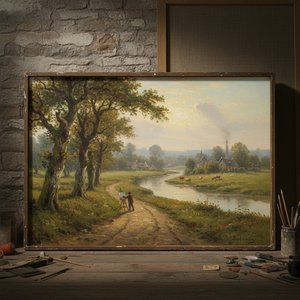
The Wandering Brush: The Life and Legacy of Walery Brochocki
In the tapestry of nineteenth-century European art, few threads capture the quiet, evocative essence of the natural world as tenderly as the works of Walery Brochocki. Born on December 15, 1847, in Włocławek, Poland, Brochocki’s journey was one of profound movement, shaped by both personal loss and an insatiable wanderlust. After the untimely death of his father during his childhood, the young Brochocki found himself within the disciplined walls of the Cadet School in Moscow. Yet, the rigid life of a soldier could not contain his burgeoning artistic spirit. By 1866, he had resigned from the Russian Army to pursue the much more fluid and uncertain path of an artist, enrolling in a private drawing school in Warsaw under the guidance of the esteemed Chrystian Breslauer.
His thirst for mastery eventually led him far beyond the borders of Poland. In 1869, Brochocki moved to Munich, a pivotal moment that would define his technical foundation. At the Academy of Fine Arts, he immersed himself in the teachings of Adolf Heinrich Lier and Hermann Anschütz, mentors who helped him refine his ability to capture the subtle nuances of light and atmosphere. It was during this period that he began to specialize in landscapes, a genre that would become his lifelong passion. His early exhibitions in Munich’s prestigious salons marked the emergence of a talent capable of translating the soul of a landscape onto canvas, earning him international recognition as early as the 1873 Vienna World's Fair, where his painting of a Gypsy camp was honored with a silver medal.
A Journey Through Light and Landscape
The evolution of Brochocki’s style is inextricably linked to his travels across the continent and beyond. In 1877, he migrated to Paris, the beating heart of the art world, where the air was thick with the revolutionary spirit of the Impressionists. It was here that he encountered the profound influence of Charles-François Daubigny, whose approach to capturing the fleeting moments of nature resonated deeply with Brochocki’s own sensibilities. This period in France saw him devoted to the meticulous study of landscapes and cityscapes, blending a classical sense of structure with an increasingly atmospheric and emotive technique.
His wanderings were not limited to the European metropolises; he sought inspiration in the sun-drenched terrains of North Africa. Commissioned by the French Colonial Society, Brochocki traveled to Algiers, where he produced a magnificent large-scale panorama of the city, demonstrating his ability to scale his intimate landscape style to monumental proportions. Upon returning to Poland in 1888, he settled in Warsaw, yet his spirit remained that of a traveler. He traversed the landscapes of Podole, Bessarabia, and Lithuania, bringing back visual memories of the vast, untamed beauty of Eastern Europe. His work became a staple of Polish cultural life, with reproductions appearing in popular weeklies such as Kłosy (Ears) and Wędrowiec (The Wanderer), allowing his vision of the natural world to reach the hearts of the Polish public.
Artistic Significance and Final Reflections
As his career matured, Brochocki became a vital figure in the Polish art scene, participating in the Society for the Encouragement of Fine Arts in Warsaw and the Kraków Society of Friends of Fine Arts. In his later years, he joined the progressive Pro Arte group, signaling his continued relevance amidst the shifting tides of modernism. His paintings—ranging from serene riverbanks to bustling rural scenes featuring peasants and livestock—serve as a nostalgic window into a bygone era of pastoral tranquility.
The enduring legacy of Walery Brochocki lies in his ability to bridge the gap between the academic traditions of Munich and the atmospheric innovations of Paris, all while maintaining a uniquely Polish perspective. His works remain cherished for their:
- Atmospheric Depth: A masterful use of light that captures the changing moods of the sky and water.
- Narrative Tenderness: The inclusion of sztafaż (staffage), such as cows crossing rivers or peasants returning from fields, which breathes life into his landscapes.
- Historical Resonance: A visual record of the diverse landscapes of Poland and the Mediterranean during a period of great transition.
Вопросы и ответы
В каком городе и стране родился(ась) Walery Brochocki?
Walery Brochocki родился в Włocławek, Poland.
Как мне найти работы Walery Brochocki в определенной цветовой гамме?
На странице По палитрам работы Walery Brochocki сгруппированы по цветовым палитрам.
Есть ли хронологическая биография Walery Brochocki?
Страница Хронология работ художника Walery Brochocki представляет собой интерактивную ленту времени, где работы представлены в хронологическом порядке и разделены на главы по периодам творчества.
Откуда Walery Brochocki?
Walery Brochocki родился в Poland.