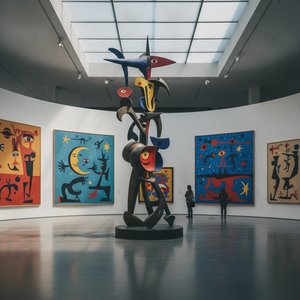
The Artistic Evolution of Manolo Millares
Manolo Millares was a Spanish painter who began his journey as a self-taught artist. After being introduced to Surrealism in 1948, he moved to Madrid in 1953, where he transitioned into an abstract painter. He became a founding member of the avant-garde group El Paso in Madrid, alongside artists such as Rafael Canogar, Luis Feito, Juana Francés, Manuel Rivera, Antonio Suárez, Antonio Saura, and the sculptor Pablo Serrano. By the early 1960s, Millares had attained an international reputation, leading to a solo show at the Pierre Matisse Gallery in New York in 1961.
Technique and Visual Language
Millares is renowned for his spectacular collages created using burlap sack. These jute fabrics, which he began making for the first time in 1953, were often stretched and roughly sewn together to create tears and voids. His work utilized a palette of dark tones, including black, white, and red, which splashed and flowed across the surface. His visual language was inspired by the organic forms of the pre-Hispanic Guanches, which he reconciled with the automatism of the surrealists. This approach combined tradition and direct expression with contemporary symbolism.
Вопросы и ответы
Можно ли отсортировать работы Manolo Millares по цвету?
Работы Manolo Millares можно просмотреть по цвету на странице художника Спектральный индекс.
Где я могу увидеть работы Manolo Millares в хронологическом порядке?
На странице Хронология работ представлены работы Manolo Millares, упорядоченные по датам, год за годом.
К какой исторической эпохе относится Manolo Millares?
Manolo Millares работал в эпоху Modern. Этот период позволяет определить место творчества художника в истории.
Где я могу увидеть цветовую палитру работ Manolo Millares?
Использование цвета в работах Manolo Millares, представленных на данный сайт, можно изучить на странице Палитра художника художника.