Early Life, Family and Training
Johan Philip Korn was born in Uddevalla, Sweden, into a family that provided his earliest connections to the world of craft. He was the son of Filip Ludvig Korn and Maria Elfwing. Growing up in this environment, he did not immediately find his way to the grand landscapes that would later define his reputation. Instead, his hands first learned the steady, practical work of a decorative painter, a trade that required a keen eye for detail and a disciplined approach to color and surface.
His path toward more formal artistic expression began when he entered the studio of the artist Johan Sevenbom. Under Sevenbom's guidance, Korn moved beyond the decorative applications of his youth, refining his ability to observe the natural world. This period of study was essential, as it provided the technical foundation he needed to transition from the functional world of decoration into the more nuanced realm of landscape painting.
Technique and Style
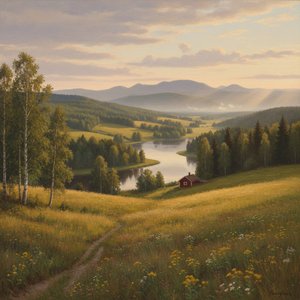
Korn’s artistic direction shifted significantly after his early years as a decorative painter. Under the guidance of his teacher, Johan Sevenbom, he moved toward landscape painting, adopting a Rococo style inspired by the works of François Boucher. His compositions often focused on idyllic settings, creating a sense of quietude through carefully arranged natural scenes. He frequently worked in a small format, producing intimate works that might have once adorned door panels or decorative wall paintings.
There is a particular warmth to his palette, which relied heavily on gold-brown tones. This color choice complemented his preference for specific lighting conditions; he was drawn to the soft glow of moonlight or the flickering light of fires. These elements helped define the atmosphere of his landscapes, lending them a gentle, nocturnal quality. To bring life to these quiet environments, he often included rich staffage, populating his scenes with various figures that added a sense of human presence to the natural world.
Professional Career and Achievements
Korn’s professional life was defined by a steady rise through the ranks of the Swedish art establishment. After moving away from his early beginnings in decorative painting, he found his true calling in landscape painting. His ability to capture the quiet moods of nature eventually led him to significant institutional roles in Stockholm. In 1759, he reached a major milestone when he was named master of the Stockholm Painting Office. He remained in this influential position, overseeing the city's painting standards, until his death in 1796.
His standing within the artistic community was further solidified through formal recognition from the state. In 1777, he was accepted as a member, or agré, at the Swedish Royal Academy of Fine Arts. This membership marked his transition from a skilled craftsman to a recognized figure in the nation's fine arts circles. Throughout his years in Stockholm, he focused his efforts on the landscape genre, establishing himself as a specialist in the field.
Key Works and Artistic Output
Korn’s output was varied, reflecting his early training and his later mastery of the landscape. He did not limit himself to canvas, often applying his skill to the architecture of daily life through decorative wall paintings. He also worked on door panels, bringing his specific vision to the functional surfaces of the homes he painted. These works often appeared in small formats, focusing on intimate scenes rather than large-scale compositions.
His landscape paintings frequently featured idyllic settings, often characterized by the glow of moonlight or the warmth of fires. He had a particular interest in coastal scenes, capturing the quiet activity of maritime life. His brushwork often utilized a palette of gold-brown tones to establish a specific mood within these settings. Many of his compositions included rich staffage, adding human figures to the natural surroundings to give the scenes a sense of life and movement.
- Coastal landscape with fishermen (1769)
- Works featuring fishing boats
Where to See the Works Today
For those wishing to see his handiwork in person, several Swedish institutions hold pieces from his collection. The Nationalmuseum in Stockholm maintains a significant presence of his work, including five of his landscapes. These pieces offer a direct look at the way he handled light and the specific tones he favored in his smaller compositions.
Beyond the capital, his paintings can be found in other important regional collections. The Gothenburg Art Museum and the Norrköping Art Museum both hold works that reflect his transition from decorative painting to his later landscape style. Visiting these locations allows for a closer look at the textures and the figures he often included in his scenes.
Вопросы и ответы
К какой исторической эпохе относится Johan Philip Korn?
Johan Philip Korn работал в эпоху Early Modern. Этот период позволяет определить место творчества художника в истории.
Какие настроения передают работы Johan Philip Korn?
На странице Подбор по настроению художника Johan Philip Korn произведения автора распределены по настроению.
Где я могу найти статистику по работам Johan Philip Korn?
Для Johan Philip Korn доступна страница Статистика просмотров, где представлена статистика произведений этого художника на данный сайт.
Можно ли искать работы Johan Philip Korn по ключевым словам?
Работы Johan Philip Korn можно найти по ключевым словам на странице художника По ключевым словам. Каждое ключевое слово объединяет соответствующие произведения искусства.