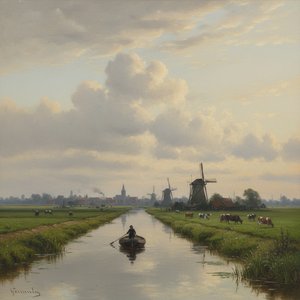
A Life Shaped by the Alpine Landscape
Born in Zurich to a rope maker, Johann Heinrich Wüest lived a life deeply rooted in the geography of his home. His early years were defined by the local rhythms of Switzerland, but his artistic vision expanded far beyond the city walls. Under the guidance of Johann Balthasar Bullinger, he began a formal training that would eventually lead him across borders. A recommendation to study in Holland brought him into contact with the traditions of the Dutch Golden Age, where the influence of Flemish painting left a lasting mark on his technique.
During his time in the Netherlands, Wüest found companionship and mentorship in Jacob Maurer. This connection was more than professional; it was personal, as Wüest later adopted Maurer’s son in 1780. His travels also took him to Paris in 1766, adding a layer of continental refinement to his developing style. Upon returning to Zurich in 1769, he entered the painters' guild, marking the beginning of a long and settled career in the city where he was born and would eventually die.
The Emergence of a New Vision
Wüest’s work began to move away from the structured compositions of his early training toward something more rugged and elemental. He became a precursor to Romantic landscape painting, focusing on the immense scale of the natural world. His canvases often featured the Swiss Alps, specifically the formidable presence of glaciers. In works such as Der Rhonegletscher, he captured the movement of ice spilling into valleys, creating a sense of weight and geological power.
A defining characteristic of his method was the use of tiny figures, or staffage, placed within vast, overwhelming environments. These small human silhouettes—travelers, fishermen, or even the artist himself at work—did not dominate the scene but instead provided a sense of scale. This technique emphasized the relationship between the individual and the immense, often intimidating, forces of nature. His style drew inspiration from the works of Jacob van Ruisdael, blending a fascination with mountain views with a meticulous attention to the textures of rock and cloud.
Contributions to the Zurich Art Scene
Beyond his own brushwork, Wüest was an active participant in the institutional life of his community. In 1787, he helped establish the Zürcher Künstlergesellschaft, an art society that provided a structure for local creators. His influence extended to the next generation of painters through his work as a teacher. He passed his knowledge to students such as Ludwig Hess and Heinrich Freudweiler, ensuring that his approach to landscape and light would persist in Swiss art.
His legacy is found in the quiet strength of his depictions of the natural world. While his early works reflected the influence of Flemish masters, his later focus on the sublime qualities of the Alps helped shift the focus of regional painting toward the dramatic and the atmospheric. He remained a fixture of Zurich until his death in 1821, leaving behind a body of work that documented the changing face of the Swiss landscape.
Вопросы и ответы
Сколько работ Heinrich Wüest представлено в каталоге?
Вы можете просмотреть 4 произведений работ Heinrich Wüest на странице Все работы художника.
Насколько популярны произведения Heinrich Wüest?
Страница со статистикой Статистика просмотров для Heinrich Wüest содержит данные, рассчитанные на основе произведений этого художника, представленных на данный сайт.
Можно ли просматривать работы Heinrich Wüest по направлениям искусства?
Работы Heinrich Wüest можно просматривать по направлениям на странице Все направления художника.
Под какими еще именами известен Heinrich Wüest?
Heinrich Wüest также известен под именами Johann Heinrich Wuest, Joh. Heinr. Wüest, Heinrich Wüst, Johann Heinrich Wüst, H. Wust.