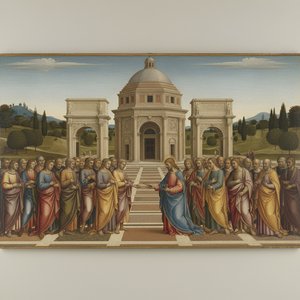
The Lombard Master: The Life and Legacy of Bernardino Butinone
In the vibrant, burgeoning landscape of the Italian Renaissance, few artists captured the spiritual intimacy of the Lombardy region as profoundly as Bernardino Butinone. Born in the town of Treviglio around 1435 or 1436, Butinone emerged from a lineage of artistic tradition, being the son of Jacopo da Treviglio. His early years were shaped by the rich cultural currents flowing through Milan and its surrounding territories, a period where the rigid structures of the Middle Ages were gracefully yielding to the humanistic inquiries of the Quattrocento. As a pupil of the esteemed Vincenzo Foppa, Butinone inherited a mastery of naturalism and a delicate approach to light that would become the cornerstone of his expressive power.
The development of Butinone’s style was marked by a unique ability to blend linear precision with a soft, atmospheric emotion. While his training under Foppa provided him with a foundation in the Lombard tradition—characterized by a deep respect for the physical weight of figures and the tangible reality of their surroundings—he also possessed a singular gift for portraying the divine through the lens of human tenderness. This duality is perhaps most evident in his collaborative spirit; he worked alongside notable contemporaries such as Bernardino Zenale and served as a tutor to the talented Bramantino, helping to shape the next generation of Milanese masters.
A Sacred Narrative: Masterworks and Devotional Brilliance
The true essence of Butinone’s artistry is found in his ability to transform religious iconography into deeply moving, personal encounters. His oeuvre is celebrated for its narrative clarity and its capacity to evoke a sense of hushed reverence. One of his most significant achievements remains the polyptych of San Martino in Treviglio, commissioned in 1485, which stands as a testament to his skill in large-scale, multi-paneled devotional works. Beyond these grand altarpieces, Butinone found immense success in creating smaller, more intimate panels that chronicled the life of Christ—works that are now cherished in prestigious collections such as the National Gallery in London and the Art Institute of Chicago.
In these smaller compositions, the artist’s technical brilliance shines through a sophisticated use of color and light. Whether depicting the Adoration of the Magi or the poignant Flight into Egypt, Butinone employs a rhythmic movement of light to guide the viewer's eye through sacred vignettes. His figures are never mere icons; they possess a palpable presence, their expressions a masterful blend of profound love and gentle contemplation. In works like his Madonna and Child, one can almost feel the warmth of maternal devotion, rendered with such care that the softness of drapery and the tenderness of a gaze become windows into the eternal.
Historical Significance and Artistic Footprint
Though the name Bernardino Butinone may not resonate with the same immediate fame as Leonardo da Vinci, his historical significance within the Lombard Renaissance is undeniable. He was a vital link in the chain of artistic evolution in Northern Italy, bridging the gap between the early innovations of Foppa and the High Renaissance splendor that would later define the region. His contributions to the Grifi Chapel in San Pietro in Gessate and his frescoes in Santa Maria delle Grazie in Milan demonstrate a painter who was deeply integrated into the very fabric of Milanese spiritual life.
The legacy of Butinone is found in the enduring emotional resonance of his work. He mastered the art of the "sacred narrative," creating a visual language where the earthly and the divine intersect seamlessly. Through his meticulous attention to detail, his atmospheric use of light, and his profound empathy for his subjects, Butinone ensured that the stories of the Christian faith were not just told, but felt. His influence lived on through his students and his collaborations, leaving behind a body of work that continues to invite viewers into a state of quiet, contemplative prayer.
Вопросы и ответы
Можно ли просматривать работы Bernardino Butinone по цветовой палитре?
Чтобы найти работы Bernardino Butinone в определенной цветовой гамме, воспользуйтесь страницей художника По палитрам.
Можно ли просматривать работы Bernardino Butinone по настроению?
На странице Подбор по настроению работы Bernardino Butinone распределены по настроению.
Откуда Bernardino Butinone?
Bernardino Butinone родился в Italy.
К какой исторической эпохе относится Bernardino Butinone?
Bernardino Butinone работал в эпоху Renaissance. Этот период позволяет определить место творчества художника в истории.