Cymon and Iphigenia
Oil On Canvas
WallArt
Academic Romanticism
1884
218.0 x 390.0 cm
Галерея Нового Южного Уэльса
Масляная репродукция ручной работы
Картина маслом на холсте в выбранном вами размере и раме, написанная на заказ нашими художниками. ( Купить принт
Купить изображение)
P118B $10
P118H $10
P118W $10
P438Z $10
P508JH $12
P508YH $12
P805H $10
P805Z $10
P919BZ $10
P919G $10
P919XJ $10
P959ZH $10
P968JZ $12
W106C $8
W218G $10
W218JH $8
W218Y $10
W307PJ $10
W316G $10
W316PJ $8
W316Y $10
W398PJ $8
W4111J $10
W500HY $15
W500JH $15
W692G $12
W849H $8
W940BG $15
W953PJ $8
Выберите один из наших стандартных размеров, соответствующих оригинальным пропорциям произведения искусства.
Вы можете указать собственные размеры, чтобы картина идеально вписалась в выбранную раму или пространство. Если выбранный вами размер не соответствует пропорциям оригинала, мы либо обрежем полотно, либо расширим его за счет дополнительных элементов, написанных вручную. Цифровой макет будет отправлен вам на утверждение перед началом производства.
Обратите внимание, что предварительный просмотр на экране не отражает фактическую обрезку или расширение. Только макет точно покажет окончательную композицию.
Хотя доступны индивидуальные размеры, мы рекомендуем выбирать вариант из предопределенного списка, чтобы сохранить исходные пропорции.
После оформления заказа команда OriginalUniqueArt.com свяжется с клиентом по электронной почте для уточнения деталей и предоставит предварительный макет
Доставка по всему миру () за 3–4 недели вместо стандартных 5 недель. (22 Август). Без компромиссов в качестве.
Бесплатная экспресс-доставка по всему миру
Высококачественный льняной холст
Полное страхование доставки
Гарантия возмещения таможенных пошлин
Гарантия точного соответствия цветов
Политика возврата в течение 60 дней (только при наличии дефектов)
Гарантия возврата 100% средств
Предложение оптовых скидок
Cymon and Iphigenia
Техника репродукции
Размер репродукции
-
Итоговая стоимость
$ 300
Описание произведения
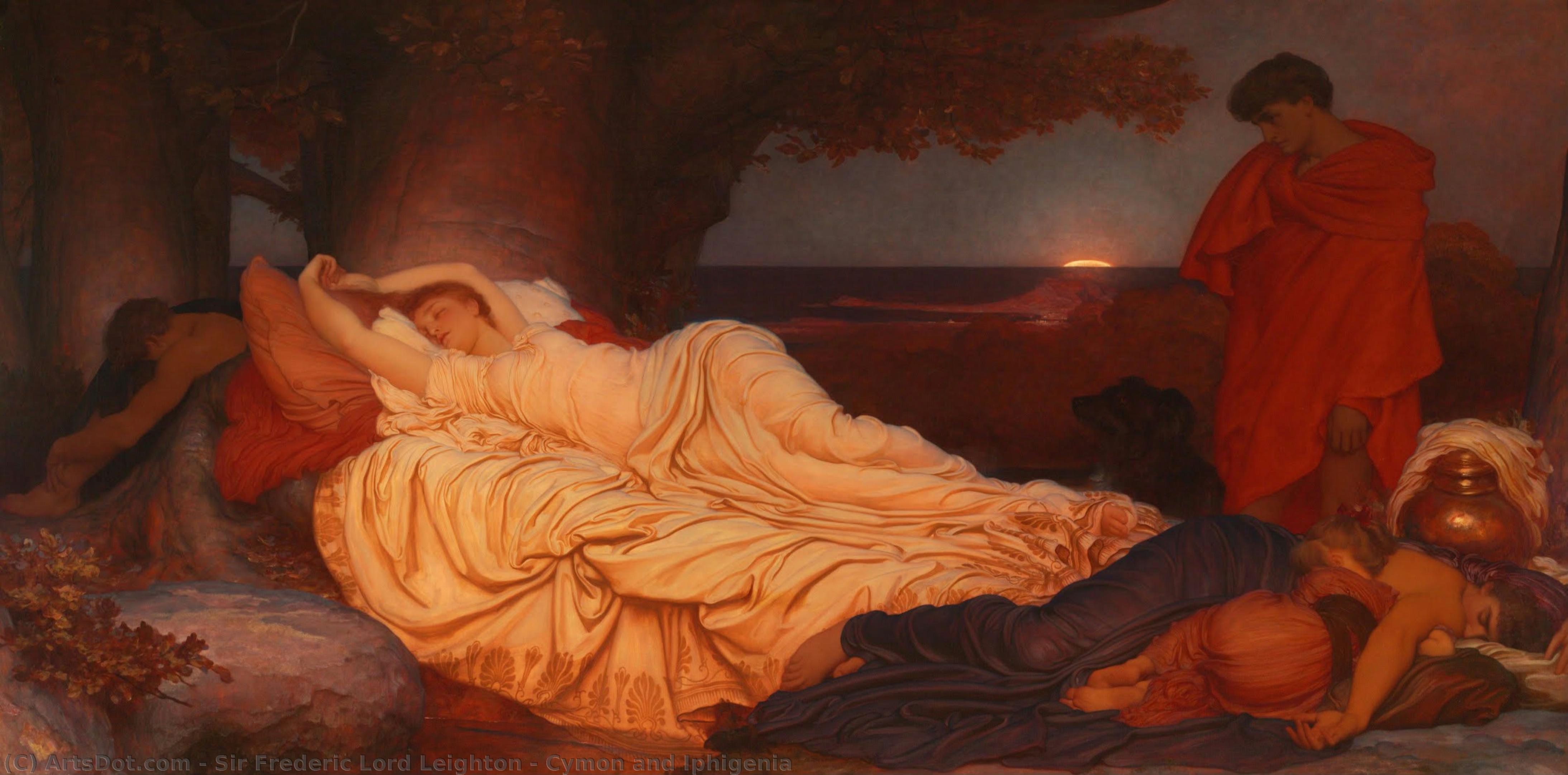
A Vision of Ideal Beauty: Frederic Leighton’s “Cymon and Iphigenia”
Frederic Leighton's "Cymon and Iphigenia," painted in 1884, isn’t merely a depiction of Greek myth; it’s a carefully constructed tableau of Victorian ideals – a testament to beauty, virtue, and the transformative power of love. Leighton, already established as a Royal Academician and a master of historical painting, sought to elevate the narrative beyond its original source material, weaving in elements of Pre-Raphaelite sensuality and classical restraint into a scene brimming with quiet drama. The painting immediately draws the eye to Iphigenia, lying gracefully on a mossy bank beneath an ancient tree – her pose suggesting both languor and vulnerability. Her golden hair cascades around her face, illuminated by dappled sunlight that filters through the leaves, while her eyes are closed in peaceful slumber. The artist’s meticulous attention to detail is evident in every curve of her body, every ripple of fabric, and the delicate rendering of the foliage surrounding her.A Story of Awakening and Moral Ascent
The myth underpinning “Cymon and Iphigenia” originates from Boccaccio’s *Decameron*, a collection of tales set in Florence during the Black Death. The story recounts how the brutish youth Cymon, initially characterized by his rudeness and lack of refinement, encounters the beautiful Iphigenia. Through her presence, he undergoes a profound transformation, shedding his coarse manners and embracing intellectual pursuits – becoming a man of virtue and learning. Leighton cleverly captures this pivotal moment in the narrative, not through overt action but through subtle gestures and expressions. Cymon stands before her, gazing at her with an expression of rapturous admiration, while Iphigenia’s serene repose suggests that she has already initiated his moral awakening. The inclusion of a young slave girl, Lena, adds another layer to the scene, representing innocence and serving as a visual reminder of the transformative power of beauty.Technique and Aesthetic Choices
Leighton's mastery is evident in his masterful use of color and light. He employs a muted palette dominated by earthy greens, browns, and golds, creating an atmosphere of tranquility and timelessness. The lighting is particularly noteworthy – it’s diffused and atmospheric, casting long shadows and highlighting the textures of the foliage and Iphigenia's garments. The artist meticulously rendered every detail with painstaking precision, utilizing a smooth, polished technique that reflects his academic training. He drew heavily on classical sculpture for inspiration, evident in the idealized forms of the figures and the careful arrangement of the composition. The background landscape is deliberately vague, allowing the viewer’s attention to remain focused on the central figures. The use of a dark, almost velvety moss beneath Iphigenia further emphasizes her vulnerability and purity.Symbolism and Victorian Ideals
“Cymon and Iphigenia” is deeply rooted in the artistic and social conventions of Victorian England. The painting embodies several key ideals prevalent during that era: the celebration of beauty, the pursuit of virtue, and the reverence for classical antiquity. Leighton’s choice to depict a mythological scene rather than a contemporary subject allowed him to explore these themes within a framework of idealized beauty and moral instruction. The image speaks to the Victorian fascination with both Greek mythology and the concept of “moral education,” where art was seen as a tool for shaping virtuous citizens. Furthermore, the painting reflects Leighton’s own personal interests – his love of classical sculpture and his desire to create works that were both aesthetically pleasing and morally uplifting. The overall effect is one of serene contemplation, inviting viewers to reflect on the timeless themes of beauty, virtue, and transformation.A Legacy of Beauty: Reproductions and Inspiration
Today, “Cymon and Iphigenia” remains a beloved masterpiece, admired for its exquisite detail, evocative atmosphere, and profound symbolism. High-quality reproductions capture the painting’s luminous quality and intricate details, making it accessible to a wider audience. Its themes continue to resonate with art lovers and interior designers alike, who appreciate its timeless beauty and its ability to evoke a sense of tranquility and contemplation. When selecting a reproduction, consider the scale and framing options to best complement your space – allowing this iconic work of art to grace your home and inspire generations to come.Биография художника
A Life Bathed in Light: The World of Sir Frederic Lord Leighton
Sir Frederic Lord Leighton, born in Scarborough, England, in 1830, was a figure whose life and art were inextricably linked to beauty, classical ideals, and the vibrant currents of Victorian society. His early existence, cushioned by his family’s considerable wealth – stemming from his grandfather's distinguished service as physician to the Russian Tsars – afforded him an unparalleled opportunity for artistic development, allowing him to embark on extensive travels across Europe and immerse himself in the artistic traditions of Italy, Germany, and France. These formative years were not merely a period of observation; they were a crucible where Leighton’s distinctive style began to coalesce—a masterful blend of academic precision, Pre-Raphaelite sensuality, and an unwavering reverence for the classical world. A particularly memorable event during his youth occurred at seventeen when he encountered Arthur Schopenhauer in Frankfurt, resulting in the only known full-length portrait of the notoriously reclusive philosopher – a testament to Leighton’s intellectual curiosity and his fascination with exploring the complexities of human experience. This encounter hinted at a deeper artistic intent, one that would consistently inform his work for decades to come.The Painterly Embrace of Myth and History
Leighton's artistic career flourished during an era deeply invested in historical narratives, biblical tales, and the enduring allure of classical mythology. He didn’t simply depict these subjects; he inhabited them, meticulously researching costumes, settings, and the subtle nuances of ancient life to create works that possessed a remarkable sense of authenticity and dramatic power. His paintings weren't mere illustrations—they were immersive experiences, transporting viewers to worlds populated by gods, heroes, and forgotten empires. *Clytie*, perhaps his most celebrated work, exemplifies this approach perfectly. The painting portrays the nymph Clytie, transformed into a sunflower, eternally yearning for Apollo’s gaze. It is not merely a beautiful image; it's a poignant exploration of unrequited love, longing, and the transformative power of nature—rendered with an astonishing level of detail and bathed in a luminous quality that seems to emanate from within the canvas itself. Similarly, *The Daphnephoria*, depicting Apollo’s pursuit of the nymph Daphne as she transforms into a laurel tree, showcases Leighton's mastery of composition, color, and his ability to capture movement and energy with breathtaking skill. He deliberately embraced opulent textures, rich fabrics, and dramatic lighting—elements that contributed significantly to the sheer visual splendor of his paintings. Leighton’s meticulous attention to detail extended beyond mere aesthetics; he sought to evoke a sense of atmosphere and emotion, drawing upon his extensive knowledge of classical art and mythology to create works that resonated deeply with viewers.Beyond the Canvas: Sculpture and Architectural Vision
While primarily recognized as a painter, Leighton's artistic ambitions transcended the limitations of two-dimensional representation. He was a gifted sculptor, and his *Athlete Wrestling with a Python*, created between 1888 and 1891, marked a pivotal moment in British sculpture—often credited with initiating a renaissance in contemporary sculptural practice known as the “New Sculpture.” This monumental work, carved from pristine white marble, embodies both physical power and dramatic tension. The sculpture’s dynamic pose and expressive musculature were revolutionary for its time, demonstrating a newfound emphasis on naturalism and anatomical accuracy. However, Leighton's creative vision extended far beyond sculpture. He was an avid collector of art and artifacts, particularly those originating from the Near East – treasures that he didn’t simply display but integrated into the very fabric of his home, Leighton House in Holland Park, London. Designed by George Aitchison, Leighton House is a masterpiece in its own right—a stunning example of Aestheticism that served as both a residence and a studio. The iconic Arab Hall, with its intricate tilework and soaring arches, stands as a lasting testament to Leighton’s eclectic tastes and his desire to create a total work of art – an environment designed to inspire and nurture his creativity.Legacy and the Echoes of an Era
Leighton's influence on British art was profound and enduring. He served as President of the Royal Academy from 1878 until his death in 1896, a position he held with distinction, championing artistic excellence and fostering a vibrant creative community. His knighted in 1878, made a baronet in 1886, and remarkably, granted a peerage just one day before his passing – a testament to the immense respect he commanded within the art world and beyond. While his work experienced a period of relative obscurity following his death, eclipsed by the rise of modernism, there has been a significant resurgence of interest in Leighton’s art in recent decades. Today, his paintings and sculptures are celebrated for their technical brilliance, their evocative power, and their ability to transport viewers to worlds of beauty and wonder. His legacy is not merely one of aesthetic achievement but also of a life dedicated to the pursuit of beauty, knowledge, and artistic innovation – a truly remarkable figure in the history of British art.- His works continue to inspire artists and captivate audiences around the globe.
- Leighton House Museum stands as a lasting tribute to his artistic vision and remains a vital cultural landmark.
- He represents a fascinating intersection of Victorian ideals, classical influences, and Pre-Raphaelite sensibilities – a unique voice in the history of British art.
Notable Works
- Clytie (1871-1872)
- Flaming June (1875)
- Athlete Wrestling with a Python (1888-1891)
- The Sluggard (1885)
- Daphnephoria (1864)
Фредерик Лейтън
1830 - 1896 , Великобритания
Основные сведения
- Artistic Movement Or Style: Академический, Прерафаэлитянин
- Artists Or Movements Influenced By This Artist:
- Новый скульптурный
- Аэстетизм
- Artists Who Influenced This Artist:
- Эдуард фон Штайнель
- Джованни Коста
- Date Of Birth: 3 декабря 1830 г.
- Date Of Death: 25 января 1896 г.
- Full Name: Sir Frederic Lord Leighton
- Nationality: Британский
- Notable Artworks:
- Клития
- Фламмюнь
- Спортмен, борется с питоном
- Place Of Birth: Scarborough, Великобритания

Вариант со стеклом доступен только для размеров менее 110 см