Surrealist Expressionism · 1927
The Forest (Макс Эрнст, 1927)
Макс Эрнст (1891–1976) создал(а) The Forest. Создано в 1927. Относится к направлению Surrealist Expressionism. Выполнено в технике Acrylic On Canvas. Хранится в Tel Aviv Museum of Art в Тель-Авив, Израиль. Размер: 25 × 36 cm
- 1927
- Acrylic On Canvas
- 25 × 36 cm
- Tel Aviv Museum of Art, Тель-Авив

 Предпросмотр

 Картина маслом ручной работы
 Поделиться
 Поделиться
 Информационный лист


 Скачать
 Похожие предметы
 Рентгенография
 Слайд-шоу
 Вопросы и ответы

 Статистика просмотров
The Forest вкратце
- Название
- The Forest
- Автор
- Макс Эрнст (1891–1976)
- Дата рождения художника
- Брюль, Германия
- Дата
- 1927
- Техника
- Acrylic On Canvas
- Размеры
- 25 × 36 cm
- Где посмотреть
- Tel Aviv Museum of Art, Тель-Авив, Израиль
- Движение
- Surrealist Expressionism
- Период
- Early Modern
- Сюжет
- moonlit cityscape, surreal forest, urban night, max ernst, german art, 1927 painting
Что изображено на The Forest?
A Nocturne of Dreams: Max Ernst’s “The Forest”
Max Ernst's "The Forest," painted in 1927, isn’t merely a depiction of a landscape; it’s an immersion into the subconscious, a carefully constructed dreamscape rendered with the unsettling beauty characteristic of the artist’s early Surrealist explorations. This intimate canvas – measuring just 25 x 36 cm – holds within its borders a potent collision of natural and urban elements, inviting viewers to contemplate the anxieties and aspirations simmering beneath the surface of modern life. The painting immediately draws the eye upward to a luminous moon dominating the sky, casting an ethereal glow upon the sprawling cityscape below. Buildings rise from the darkness, not as symbols of progress or order, but as strangely distorted monoliths, hinting at a world both familiar and profoundly alien.
Ernst’s technique is deliberately evocative, employing a layered approach that anticipates techniques he would later refine in his collage work. He utilizes loose, expressive brushstrokes, building up the forms of trees and buildings with a sense of urgency and movement. The color palette leans heavily into cool blues and greens, punctuated by the stark white of the moon and the muted tones of the city lights – colors that contribute to the painting’s nocturnal atmosphere and imbue it with a feeling of quiet mystery. Notice how he doesn't meticulously render detail; instead, he favors suggestion and mood, allowing the viewer’s imagination to fill in the gaps.
The Seeds of Surrealism: Ernst’s Intellectual Landscape
Understanding “The Forest” requires acknowledging Max Ernst’s unique artistic trajectory. Born in Brühl, Germany, in 1891, Ernst wasn't a traditional painter; his path was forged through rigorous academic study – philosophy, art history, literature, psychology, and psychiatry at the University of Bonn. This intellectual grounding profoundly shaped his approach to art, moving him beyond mere representation towards exploring the realm of dreams, memory, and the irrational. His father, a teacher of the deaf, instilled in him a sensitivity to the world and a rebellious spirit – qualities that would become central to Ernst’s artistic vision. He was deeply influenced by thinkers like Freud and Jung, particularly their theories on the unconscious mind, which he sought to translate into visual form.
The year 1927 is crucial within this context. It represents a pivotal moment in Ernst's development as a Surrealist, a period marked by experimentation with automatism – a technique of spontaneous creation designed to bypass conscious control and tap directly into the subconscious. "The Forest," therefore, can be seen as a product of this process, a visual manifestation of his inner world.
Symbolic Echoes: Nature Versus Urbanity
The juxtaposition of the forest and the city is laden with symbolic weight. The forest, traditionally associated with nature, instinct, and the primal, stands in stark contrast to the rigid geometry and artificial light of the urban landscape. This isn’t a harmonious blend; rather, it's a tension – a suggestion that the encroachment of modernity threatens to overwhelm the natural world. The moon itself is a potent symbol, often linked to cycles, intuition, and the hidden realms of the unconscious. Its presence elevates the scene beyond a simple cityscape, transforming it into a dreamlike tableau.
Furthermore, consider the distorted forms of the buildings. They aren’t simply architectural structures; they seem to lean inward, almost collapsing under their own weight, mirroring perhaps a sense of unease or anxiety about the future. The trees, though present, are somewhat obscured by the city's glow, hinting at a diminishing connection with nature.
A Timeless Resonance: Reproduction and Artistic Legacy
"The Forest" continues to resonate with viewers today because it taps into fundamental human experiences – the longing for escape, the anxieties of urban life, and the enduring power of the subconscious. OriginalUniqueArt’s meticulously crafted hand-painted reproductions capture not only the visual details of Ernst's original but also its emotional depth and atmospheric quality. Each reproduction is created with the same attention to texture and color as the original, ensuring a faithful representation of this iconic Surrealist masterpiece. Whether you are an art collector seeking to expand your collection or an interior designer searching for a unique piece to elevate a space, a OriginalUniqueArt reproduction of “The Forest” offers a captivating glimpse into the mind of one of 20th-century’s most visionary artists.
В каком музее находится The Forest?
Tel Aviv Museum of Art
Тель-Авив, Израиль
Маяк творчества на средиземноморском побережье Расположенный в самом сердце оживленного Тель-Авива — города, пульсирующего художественной энергией и исторической значимостью, — стоит Музей искусств Тель-Авива , являющийся истинным свидетельством процветающего культурного ландшафта Израиля. TAMA, как его ласково называют, — это не просто хранилище шедевров; он вдыхает жизнь в искусство, способствуя диалогу, вдохновляя поколения и служа жизненно важным связующим звеном между прошлым нации и ее динамичным настоящим. Его история начинается не в величественных залах, а в скромных стенах дома первого мэра Тель-Авива — пространства, пропитанного эхом становления целой нации.


Изображения в высоком разрешении: The Forest

Объект защищен авторским правом: данные файлы предназначены для личного ознакомления и не являются лицензией на переиздание.
Макс Эрнст, The Forest (1927), Tel Aviv Museum of Art.
Ответы на вопросы о The Forest
Где сегодня можно увидеть «The Forest», Макс Эрнст?
Вы можете увидеть оригинал произведения «The Forest» в Tel Aviv Museum of Art, Тель-Авив, Израиль.
В каком году было создано произведение «The Forest», Макс Эрнст?
Создание «The Forest», Макс Эрнст датируется 1927 годом.
В какой технике выполнено произведение «The Forest»?
Для создания «The Forest» Макс Эрнст использовал(а) технику Acrylic On Canvas. Эта техника определяет материальную природу оригинального произведения.
Каковы размеры оригинала «The Forest», Макс Эрнст?
Размеры оригинала «The Forest», Макс Эрнст составляют 25 x 36 cm. Вы можете заказать репродукции в других размерах с сохранением тех же пропорций.
Что изображено на картине «The Forest»?
Темы, представленные в «The Forest», Макс Эрнст, включают moonlit cityscape, surreal forest, urban night, max ernst, german art, 1927 painting, dreamlike scene. Вместе они раскрывают основной сюжет произведения.
Находится ли изображение «The Forest», Макс Эрнст в общественном достоянии?
Что касается авторских прав, произведение «The Forest» находится в находится под защитой авторского права.
Кто является автором работы «The Forest»?
Авторство работы «The Forest» приписывается Макс Эрнст.
К какому стилю относится «The Forest»?
Художественное направление, к которому относится «The Forest», Макс Эрнст, — это Surrealist Expressionism. Такая классификация позволяет соотнести данную работу с другими произведениями и мастерами того же периода.
К какому периоду творчества Макс Эрнст относится произведение «The Forest»?
«The Forest» относится к Early Surrealism художника Макс Эрнст.
Об авторе, Макс Эрнст

1891–1976, Германия
Макс Эрнст
Жизнь и истоки Макса Эрнста Макс Эрнст появился на свет 2 апреля 1891 года в немецком Брюле. Он рос в католической семье среднего достатка, будучи третьим из девяти детей. Его детство прошло в тихой и дисциплинированной домашней атмосфере, где его отец, Филипп, работал учителем для глухих. Филипп также был художником-любителем, и именно через него мальчик впервые соприкоснулся с инструментами и самой практикой созидания искусства.
Другие работы Макс Эрнст
 Сэлэб или Элефе́нт Сэлэ́бс1921
 Элефе́нт Целе́бс1921
 Европа после дождя II1942
 От этого мужчины ничего не узнают1923
Эссе к произведению The Forest
 Symphony of Sunlight: The Luminous Legacy of Pine Tree Landscapes in Art HistoryExplore the luminous history of pine landscapes through Sorolla and Shishkin. Discover the magic of forest art today.
 Unlocking the Unconscious: The Top 25 Surrealist Masterpieces by Max ErnstStep into the dreamscapes of Max Ernst. Explore 25 iconic Surrealist masterpieces, from pioneering collages to haunting landscapes. Find in…
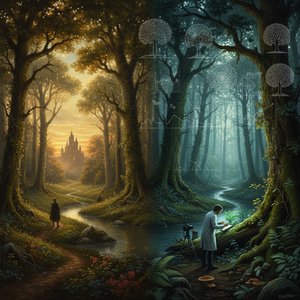 The Enchanted Canopy: Exploring Forests in Art History – From Romantic Idealization to Ecological ConsciousnessExplore the rich history of forests in art! Discover Romantic masterpieces by Friedrich & Monet, Symbolist depths, and contemporary visions…