

 Предпросмотр
 Поделиться
 Поделиться
 Детали произведения

 Скачать
 Похожие работы
 Рентгенография
 Слайд-шоу
Untitled (AQTTGV)


 Читать далее
Масляная репродукция ручной работы
Картина маслом на холсте в выбранном вами размере и раме, написанная на заказ нашими художниками. ( Купить принт Купить изображение)




P118B $10

P118H $10

P118W $10

P438Z $10

P508JH $12

P508YH $12

P805H $10

P805Z $10

P919BZ $10

P919G $10

P919XJ $10

P959ZH $10

P968JZ $12

W106C $8

W218G $10

W218JH $8

W218Y $10

W307PJ $10

W316G $10

W316PJ $8

W316Y $10

W398PJ $8

W4111J $10

W500HY $15

W500JH $15

W692G $12

W849H $8

W940BG $15

W953PJ $8




Выберите один из наших стандартных размеров, соответствующих оригинальным пропорциям произведения искусства.

Вы можете указать собственные размеры, чтобы картина идеально вписалась в выбранную раму или пространство. Если выбранный вами размер не соответствует пропорциям оригинала, мы либо обрежем полотно, либо расширим его за счет дополнительных элементов, написанных вручную. Цифровой макет будет отправлен вам на утверждение перед началом производства.
Обратите внимание, что предварительный просмотр на экране не отражает фактическую обрезку или расширение. Только макет точно покажет окончательную композицию.
Хотя доступны индивидуальные размеры, мы рекомендуем выбирать вариант из предопределенного списка, чтобы сохранить исходные пропорции.
После оформления заказа команда OriginalUniqueArt.com свяжется с клиентом по электронной почте для уточнения деталей и предоставит предварительный макет
Доставка по всему миру () за 3–4 недели вместо стандартных 5 недель. (29 Август). Без компромиссов в качестве.

Бесплатная экспресс-доставка по всему миру

Высококачественный льняной холст

Полное страхование доставки

Гарантия возмещения таможенных пошлин

Гарантия точного соответствия цветов

Политика возврата в течение 60 дней (только при наличии дефектов)

Гарантия возврата 100% средств

Предложение оптовых скидок
 Вариант со стеклом доступен только для размеров менее 110 см

Untitled (AQTTGV)
Техника репродукции
Размер репродукции
-


Итоговая стоимость
$ 300
Биография художника
The Soul Behind the Canvas: The Life and Legacy of Johan Görbitz
In the grand tapestry of nineteenth-century European art, few names evoke the quiet dignity of classical portraiture quite like Johan Görbitz. Born in the coastal serenity of Sandviken, Norway, in 1782, Görbitz was a painter whose life journey mirrored the sweeping cultural shifts of his era. Though often celebrated as a pioneer of German and Norwegian portraiture, his roots were deeply embedded in the merchant traditions of Bergen. As the son of Martin Görbitz, a successful merchant, his early years provided a foundation of stability that allowed him to pursue an ambitious artistic vocation. His path was not merely one of local talent but of international exploration, as he moved through the great artistic capitals of Europe—from the academic rigor of Copenhagen to the vibrant streets of Paris and the historic halls of Dresden and Vienna.
The development of Görbitz’s technique was a profound dialogue with the masters of the past. His education at the Royal Danish Academy of Fine Arts in Copenhagen served as the crucible for his classical sensibilities. Under the influence of esteemed mentors, he learned to marry anatomical precision with an expressive, almost poetic, use of gesture. As he traveled through Italy and England, he absorbed the diverse currents of European art, yet he remained anchored by a devotion to the principles of classical realism. He looked backward to the dramatic chiaroscuro of Caravaggio and the masterful light of Rembrandt, seeking to use shadow not merely as a void, but as a tool to sculpt the very essence of his subjects' souls.
A Mastery of Character and Light
To gaze upon a portrait by Görbitz is to engage in an intimate encounter with history. He possessed a rare ability to transcend simple likeness, striving instead to capture the psychological depth and inner character of those who sat before him. Whether depicting the aristocratic grandeur of Swedish nobility or the stoic presence of prominent Norwegians, his brushwork conveyed a sense of dignified contemplation. His works are characterized by an unwavering commitment to form, where every fold of fabric and every subtle nuance of facial expression serves a greater narrative purpose.
His technical repertoire was remarkably versatile, allowing him to navigate various mediums and styles with ease:
- Academic Realism: A dedication to capturing the physical world with meticulous detail and structural integrity.
- Chiaroscuro: The use of dramatic light and shadow to create atmosphere and a sense of three-dimensional presence.
- Symbolic Depth: The integration of subtle elements within his compositions to hint at the status, temperament, or history of his sitters.
In his later years, particularly during his time in Paris and his eventual return to Christiania (now Oslo) in 1836, Görbitz became a sought-after chronicler of his age. His portraits from the 1830s and 1840s remain some of his most poignant, capturing a world on the cusp of modernity through a lens of timeless elegance. Through his ability to render both the monumental and the intimate, Johan Görbitz secured his place as an artist who did not just paint faces, but captured the very heartbeat of the nineteenth century.

johan gørbitz
1782 - 1853
Основные сведения
- Artistic Movement Or Style: Classical Painting
- Artists Or Movements Influenced By This Artist: ['Romanticism']
- Artists Who Influenced This Artist: ['Academic Art']
- Date Of Birth: 1782
- Date Of Death: 1853
- Full Name: Johan Görbitz
- Nationality: German
- Notable Artworks:
- Untitled (AQTTG5)
- Untitled (AQTTGR)
- Untitled (AQTTGM)
- Place Of Birth: Germany
Похожие статьи

Топ-10 знаменитых картин в черных тонах: шедевры искусства для вашего интерьера
Погрузитесь в мир темных шедевров! Топ-10 знаменитых картин в черных тонах от Гойи, Рембрандта и Мунка. История искусства, техники живописи и вдохновение для вашего интерьера. Купите репродукции высокого качества на OriginalUniqueArt.com

The Enduring Legacy of Oil on Canvas: Technique, History & Aesthetic Impact
Explore the rich history & techniques of oil painting – from Renaissance masters to Impressionism. Discover pigments, layering methods, and why this timeless medium endures. Expert insights for artists & art enthusiasts.

Oil on Canvas: A Historical & Technical Exploration of a Timeless Artistic Medium
Explore the rich history & enduring techniques of oil painting on canvas. Discover the science behind its longevity, conservation practices, and contemporary relevance. Expert insights for art enthusiasts.

From Monochrome to Masterpiece: Reimagining Black and White Photos as Luminous Impressionist Oil Paintings
Transform your cherished black and white photographs into luminous Impressionist oil masterpieces. Our master artists breathe life into monochrome memories with hand-painted textures in the style of Monet and Van Gogh, creating timeless, museum-quality heirlooms for your home.
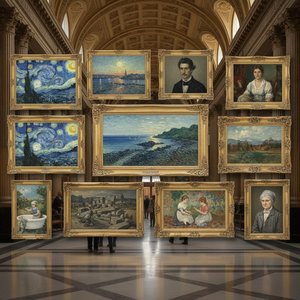
Топ-10 шедевров XIX века: искусство, история и декор от OriginalUniqueArt.com
Погрузитесь в мир искусства XIX века! От реализма до импрессионизма – 10 величайших картин, истории художников и вдохновение для вашего интерьера. Репродукции высокого качества на OriginalUniqueArt.com. Откройте всю коллекцию онлайн!

