

 Примерить в интерьере
 Отправить
 Поделиться
 Подробнее
 Руководство

 Скачать
 Похожие объекты
 Рентгенография
 Слайд-шоу
 Статистика
Spring Flood
 Oil On Canvas
- WallArt
- Impressionism
 1897
1897- 19th Century
 64.0 x 57.0 cm
 Третьяковская галерея
 Развернуть текст
Жикле / Арт-принты
Печать (жикле) или холст музейного качества с быстрыми сроками изготовления и широким выбором вариантов отделки. ( Заказать репродукцию ручной работы Перейти к цифровым изображениям)




































Выберите один из наших стандартных размеров, соответствующих оригинальным пропорциям произведения искусства.

Введите необходимую ширину и высоту, чтобы репродукция подошла к вашей раме или стене. При печати изображение можно только уменьшить, но нельзя увеличить больше оригинала, поэтому при выборе другого формата часть изображения может быть обрезана. Перед печатью мы отправим вам цифровой макет на утверждение. Изображение на этой странице не отображает реальную обрезку — ее можно увидеть только на макете.
Доставка по всему миру () за 2 недели вместо стандартных 4–5 недель. (26 Октябрь)

Бесплатная экспресс-доставка по всему миру

Высококачественный льняной холст

Полное страхование при транспортировке

Гарантия возврата таможенных пошлин

Гарантия точного цветового соответствия

100-дневный период возврата (только при обнаружении дефектов)

Гарантия возврата 100% средств

Скидка при заказе нескольких работ
 Вариант со стеклом доступен только для размеров менее 110 см

Spring Flood
Жикле / Арт-принты
Размер репродукции
-


Итоговая стоимость
$ 80
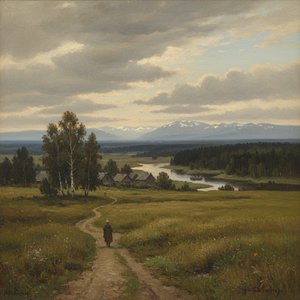
Spring Flood by Isaak Ilyich Levitan: A Serene Reflection of Nature
Isaak Ilyich Levitan's "Spring Flood," painted in 1897, is a captivating landscape that embodies the artist’s signature style – a poignant and evocative portrayal of the Russian countryside. This oil on canvas masterpiece, measuring 64 x 57 cm, resides within the esteemed collection of the Tretyakov Gallery in Moscow, Russia, serving as a testament to Levitan's profound connection with nature and his ability to translate its essence onto canvas.
Artistic Style and Technique
"Spring Flood" exemplifies Levitan’s mastery of mood landscape painting. Unlike earlier landscape artists who focused on topographical accuracy, Levitan sought to capture the emotional atmosphere and spiritual resonance of a scene. The artwork is rendered in an Impressionistic style, characterized by loose brushstrokes and a focus on capturing fleeting moments of light and color. The technique involves layering paint to build up texture and create atmospheric effects. Notice how the artist uses muted yellows, browns, and blues to evoke a sense of serenity and quietude. The delicate play of light on the water creates a sense of movement and energy, while the reflections in the water add depth and complexity to the composition. The flattened perspective is typical of Impressionism, emphasizing the surface qualities of the paint.
Subject Matter and Composition
The painting depicts a tranquil riverbank scene during what appears to be late autumn or early spring. The dominant feature is the reflection of trees and shoreline in the water, creating a symmetrical effect that draws the viewer into the heart of the landscape. A small boat rests gently on the shore, adding a subtle human element to the otherwise natural setting. The composition is carefully balanced, with the horizon line positioned slightly above the midpoint to emphasize the vastness of the sky and the surrounding environment. The inclusion of two people in the scene adds a touch of human connection to the peaceful landscape.
Historical Context and Symbolism
Levitan painted "Spring Flood" during a period of significant artistic change in Russia, as artists began to move away from traditional academic styles towards more modern approaches. The painting reflects this shift, embracing Impressionistic techniques while retaining a distinctly Russian sensibility. The flood itself can be interpreted symbolically – representing renewal and the cyclical nature of life. The muted color palette and tranquil atmosphere evoke a sense of melancholy and introspection, characteristic of Levitan’s work. It is believed that Levitan was deeply affected by personal loss during this time, which may have contributed to the painting's poignant emotional tone.
Emotional Impact and Legacy
"Spring Flood" continues to resonate with viewers today due to its ability to evoke a profound sense of peace and contemplation. The artwork’s beauty lies not only in its technical skill but also in its capacity to transport the viewer to a tranquil natural setting, inviting them to reflect on the beauty and fragility of life. As a masterpiece of Russian art, "Spring Flood" stands as a testament to Levitan's enduring legacy as one of Russia's most beloved landscape painters.
Вопросы и ответы
Является ли «Spring Flood», Isaak Ilyich Levitan одним из самых востребованных произведений в стиле Impressionism?
В рамках направления Impressionism произведение «Spring Flood» обладает уровнем популярности Recognized.
К какой исторической эпохе относится «Spring Flood», Isaak Ilyich Levitan?
«Spring Flood» относится к эпохе 19th Century.
Какие цвета преобладают в работе «Spring Flood», Isaak Ilyich Levitan?
В работе «Spring Flood», Isaak Ilyich Levitan используется палитра Neutrals, где доминирующим цветом является Celadon (#bbc5c3).
Биография художника
A Symphony of the Russian Soul: The Life and Art of Isaak Ilyich Levitan
Isaak Ilyich Levitan, a name inextricably linked to the heart of Russian landscape painting, was far more than simply a recorder of nature’s beauty. He was a poet of the land, a translator of its moods into visual form—a profound interpreter of Russia's soul. Born in 1860 in Kibarty (present-day Lithuania), a small settlement within the vastness of the Russian Empire, Levitan’s life unfolded against a backdrop of both immense hardship and an unwavering dedication to his art. The early loss of his parents – his mother succumbing to illness when he was just fifteen, followed by his father two years later – instilled in him a deep sensitivity, a melancholic awareness that would permeate his canvases with an enduring sense of longing and quiet contemplation. This profound personal experience, coupled with the restrictions faced by Jewish communities within Tsarist Russia, fueled a powerful desire for solace and self-expression—a need to find beauty and meaning amidst adversity, reflected in the landscapes he so meticulously captured. His journey began at the Moscow School of Painting, Sculpture and Architecture in 1873, where he found his mentor in Alexei Savrasov, whose influence would shape the very core of Levitan’s artistic vision.The Genesis of the “Mood Landscape”
Levitan quickly distinguished himself as an artist capable of conveying profound emotion through landscape—a departure from the purely representational approach prevalent at the time. He wasn't interested in achieving photographic accuracy or meticulous topographical detail; rather, he sought to imbue his paintings with a palpable *mood*, a feeling that resonated deeply within the viewer’s soul, evoking a sense of tranquility, solitude, or even poignant melancholy. This distinctive approach earned him the title of pioneer of the “mood landscape,” a genre that transcended simple depiction and ventured into the realm of spiritual connection—a recognition of nature's capacity to stir the emotions and reflect the human condition. His palette was often deliberately restrained, favoring naturalistic colors and subtle poetic elements over bold, vibrant displays. He masterfully employed light and shadow, creating atmospheric effects that were both breathtakingly beautiful and deeply evocative, transporting the viewer into a world of quiet contemplation. Works such as *Autumn Day. Sokolniki* (1879), painted when he was barely nineteen years old, already demonstrated this remarkable ability to capture the subtle nuances of the Russian countryside—a scene imbued with a sense of wistful nostalgia and the poignant awareness of time’s passage. The painting's muted tones and delicate rendering of light create an atmosphere of quiet reflection, hinting at the transience of beauty and the inevitability of change. Later masterpieces like *The Vladimirka Road* (1892) and *Eternal Rest* (1894), prominently displayed in the Tretyakov Gallery, further solidified his reputation as a master of emotional landscape painting—each canvas a testament to his evolving style and deepening understanding of the human experience within the natural world.Influences and Artistic Kinships
While deeply indebted to Savrasov’s foundational influence – particularly his exploration of lyricism in Russian landscape painting – Levitan was also receptive to broader artistic currents. He benefited from the guidance of other esteemed teachers at the Moscow School, including Vasily Perov and Vasily Polenov, each contributing unique perspectives to his artistic development. Crucially, he cultivated close relationships with fellow artists, most notably Nikolai Chekhov—the brother of the renowned playwright Anton Chekhov, who became a lifelong friend and confidant. This circle fostered an environment of intellectual exchange and mutual support, enriching Levitan’s creative process and broadening his artistic horizons. Though he briefly experimented with Impressionistic techniques – influenced by the vibrant colors and fleeting effects of light that characterized the movement – Levitan ultimately maintained a uniquely Russian sensibility in his work, prioritizing emotional resonance over strict adherence to stylistic conventions. He found inspiration not only in the visual world but also in music and literature—seeking to translate their evocative power into his paintings. His designs for scenery for Savva Mamontov’s private Russian Opera demonstrate his versatility and willingness to explore different artistic mediums – a testament to his broad creative range.Major Achievements and Artistic Evolution
Levitan's career unfolded against the backdrop of significant social and political changes in Russia, particularly the tumultuous years following the assassination of Tsar Alexander II in 1881. The subsequent wave of anti-Jewish pogroms forced many Jewish artists to flee Moscow, including Levitan, who was temporarily exiled from the city. Despite these challenges, he continued to produce a prolific body of work, exploring diverse themes and landscapes—from the vast plains of Crimea to the serene banks of the Volga River. His paintings during this period often reflected a sense of melancholy and introspection, mirroring his own personal experiences with loss and displacement. However, in the early 1890s, Levitan’s style underwent a subtle but significant transformation, influenced by the burgeoning Impressionist movement. He began to incorporate brighter colors, looser brushstrokes, and a greater emphasis on capturing fleeting moments of light and atmosphere—a shift that can be seen in works such as *Over Eternal Peace* (1894) and *The Golden Shore*. Yet, despite these influences, he never fully abandoned his distinctly Russian sensibility, retaining a profound connection to the national landscape and its cultural heritage.Legacy and Enduring Resonance
Isaac Levitan’s untimely death in 1900 at the age of thirty-nine cut short a brilliant career but left an indelible mark on the history of Russian art. His paintings—characterized by their emotional depth, atmospheric beauty, and profound connection to the Russian landscape—continue to resonate with audiences today. He is remembered as a pioneer of the “mood landscape,” a genre that elevated Russian landscape painting to new heights of artistic expression. His legacy extends beyond his individual works; he profoundly influenced generations of artists who followed in his footsteps, shaping the course of Russian art and solidifying its place on the international stage. His remains were interred in the Novodevichy Cemetery in Moscow alongside Anton Chekhov—a poignant symbol of their shared artistic kinship and enduring contribution to the cultural landscape of Russia.
Isaak Ilyich Levitan
1860 - 1900 , Россия
Краткая справка
- Artistic Movement Or Style: Пейзаж настроения
- Artists Or Movements Influenced By This Artist: ['Импрессионизм']
- Artists Who Influenced This Artist:
- Алексей Саврасов
- Василий Перов
- Date Of Birth: 30 августа 1860
- Date Of Death: 22 июля 1900
- Full Name: Исаак Ильич Левитан
- Nationality: Русский
- Notable Artworks:
- Осенний день. Сокольники
- Владимирка
- Вечный покой
- Place Of Birth: Кибартай, Литва
Похожие статьи

Evocations of Place: A Historical Journey Through Landscape Art
Explore the rich history of landscape art with OriginalUniqueArt. Discover renowned artists, movements like Impressionism & Romanticism, and expert guidance for collecting timeless pieces. Find your perfect serene escape today!

Джон Констебль: 25 шедевров английского пейзажа для вашего интерьера
Погрузитесь в мир английского пейзажа с Джоном Констеблом! 25 шедевров романтизма, история создания картин и вдохновение для вашего интерьера. Репродукции высокого качества на OriginalUniqueArt.com – искусство для ценителей.

Aleksey Savrasov: The Poetic Realism That Defined Russian Landscape Painting
Explore the poetic realism of Aleksey Savrasov, founder of Russian lyrical landscape painting. Discover his masterpieces like 'The Rooks Have Returned' and learn about his lasting influence on 19th-century art. OriginalUniqueArt offers high-quality reproductions.

Романтический пейзаж: 10 шедевров, изменивших искусство | OriginalUniqueArt.com
Погрузитесь в мир романтического пейзажа! 10 шедевров Фридриха, Тёрнера и других гениев. Узнайте историю создания культовых картин и вдохновитесь для декора интерьера. Репродукции высокого качества на OriginalUniqueArt.com.
Fyodor Vasilyev: A Poetic Vision of Russian Landscape – Life, Legacy, and the Transience of Nature
Explore the captivating world of Fyodor Vasilyev, a pioneering Russian landscape painter. Discover his lyrical style, influential works like 'Clouds' & lasting legacy. Learn about his life, artistic journey & impact on Russian art history.
