Предпросмотр
 Поделиться
 Поделиться
 Детали произведения

 Скачать
 Похожие работы
 Рентгенография
 Слайд-шоу
The Trellis
 Oil On Canvas
- WallArt
- Contemporary Realism
 1862
1862- 19th Century
 109.0 x 135.0 cm
 Toledo Museum of Art
 Читать далее
Масляная репродукция ручной работы
Картина маслом на холсте в выбранном вами размере и раме, написанная на заказ нашими художниками. ( Купить принт Купить изображение)




P118B $10

P118H $10

P118W $10

P438Z $10

P508JH $12

P508YH $12

P805H $10

P805Z $10

P919BZ $10

P919G $10

P919XJ $10

P959ZH $10

P968JZ $12

W106C $8

W218G $10

W218JH $8

W218Y $10

W307PJ $10

W316G $10

W316PJ $8

W316Y $10

W398PJ $8

W4111J $10

W500HY $15

W500JH $15

W692G $12

W849H $8

W940BG $15

W953PJ $8




Выберите один из наших стандартных размеров, соответствующих оригинальным пропорциям произведения искусства.

Вы можете указать собственные размеры, чтобы картина идеально вписалась в выбранную раму или пространство. Если выбранный вами размер не соответствует пропорциям оригинала, мы либо обрежем полотно, либо расширим его за счет дополнительных элементов, написанных вручную. Цифровой макет будет отправлен вам на утверждение перед началом производства.
Обратите внимание, что предварительный просмотр на экране не отражает фактическую обрезку или расширение. Только макет точно покажет окончательную композицию.
Хотя доступны индивидуальные размеры, мы рекомендуем выбирать вариант из предопределенного списка, чтобы сохранить исходные пропорции.
После оформления заказа команда OriginalUniqueArt.com свяжется с клиентом по электронной почте для уточнения деталей и предоставит предварительный макет
Доставка по всему миру () за 3–4 недели вместо стандартных 5 недель. (25 Август). Без компромиссов в качестве.

Бесплатная экспресс-доставка по всему миру

Высококачественный льняной холст

Полное страхование доставки

Гарантия возмещения таможенных пошлин

Гарантия точного соответствия цветов

Политика возврата в течение 60 дней (только при наличии дефектов)

Гарантия возврата 100% средств

Предложение оптовых скидок
 Вариант со стеклом доступен только для размеров менее 110 см

The Trellis
Техника репродукции
Размер репродукции
-


Итоговая стоимость
$ 300
Описание произведения
A Bold Statement Against Convention: Gustave Courbet’s “The Trellis”
Courbet's "The Trellis," painted in 1862, stands as a pivotal moment in the trajectory of Realism—a movement that fundamentally challenged the artistic conventions of its era and cemented Courbet’s reputation as a rebellious innovator. More than just a depiction of flowers; it embodies a profound critique of academic art and an unwavering dedication to portraying life as observed by the artist himself, unshackled from idealized fantasies.- Subject Matter & Context: The painting captures a serene tableau – a young woman tending to a trellis laden with vibrant summer blooms. This seemingly simple scene was deliberately chosen by Courbet to dismantle prevailing artistic tropes. Unlike the mythological or allegorical subjects favored by Romantic painters, Courbet opted for a portrait of contemporary life, mirroring his manifesto that artists should represent the world around them authentically.
- Stylistic Innovation: Courbet’s Realist approach rejected the polished surfaces and theatrical compositions characteristic of academic painting. Instead, he embraced a directness of observation, prioritizing texture and color to convey the immediacy of experience. The monumental scale of the blossoms—dominating the canvas—was a deliberate provocation, asserting that flower painting deserved the same grandeur as landscapes or historical scenes.
Technique & Artistic Vision
Courbet’s masterful technique exemplifies his commitment to realism. He employed oil paints on canvas with meticulous attention to detail, layering brushstrokes to build up a rich tapestry of color and texture. The artist painstakingly rendered the delicate petals of the flowers, capturing their subtle variations in hue and form—a feat that demanded considerable skill and patience. This painstaking process wasn’t merely about accuracy; it was about conveying the very essence of beauty found in everyday life.- Symbolism & Emotional Resonance: Beyond its visual splendor, “The Trellis” carries symbolic weight. The trellis itself represents resilience and growth—themes central to Courbet’s broader philosophical outlook. The woman's posture exudes calm contemplation, suggesting an appreciation for the natural world and a rejection of artificial embellishment.
- Historical Significance: Painted during a period of intense artistic debate, “The Trellis” served as a powerful rebuttal to the idealized visions championed by Romanticism. Courbet’s insistence on portraying reality without romantic embellishment paved the way for subsequent generations of artists who sought to capture the complexities and contradictions of modern life.
A Legacy of Authenticity
“The Trellis” continues to resonate with audiences today, not only as a stunning example of artistic craftsmanship but also as a testament to Courbet’s unwavering belief in the transformative power of art. Its enduring appeal lies in its ability to evoke feelings of tranquility and admiration for the beauty inherent in the natural world—a sentiment that aligns perfectly with contemporary interior design trends. A high-quality reproduction allows viewers to experience the grandeur and subtlety of Courbet's vision, preserving a cornerstone of Realist art history.Биография художника
A Rebel’s Brush: The Life and Legacy of Gustave Courbet
Jean Désiré Gustave Courbet (1819-1877) stands as a monumental figure in the history of art, recognized unequivocally as the progenitor of Realism – a movement that irrevocably altered the trajectory of 19th-century painting. More than simply capturing visual impressions; his artistic endeavor was driven by a profound conviction: to depict the world precisely as he perceived it—unvarnished, brutally honest, and imbued with an unwavering regard for its tangible reality. His journey began in Ornans, France, a modest village that nurtured within him a spirit of defiance against the prevailing artistic dogma of his era.Early Life and Artistic Training
Courbet’s upbringing instilled in him a certain independence and intellectual curiosity—qualities that would prove instrumental in shaping his artistic vocation. Encouraged by his mother to pursue his passions, he embarked on formal training at the École des Beaux-Arts in Paris in 1839, yet swiftly recognized the limitations imposed by the academy’s adherence to Romantic idealism. While acknowledging influences from luminaries like Eugène Delacroix and Théodore Géricault—artists who wrestled with grand narratives of heroism and emotion—Courbet resolutely forged his own path, prioritizing observation over imaginative embellishment and truthfulness above convention. He wasn't seduced by the allure of mythological tales or idealized portraits; instead, he turned his gaze toward the everyday lives of ordinary individuals – laborers, peasants, and rural landscapes – subjects largely ignored by the artistic establishment of his time.The Birth of Realism: A Revolutionary Vision
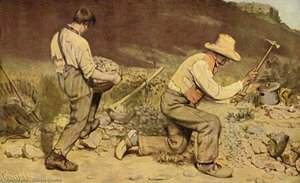
Courbet’s artistic breakthrough arrived with a deliberate rejection of Romantic conventions. He eschewed the theatrical grandeur favored by Delacroix and Géricault, opting for a starkly realistic portrayal of human experience. This decision wasn't merely stylistic; it represented a fundamental assertion about the dignity inherent in portraying commonplace existence. His early canvases explored landscapes and portraits, but soon focused on scenes of working-class life—executed on monumental scales traditionally reserved for historical or religious paintings. Consider The Stone Breakers (1849), tragically destroyed during World War II – an image that encapsulates Courbet’s revolutionary ethos. The painting depicts two laborers engaged in arduous toil, their faces obscured by exhaustion and grime; Courbet deliberately avoided romanticizing their plight, presenting them with unflinching honesty—a bold departure from the idealized depictions prevalent in academic circles. This uncompromising commitment to realism established him as a champion of artistic integrity and challenged the prevailing aesthetic sensibilities of his time.Notable Works and Artistic Philosophy
Courbet’s oeuvre is marked by an extraordinary range of subjects and stylistic approaches, reflecting his unwavering belief in the transformative power of art. Among his most celebrated paintings are A Burial at Ornans (1850-51), a monumental canvas depicting a rural funeral—a scene rendered with meticulous detail and devoid of sentimental embellishment. Its sheer scale—typically reserved for grand historical canvases—served as a deliberate provocation, signaling Courbet’s refusal to conform to artistic expectations. He championed the use of *impasto*, applying paint thickly onto the canvas surface, thereby emphasizing its materiality and capturing the textures of the natural world with remarkable accuracy. Similarly, The Painter's Studio (1855) is an allegorical masterpiece—a self-portrait that embodies Courbet’s artistic convictions and engages in a dialogue with contemporary social issues. He sought to convey not merely what he saw but also *how* he perceived the world—a perspective informed by his unwavering belief in the importance of truthful representation.Legacy and Influence
Gustave Courbet's impact on subsequent generations of artists is undeniable. His pioneering spirit ignited the flame of Realism, inspiring Impressionists and Post-Impressionists to liberate themselves from academic constraints and explore new avenues for artistic expression. He championed social justice through his art—a stance that resonated deeply with artists committed to confronting societal inequities. Courbet’s legacy extends beyond stylistic innovation; it embodies a profound philosophical commitment: the conviction that art should serve as a mirror reflecting the complexities of human experience, unafraid to confront uncomfortable truths and challenge prevailing ideologies. He died in 1877, leaving behind an artistic corpus that continues to captivate audiences worldwide—a testament to his enduring influence on the history of art and its ongoing capacity to provoke contemplation and inspire change.
Курбе
1819 - 1877 , Франция
Основные сведения
- Artistic Movement Or Style: Реализм
- Artists Or Movements Influenced By This Artist:
- Импрессионизм
- Послеимпрессионизм
- Artists Who Influenced This Artist:
- Эжен Делакруа
- Теодор Жерико
- Date Of Birth: 10 июня 1819 г.
- Date Of Death: 31 декабря 1877 г.
- Full Name: Gustave Courbet
- Nationality: Французский
- Notable Artworks:
- Сбор камней
- Похороны в Орнане
- Художественная мастерская
- Place Of Birth: Орланс, Франция
Похожие статьи
Реализм в живописи: 10 шедевров, изменивших искусство | OriginalUniqueArt.com
Погрузитесь в мир реализма! 10 шедевров Курбе, Милле, Мане и других великих художников. Узнайте историю создания культовых картин и вдохновитесь для интерьера с OriginalUniqueArt.com – музейное качество репродукций.
Топ-25 шедевров Ренуара: искусство, история и вдохновение для интерьера
Погрузитесь в мир Ренуара! 🎨 Откройте топ-25 шедевров импрессионизма, историю создания картин и вдохновляющую красоту. Купите репродукции высокого качества для вашего интерьера на OriginalUniqueArt.com – музейное искусство онлайн!
25 Шедевров Эрмитажа: Искусство для Вашего Дома | OriginalUniqueArt.com
Погрузитесь в мир искусства с 25 шедеврами Эрмитажа! Узнайте истории Рембрандта, Леонардо да Винчи и Вермеера. Репродукции картин для вашего дома – вдохновение и декор от OriginalUniqueArt.com. Откройте всю коллекцию онлайн!
Топ-25 шедевров Прадо: Искусство Веласкеса, Гойи и Эль Греко для вашего интерьера
Погрузитесь в мир шедевров Прадо! От Веласкеса до Гойи – история искусства Испании, барокко и знаменитые картины. Купите репродукции высокого качества для вашего интерьера на OriginalUniqueArt.com.
Марианна Норт: 25 Шедевров Художницы и Путешественницы | OriginalUniqueArt
Погрузитесь в мир ботанической живописи с Марианной Норт! 25 шедевров викторианской художницы, полных экзотических цветов и тропических пейзажей. Купить репродукции картин онлайн на OriginalUniqueArt – вдохновение для вашего интерьера!