Примерить в интерьере
 Отправить
 Поделиться
 Подробнее
 Руководство

 Скачать
 Похожие объекты
 Рентгенография
 Слайд-шоу
 Статистика
The Painter's Studio


 Развернуть текст
Жикле / Арт-принты
Печать (жикле) или холст музейного качества с быстрыми сроками изготовления и широким выбором вариантов отделки. ( Заказать репродукцию ручной работы Перейти к цифровым изображениям)




P118B $10

P118H $10

P118W $10

P438Z $10

P508JH $12

P508YH $12

P805H $10

P805Z $10

P919BZ $10

P919G $10

P919XJ $10

P959ZH $10

P968JZ $12

W106C $8

W218G $10

W218JH $8

W218Y $10

W307PJ $10

W316G $10

W316PJ $8

W316Y $10

W398PJ $8

W4111J $10

W500HY $15

W500JH $15

W692G $12

W849H $8

W940BG $15

W953PJ $8




Выберите один из наших стандартных размеров, соответствующих оригинальным пропорциям произведения искусства.

Введите необходимую ширину и высоту, чтобы репродукция подошла к вашей раме или стене. При печати изображение можно только уменьшить, но нельзя увеличить больше оригинала, поэтому при выборе другого формата часть изображения может быть обрезана. Перед печатью мы отправим вам цифровой макет на утверждение. Изображение на этой странице не отображает реальную обрезку — ее можно увидеть только на макете.
Доставка по всему миру () за 2 недели вместо стандартных 4–5 недель. (22 Октябрь)

Бесплатная экспресс-доставка по всему миру

Высококачественный льняной холст

Полное страхование при транспортировке

Гарантия возврата таможенных пошлин

Гарантия точного цветового соответствия

100-дневный период возврата (только при обнаружении дефектов)

Гарантия возврата 100% средств

Скидка при заказе нескольких работ
 Вариант со стеклом доступен только для размеров менее 110 см

The Painter's Studio
Жикле / Арт-принты
Размер репродукции
-


Итоговая стоимость
$ 80
A Bold Declaration of Realism: Gustave Courbet’s The Painter's Studio
Dr. Steven Zucker begins his exploration of Gustave Courbet’s monumental painting, “The Painter’s Studio,” by highlighting its significance within the broader artistic landscape of mid-19th century France. He emphasizes that Courbet’s decision to organize an independent exhibition—a defiant act against the restrictive conventions of the Académie des Beaux-Arts—was crucial in ensuring accessibility and fostering a dialogue about artistic expression beyond official channels. This bold move cemented Courbet's reputation as a revolutionary figure who championed realism, rejecting idealized representations for unflinching depictions of everyday life.- Subject Matter & Composition: The painting presents an ambitious tableau vivant—a “living picture”—featuring intellectuals and artists engaged in conversation within a cluttered studio space. Courbet meticulously populated the scene with figures representing diverse professions and social strata, including philosophers, critics, writers, a priest, a merchant, a hunter (symbolic of Napoleon III), and even a marginalized worker and child beggar. This deliberate inclusion wasn’t merely decorative; it served as a powerful commentary on societal inequalities.
- Stylistic Influences & Technique: Courbet's style draws inspiration from both Neoclassicism and Romanticism, yet decisively abandons their formal constraints. He employs a thick impasto technique—applying paint in heavy layers—creating textured surfaces that convey palpable physicality and immediacy. This tactile approach contrasts sharply with the polished smoothness favored by academic painters of the era.
Allegory & Symbolism: Decoding Courbet’s Manifesto
Beyond its realistic portrayal, “The Painter’s Studio” operates as a complex allegory exploring themes of artistic freedom and social responsibility. The central figure—Courbet himself—is surrounded by symbols representing truth (the nude woman), innocence (the child), and contemplation. Notably, the inclusion of instruments like a guitar and dagger serves to denounce academic art's perceived rigidity and moral conservatism. The figures positioned around Courbet represent various facets of intellectual life and societal values.
- The Figures: Each participant embodies a specific role or perspective—Alfred Bruchas, the art collector; Proudhon, the philosopher; Baudelaire, the poet—reflecting the intellectual currents of the time. The woman-muse symbolizes artistic inspiration and purity, while the cat represents independence and cunning.
- Symbolic Objects: Items like the guitar and dagger are deliberately placed to challenge established artistic dogma. They represent defiance against convention and a commitment to portraying reality without embellishment.
Historical Context & Significance
Painted in 1855, “The Painter’s Studio” arrived at a pivotal moment in art history—immediately following the rejection of Courbet's submission for the Universal Exhibition. This snub fueled his determination to showcase his work independently, establishing the Pavilion of Realism and demonstrating that artistic excellence could exist outside the confines of official patronage. The painting solidified Courbet’s position as a champion of realism and profoundly impacted subsequent generations of artists.
Emotional Impact & Artistic Legacy
Courbet's masterful depiction captures not only the visual details of the studio but also its atmosphere—a space brimming with intellectual curiosity and creative energy. The painting’s raw materiality and unflinching gaze invite viewers to confront uncomfortable truths about societal norms and artistic ambition. “The Painter’s Studio” remains a testament to Courbet’s unwavering conviction in portraying the world as he experienced it, securing his place as one of the most influential figures in modern art.
Вопросы и ответы
Где можно увидеть оригинал «The Painter's Studio», Курбе?
Картина «The Painter's Studio», Курбе представлена в коллекции Музей Орсе, Paris, France. В описании музея речь идет об оригинальном произведении, а не о репродукциях.
Для какого использования и в каком пространстве рекомендуется размещать «The Painter's Studio», Курбе?
Для «The Painter's Studio», Курбе указаны две рекомендации по использованию (Accent) и размещению в пространстве (Living Room).
Откуда приезжают посетители «The Painter's Studio», Курбе?
Для произведения «The Painter's Studio» доступна страница Статистика. На ней представлен график ежемесячных просмотров данного произведения и других работ автора с разбивкой по странам и языкам.
Биография художника
A Rebel’s Brush: The Life and Legacy of Gustave Courbet
Jean Désiré Gustave Courbet (1819-1877) stands as a monumental figure in the history of art, recognized unequivocally as the progenitor of Realism – a movement that irrevocably altered the trajectory of 19th-century painting. More than simply capturing visual impressions; his artistic endeavor was driven by a profound conviction: to depict the world precisely as he perceived it—unvarnished, brutally honest, and imbued with an unwavering regard for its tangible reality. His journey began in Ornans, France, a modest village that nurtured within him a spirit of defiance against the prevailing artistic dogma of his era.Early Life and Artistic Training
Courbet’s upbringing instilled in him a certain independence and intellectual curiosity—qualities that would prove instrumental in shaping his artistic vocation. Encouraged by his mother to pursue his passions, he embarked on formal training at the École des Beaux-Arts in Paris in 1839, yet swiftly recognized the limitations imposed by the academy’s adherence to Romantic idealism. While acknowledging influences from luminaries like Eugène Delacroix and Théodore Géricault—artists who wrestled with grand narratives of heroism and emotion—Courbet resolutely forged his own path, prioritizing observation over imaginative embellishment and truthfulness above convention. He wasn't seduced by the allure of mythological tales or idealized portraits; instead, he turned his gaze toward the everyday lives of ordinary individuals – laborers, peasants, and rural landscapes – subjects largely ignored by the artistic establishment of his time.The Birth of Realism: A Revolutionary Vision
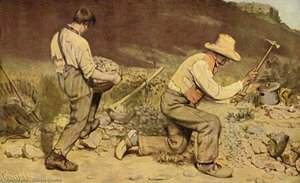
Courbet’s artistic breakthrough arrived with a deliberate rejection of Romantic conventions. He eschewed the theatrical grandeur favored by Delacroix and Géricault, opting for a starkly realistic portrayal of human experience. This decision wasn't merely stylistic; it represented a fundamental assertion about the dignity inherent in portraying commonplace existence. His early canvases explored landscapes and portraits, but soon focused on scenes of working-class life—executed on monumental scales traditionally reserved for historical or religious paintings. Consider The Stone Breakers (1849), tragically destroyed during World War II – an image that encapsulates Courbet’s revolutionary ethos. The painting depicts two laborers engaged in arduous toil, their faces obscured by exhaustion and grime; Courbet deliberately avoided romanticizing their plight, presenting them with unflinching honesty—a bold departure from the idealized depictions prevalent in academic circles. This uncompromising commitment to realism established him as a champion of artistic integrity and challenged the prevailing aesthetic sensibilities of his time.Notable Works and Artistic Philosophy
Courbet’s oeuvre is marked by an extraordinary range of subjects and stylistic approaches, reflecting his unwavering belief in the transformative power of art. Among his most celebrated paintings are A Burial at Ornans (1850-51), a monumental canvas depicting a rural funeral—a scene rendered with meticulous detail and devoid of sentimental embellishment. Its sheer scale—typically reserved for grand historical canvases—served as a deliberate provocation, signaling Courbet’s refusal to conform to artistic expectations. He championed the use of *impasto*, applying paint thickly onto the canvas surface, thereby emphasizing its materiality and capturing the textures of the natural world with remarkable accuracy. Similarly, The Painter's Studio (1855) is an allegorical masterpiece—a self-portrait that embodies Courbet’s artistic convictions and engages in a dialogue with contemporary social issues. He sought to convey not merely what he saw but also *how* he perceived the world—a perspective informed by his unwavering belief in the importance of truthful representation.Legacy and Influence
Gustave Courbet's impact on subsequent generations of artists is undeniable. His pioneering spirit ignited the flame of Realism, inspiring Impressionists and Post-Impressionists to liberate themselves from academic constraints and explore new avenues for artistic expression. He championed social justice through his art—a stance that resonated deeply with artists committed to confronting societal inequities. Courbet’s legacy extends beyond stylistic innovation; it embodies a profound philosophical commitment: the conviction that art should serve as a mirror reflecting the complexities of human experience, unafraid to confront uncomfortable truths and challenge prevailing ideologies. He died in 1877, leaving behind an artistic corpus that continues to captivate audiences worldwide—a testament to his enduring influence on the history of art and its ongoing capacity to provoke contemplation and inspire change.
Курбе
1819 - 1877 , Франция
Краткая справка
- Artistic Movement Or Style: Реализм
- Artists Or Movements Influenced By This Artist:
- Импрессионизм
- Послеимпрессионизм
- Artists Who Influenced This Artist:
- Эжен Делакруа
- Теодор Жерико
- Date Of Birth: 10 июня 1819 г.
- Date Of Death: 31 декабря 1877 г.
- Full Name: Gustave Courbet
- Nationality: Французский
- Notable Artworks:
- Сбор камней
- Похороны в Орнане
- Художественная мастерская
- Place Of Birth: Орланс, Франция
Похожие статьи

Romantic Realism's Finest: 10 Masterpieces for Your Home | OriginalUniqueArt
Explore 10 defining masterpieces of Romantic Realism! Discover Courbet, Millet & Daumier's powerful paintings—capturing emotion and social realities. Find museum-quality reproductions for your home at OriginalUniqueArt.com.
Реализм в живописи: 10 шедевров, вдохновляющих на декор интерьера
Погрузитесь в мир реализма! От Courbet до Manet – 10 величайших картин, отражающих жизнь и эмоции. Узнайте историю шедевров и вдохновитесь для создания уникального интерьера с OriginalUniqueArt.com. Explore the full collection online!
Реализм в живописи: 10 шедевров, изменивших искусство | OriginalUniqueArt.com
Погрузитесь в мир реализма! 10 шедевров Курбе, Милле, Мане и других великих художников. Узнайте историю создания культовых картин и вдохновитесь для интерьера с OriginalUniqueArt.com – музейное качество репродукций.
25 Шедевров Густава Климта: Искусство, Декор и Золотой Век Австрийского Модерна
Погрузитесь в мир Густава Климта! 25 шедевров австрийского модерна, символизма и золотой живописи. Узнайте истории создания знаменитых картин Климта и вдохновитесь для декора интерьера. Репродукции музейного качества на OriginalUniqueArt.com.
Gustave Courbet: Realism's Revolutionary Vision & the Social Canvas of 19th-Century France
Explore the revolutionary art of Gustave Courbet, pioneer of Realism. Discover his iconic paintings, social commentary, and lasting impact on 19th-century French art history. Expert analysis & insights.