 Заказать принт Купить цифровое изображение
 Поделиться
 Поделиться
 Детали произведения
 Добавить в избранное

 Скачать
 Похожие работы
 Рентгенография
 Слайд-шоу
Angling
 Acrylic On Canvas
- WallArt
- Realism
 1878
1878- 19th Century
 100.0 x 75.0 cm
 Читать далее
Масляная репродукция ручной работы
Картина маслом на холсте в выбранном вами размере и раме, написанная на заказ нашими художниками.




P118B $10

P118H $10

P118W $10

P438Z $10

P508JH $12

P508YH $12

P805H $10

P805Z $10

P919BZ $10

P919G $10

P919XJ $10

P959ZH $10

P968JZ $12

W106C $8

W218G $10

W218JH $8

W218Y $10

W307PJ $10

W316G $10

W316PJ $8

W316Y $10

W398PJ $8

W4111J $10

W500HY $15

W500JH $15

W692G $12

W849H $8

W940BG $15

W953PJ $8




Выберите один из наших стандартных размеров, соответствующих оригинальным пропорциям произведения искусства.

Вы можете указать собственные размеры, чтобы картина идеально вписалась в выбранную раму или пространство. Если выбранный вами размер не соответствует пропорциям оригинала, мы либо обрежем полотно, либо расширим его за счет дополнительных элементов, написанных вручную. Цифровой макет будет отправлен вам на утверждение перед началом производства.
Обратите внимание, что предварительный просмотр на экране не отражает фактическую обрезку или расширение. Только макет точно покажет окончательную композицию.
Хотя доступны индивидуальные размеры, мы рекомендуем выбирать вариант из предопределенного списка, чтобы сохранить исходные пропорции.
После оформления заказа команда OriginalUniqueArt.com свяжется с клиентом по электронной почте для уточнения деталей и предоставит предварительный макет
Доставка по всему миру () за 3–4 недели вместо стандартных 5 недель. (21 Июль). Без компромиссов в качестве.

Бесплатная экспресс-доставка по всему миру

Высококачественный льняной холст

Полное страхование доставки

Гарантия возмещения таможенных пошлин

Гарантия точного соответствия цветов

Политика возврата в течение 60 дней (только при наличии дефектов)

Гарантия возврата 100% средств

Предложение оптовых скидок
 Вариант со стеклом доступен только для размеров менее 110 см

Angling
Техника репродукции
Размер репродукции
-


Итоговая стоимость
-
Описание произведения
Gustave Caillebotte’s “Angling”: A Snapshot of Parisian Leisure
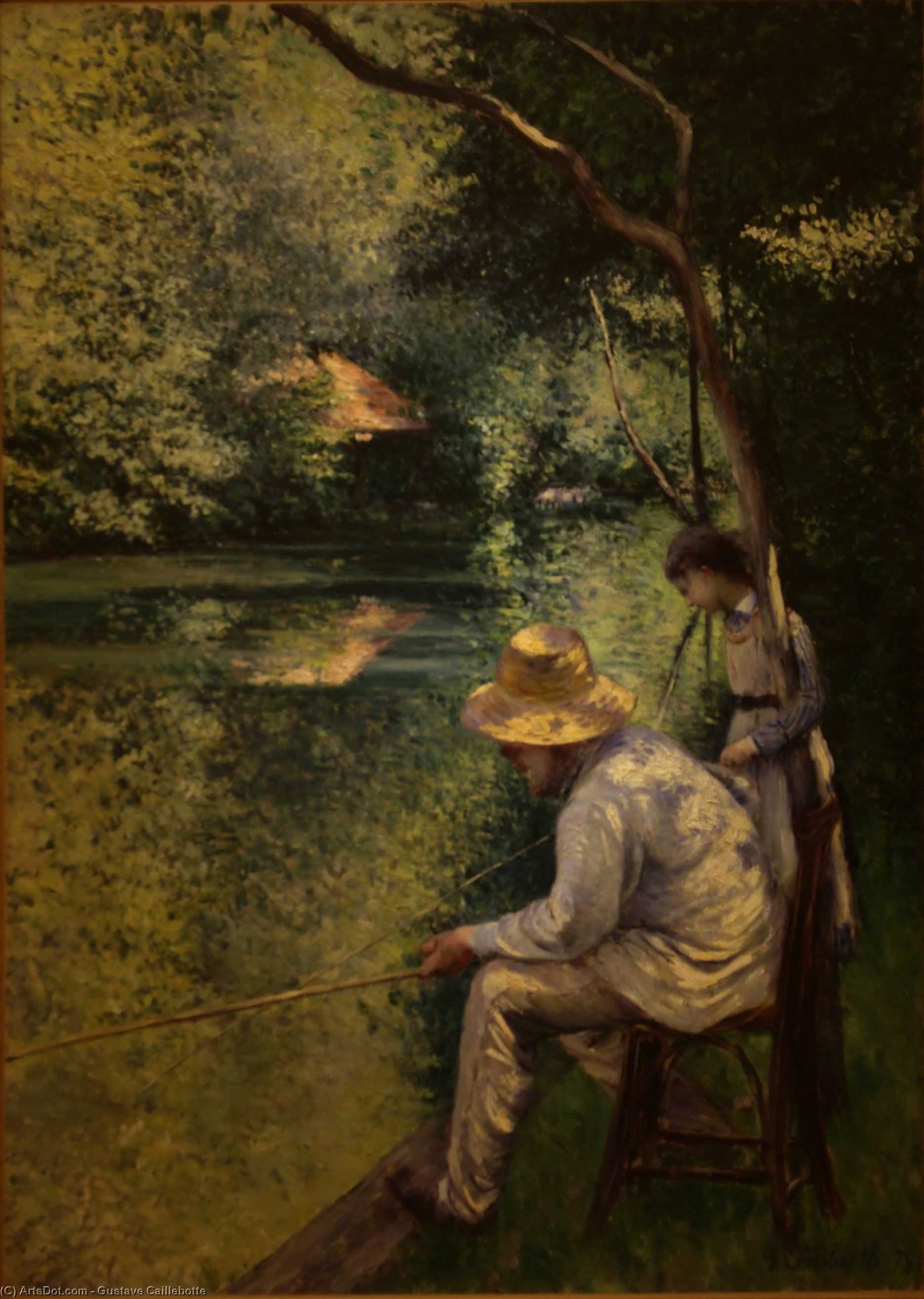
Angling, painted in 1878, offers a remarkably intimate glimpse into the burgeoning leisure culture of late nineteenth-century Paris. Executed by Gustave Caillebotte, a pivotal figure of the Impressionist movement yet distinctly his own, this work transcends a simple depiction of two individuals fishing; it’s a carefully constructed tableau that speaks volumes about social life, artistic innovation, and the evolving relationship between art and modernity.
- Subject Matter: The scene unfolds along the banks of a tranquil river, capturing a quintessential Parisian pastime – angling. Two figures, a man and a woman, are engaged in this activity, their postures relaxed and suggesting a shared moment of quiet enjoyment.
- Composition: Caillebotte’s masterful composition utilizes a shallow depth of field, characteristic of his engagement with photography, to draw the viewer into the scene. The placement of the figures, the strategically positioned chairs and bench, and the framing by the surrounding trees create a sense of immediacy and invite participation.
Technique and Artistic Innovation
Caillebotte’s technique is both precise and subtly impressionistic. He employs short, broken brushstrokes – a direct influence from his early fascination with photography – to render the textures of the riverbank, the clothing of the figures, and the foliage. The use of light and shadow is particularly noteworthy, creating a luminous quality that enhances the sense of atmosphere. Unlike many of his contemporaries who sought to capture fleeting moments in vibrant color, Caillebotte favors a more subdued palette, dominated by earthy tones – browns, greens, and blues – reflecting the natural environment.
His approach reflects a key shift within Parisian art circles at this time. While Impressionists were pushing boundaries with bold color and loose brushwork, Caillebotte demonstrated an ability to combine these influences with a rigorous attention to detail and perspective, reminiscent of academic training but filtered through a distinctly modern sensibility.
Historical Context and Symbolism
Painted in 1878, “Angling” reflects the growing importance of leisure activities within Parisian society. The rise of industrialization had created a new class of wealthy individuals who sought escape from the pressures of urban life. Fishing became a popular pastime, offering an opportunity for relaxation and social interaction. The inclusion of both a man and a woman suggests a depiction of bourgeois domesticity – a carefully constructed image of respectability and refinement.
Furthermore, Caillebotte’s interest in photography is evident in the painting's precise composition and attention to detail. This fascination with the medium would become increasingly central to his artistic practice, influencing his approach to subject matter, perspective, and ultimately, his unique visual language.
Emotional Impact and Aesthetic Value
“Angling” possesses a quiet charm that resonates deeply. It’s not a dramatic or overtly emotional scene, but rather one imbued with a sense of tranquility and understated beauty. The painting invites the viewer to contemplate the simple pleasures of life – the connection between people and nature, the pursuit of leisure, and the enduring appeal of a timeless activity. This 100 x 75 cm reproduction captures the essence of Caillebotte’s vision with exceptional fidelity, offering an ideal addition to any discerning collection or a captivating element for interior design.
Биография художника
A Parisian of the New Age: The Life and Art of Gustave Caillebotte
Gustave Caillebotte, born in Paris in 1848, was an artist uniquely positioned to witness – and then capture – the dramatic transformations sweeping across his beloved city. His father, Martial Caillebotte, a successful textile merchant and respected judge, provided not only financial stability but also a privileged vantage point from which to observe the burgeoning modernity of Paris. This upbringing instilled in Gustave a keen awareness of social change and an appreciation for the evolving urban landscape – themes that would become central to his artistic vision. Initially pursuing a path in law, earning degrees at the Sorbonne, Caillebotte’s true passion lay within the realm of art. He began formal training under Léon Bonnat, a respected academic painter, immersing himself in traditional techniques while simultaneously developing an intense fascination with photography – a relatively new medium that was rapidly changing how images were captured and perceived. This early exposure to photographic principles—its precise framing, its ability to freeze fleeting moments, and the way it presented perspective—would profoundly influence his distinctive style, shaping his approach to composition and visual storytelling. Caillebotte wasn’t simply documenting change; he was actively engaging with the aesthetic possibilities inherent in this dynamic era.Realism Meets Impressionist Light
Caillebotte's artistic journey diverged significantly from the rigid conventions of academic painting, yet he never fully embraced the purely optical explorations championed by many of his Impressionist contemporaries. He found a kindred spirit in artists like Edgar Degas and Giuseppe de Nittis, both of whom shared a fascination with modern life but approached it through distinct lenses. Caillebotte’s early masterpiece, Les Raboteurs de Parquet (The Floor Scrapers), exhibited at the 1875 Salon, immediately established his reputation as a bold and unconventional painter. This work, depicting three laborers meticulously scraping a wooden floor in a dimly lit workshop, was a deliberate departure from the idealized subjects typically favored by the Salon. The composition—cropped tightly, almost jarringly direct, and devoid of sentimental embellishment—shocked some viewers while captivating others. It wasn’t merely the subject matter – the depiction of working-class laborers rarely graced the canvases of high art – but also the unflinching honesty with which Caillebotte rendered their toil. This commitment to portraying contemporary life without resorting to romanticization or idealization became a defining characteristic of his work. He continued this exploration in paintings like View of Rooftops (Snow), where he masterfully captured the muted tones and atmospheric effects of a Parisian winter, utilizing techniques borrowed from photography to create a sense of depth and spatial ambiguity.A Patron of Innovation: Supporting the Impressionists
Beyond his own artistic pursuits, Gustave Caillebotte played an unexpectedly significant role in fostering the development of the Impressionist movement. His family’s considerable wealth—inherited after his father's death—provided him with a level of financial independence that allowed him to support and champion other artists who were struggling to gain recognition within the established art world. He became a generous patron, purchasing works by Claude Monet, Pierre-Auguste Renoir, Camille Pissarro, and many others – often at a time when these artists’ work was being rejected by the conservative Salon jury. Caillebotte wasn't simply accumulating artwork; he actively promoted the Impressionist cause, organizing and financing several of their exhibitions, effectively providing them with a platform to showcase their innovative techniques and perspectives. His involvement extended beyond mere financial support; he genuinely admired the artists’ willingness to challenge conventional artistic norms and capture the fleeting moments of modern life. This dedication to fostering innovation within the art world is a testament to his progressive spirit and his belief in the power of artistic experimentation.Capturing Modern Paris: Composition and Perspective
Caillebotte's unique approach to composition and perspective further distinguished his work from that of many of his contemporaries. He was particularly influenced by Japanese prints, which he studied with great interest, appreciating their flattened perspectives, asymmetrical arrangements, and emphasis on everyday subjects. This influence is evident in paintings like Boulevard vu d’en haut (Boulevard Seen from Above), a remarkably modern composition that captures the bustling energy of a Parisian boulevard from an elevated vantage point. The cropped view, dynamic lines, and sense of movement create a powerful impression of urban life – anticipating techniques that would later be employed by photographers and modernist painters. Furthermore, Caillebotte’s early exposure to photography informed his use of light and shadow, allowing him to capture the subtle nuances of color and atmosphere with remarkable precision. His paintings are not simply representations of reality; they are carefully constructed visual narratives that invite viewers to contemplate the complexities of modern Parisian life.Legacy and Rediscovery
For decades following his death in 1894, Caillebotte’s work remained largely overlooked by the art world. His paintings were primarily held within his family's collection and rarely exhibited or reproduced. It wasn’t until the late 20th century that a renewed appreciation for his artistic vision began to emerge, fueled by scholarly research and major exhibitions. Today, Gustave Caillebotte is recognized as a pivotal figure in 19th-century art – an artist who seamlessly blended realism with Impressionist techniques, pioneered innovative compositional strategies, and captured the spirit of a rapidly changing Paris. His paintings offer a unique window into the urban landscape of his time, revealing both the beauty and the challenges of modern life. Caillebotte’s legacy continues to grow as scholars and art enthusiasts alike rediscover the depth and originality of his remarkable body of work.
Густав Кайботт
1848 - 1894 , Франция
Основные сведения
- Artistic Movement Or Style: Реализм, Импрессионизм
- Artists Or Movements Influenced By This Artist: ['Импрессионизм']
- Artists Who Influenced This Artist:
- Дега
- Нитиссе
- Date Of Birth: 19 августа 1848 г.
- Date Of Death: 21 февраля 1894 г.
- Full Name: Gustave Caillebotte
- Nationality: Француз
- Notable Artworks:
- Лесрабы Caillebotte
- Вид на крыши (снег)
- Бульвар с высоты
- Place Of Birth: Париж, Франция
Похожие статьи
Топ-25 шедевров Метрополитен-музея: искусство для вашего дома с OriginalUniqueArt
Погрузитесь в мир искусства! Топ-25 шедевров Метрополитен-музея – Ван Гог, Моне, Рембрандт и другие великие художники. Репродукции картин для вашего дома с OriginalUniqueArt.com. Вдохновение и декор стен.

25 Шедевров Данте Габриэля Россетти: Искусство, Символизм и Декор для Вашего Дома
Погрузитесь в мир Данте Габриэля Россетти! 25 шедевров прерафаэлитов, полных символизма и страсти. Узнайте истории создания культовых картин и найдите идеальный декор для вашего дома на OriginalUniqueArt.com – музейное качество, вдохновение и искусство онлайн.

Джеймс Уистлер: Топ-25 шедевров художника для ценителей искусства и декора
Погрузитесь в мир Джеймса Уистлера! Топ-25 шедевров художника, от знаменитых ноктюрнов до изысканных портретов. Узнайте историю создания и эстетику каждой картины. Репродукции высокого качества для вашего интерьера на OriginalUniqueArt.com.
25 Шедевров Национальной Галереи Искусств: Открывая Величие Живописи с OriginalUniqueArt
Откройте для себя 25 шедевров Национальной галереи искусств! Узнайте истории Сезанна, Матисса и других великих художников. Вдохновение для интерьера и репродукции картин высокого качества на OriginalUniqueArt.com.

Альфред Муннингс: 25 шедевров британского импрессионизма для вашего интерьера | OriginalUniqueArt
Погрузитесь в мир Альфреда Муннингса! 25 шедевров британского импрессионизма, запечатлевших красоту лошадей и сельской Англии. Репродукции картин высокого качества для вашего интерьера на OriginalUniqueArt.com.