
 Предпросмотр
 Поделиться
 Поделиться
 Детали произведения
 Руководство

 Скачать
 Похожие предметы
 Рентгенография
 Слайд-шоу
 Вопросы и ответы
 Статистика просмотров
Fern Walk


 Читать далее
Жикле и арт-принты
Печать (жикле) или холст музейного качества с быстрыми сроками изготовления и широким выбором вариантов отделки. ( Купить картину ручной работы Перейти к цифровым изображениям)




P118B $10

P118H $10

P118W $10

P438Z $10

P508JH $12

P508YH $12

P805H $10

P805Z $10

P919BZ $10

P919G $10

P919XJ $10

P959ZH $10

P968JZ $12

W106C $8

W218G $10

W218JH $8

W218Y $10

W307PJ $10

W316G $10

W316PJ $8

W316Y $10

W398PJ $8

W4111J $10

W500HY $15

W500JH $15

W692G $12

W849H $8

W940BG $15

W953PJ $8




Выберите один из наших стандартных размеров, соответствующих оригинальным пропорциям произведения искусства.

Введите необходимую ширину и высоту, чтобы репродукция подошла к вашей раме или стене. При печати изображение можно только уменьшить, но нельзя увеличить больше оригинала, поэтому при выборе другого формата часть изображения может быть обрезана. Перед печатью мы отправим вам цифровой макет на утверждение. Изображение на этой странице не отображает реальную обрезку — ее можно увидеть только на макете.
Доставка по всему миру () за 2 недели вместо стандартных 4–5 недель. (4 Ноябрь)

Бесплатная экспресс-доставка по всему миру

Высококачественный льняной холст

Полное страхование при доставке

Гарантия возмещения таможенных пошлин

Гарантия точного цветового соответствия

100-дневная гарантия возврата (только при обнаружении дефектов)

Гарантия возврата 100% средств

Скидка при оптовом заказе
 Вариант со стеклом доступен только для размеров менее 110 см

Fern Walk
Жикле и арт-принты
Размер репродукции
-


Итоговая стоимость
$ 81
A Verdant Passage Through Time: Exploring Frederic Edwin Church's Fern Walk
To gaze upon Frederic Edwin Church’s Fern Walk is to step across the threshold of time and into a realm saturated with emerald life. This magnificent canvas, painted in 1865, is far more than a mere depiction of foliage; it is an immersive meditation on nature's enduring majesty. The air itself seems thick with the scent of damp earth and blooming life as one follows the winding path suggested by the composition. Church, a towering figure of the Hudson River School, possessed an almost spiritual connection to the American landscape, translating its grandeur onto canvas with breathtaking skill. Here, the lushness is overwhelming—a tapestry woven from countless shades of green that speak to vitality and deep, untamed growth.
Mastery in Light and Shadow: Technique and Composition
Observe how Church manipulates light not just as illumination, but as a palpable element within the scene. The interplay between sun-dappled patches and cool, mysterious shadows lends an incredible depth to the forest floor. This masterful use of chiaroscuro draws the eye inexorably deeper into the painting, following the gentle curve of the pathway. The composition is inherently inviting; it promises discovery around every bend. While the backdrop hints at towering mountains—a reminder of nature’s colossal scale—the immediate foreground remains intimate, drawing the viewer close enough to appreciate the delicate structure of ferns and the subtle blush of unseen blossoms. The technique employed in this oil on canvas work speaks to a meticulous hand, where every leaf placement feels deliberate, contributing to an overall sense of harmonious balance.
The Symbolism of the Natural World
For the connoisseur of art history, Fern Walk resonates with profound symbolism. The path itself is a classic artistic trope: it represents the journey of life, the passage from one state of being to another. Surrounded by such abundant, thriving plant life—the ferns symbolizing resilience and enduring beauty—the painting whispers tales of renewal. Furthermore, the slightly brooding, cloudy sky above suggests both the mystery inherent in nature’s cycles and a sublime anticipation, as if the very moment before a gentle rain is about to cleanse and revitalize the scene. It captures that perfect, suspended breath between moments.
Bringing the Wilderness Home: For the Modern Collector
For those seeking to infuse their living space with the quiet drama of the American wilderness, this reproduction offers an unparalleled opportunity. The muted yet rich palette, dominated by earthy tones and deep greens, allows Fern Walk to serve as a breathtaking focal point in any room—be it a formal drawing-room or a serene study. Owning a piece echoing Church’s vision means acquiring not just decoration, but a tangible connection to the Romantic ideals of American landscape painting. It is an artwork that calms the hurried spirit, inviting contemplation and reminding us of the enduring, quiet wonder found in simply walking through a beautiful forest.
Вопросы и ответы
Могу ли я рассмотреть «Fern Walk» более детально?
«Fern Walk» можно изучить слой за слоем на странице Рентгеновское исследование, представляющей собой интерактивный просмотрщик, вдохновленный реставрационным световым столом, с одиннадцатью оптическими пластами изображения.
В каком году было создано произведение «Fern Walk», Фредерик Эдвин Керш?
«Fern Walk», Фредерик Эдвин Керш был создан в 1865 году.
В какой технике выполнено произведение «Fern Walk», Фредерик Эдвин Керш?
Для создания «Fern Walk» Фредерик Эдвин Керш использовал(а) технику Oil On Canvas. Эта техника определяет материальную природу оригинального произведения.
Биография художника
A Pioneer of American Landscape: The Life and Art of Frederic Edwin Church
Frederic Edwin Church, born in Hartford, Connecticut, on May 4th, 1826, emerged as a pivotal figure in the blossoming landscape tradition of 19th-century America. His lineage was steeped in New England history—a direct descendant of Puritan pioneers—and his family’s prosperity afforded him opportunities rare for aspiring artists of the time. This financial stability allowed Church to dedicate himself wholeheartedly to his artistic pursuits, a path that would ultimately lead him to become one of the most celebrated and influential painters of the Hudson River School. His early training began at the age of eighteen under the tutelage of Thomas Cole, the very founder of this distinctly American art movement. These formative years spent in Catskill, New York, were crucial, instilling in Church a deep reverence for nature and a commitment to capturing its grandeur on canvas. The apprenticeship wasn’t merely technical; it was an immersion into a philosophy that saw landscape not just as scenery, but as a reflection of the divine and a symbol of national identity.The Rise of a Master: Style and Influences
Church quickly distinguished himself from his contemporaries through a remarkable ability to blend meticulous realism with a romantic sensibility. His paintings are characterized by an astonishing level of detail, capturing the textures of foliage, the play of light on water, and the imposing scale of mountains with breathtaking accuracy. He meticulously rendered every leaf, every ripple, every shadow, creating images that seemed almost photographic in their precision. However, this wasn’t simply photographic representation; Church infused his work with a dramatic flair, employing sweeping panoramic views, vibrant color palettes—often utilizing a technique called “lost and found edges” to create an illusion of depth—and a masterful command of atmospheric perspective. He was deeply influenced by the scientific explorations of Alexander von Humboldt, whose writings on the interconnectedness of nature resonated profoundly with the artist. Church saw in Humboldt’s observations a way to bridge the gap between art and science, believing that painting could not only depict beauty but also convey complex ecological relationships. This influence is evident in his later expeditions to South America and his attempts to capture the grandeur and diversity of those landscapes—from towering volcanoes to lush rainforests. His paintings often featured dramatic lighting effects, simulating the golden hour or the ethereal glow of twilight, further enhancing their emotional impact.Ventures into the Wild: Travels and Major Works
Church’s ambition extended beyond the familiar landscapes of New England and New York. Driven by a thirst for firsthand experience and inspired by Humboldt's writings, he embarked on daring expeditions to remote corners of the world. These journeys—to South America in 1853 and 1857, and later to the Arctic regions—provided him with an unparalleled wealth of visual material. The Heart of the Andes, completed in 1859, is perhaps his most ambitious undertaking, a monumental canvas that sought to encapsulate the entire ecosystem of the Andean mountains. The painting was exhibited in a specially constructed gallery, illuminated by skylights, creating an immersive experience for viewers and solidifying Church’s reputation as a master showman as well as an artist. The sheer scale of the work—nearly ten feet wide—and its intricate detail demanded that visitors approach it with reverence, almost as if entering another world. Similarly, his series of paintings inspired by his Arctic travels, such as *Icebergs: The North* (1872), demonstrated his versatility and willingness to tackle challenging subjects. These works weren’t merely depictions of remote landscapes; they were statements about the power and fragility of nature, reflecting a growing environmental consciousness in the mid-19th century. He meticulously documented the shifting ice formations, capturing their immense size and the dramatic interplay of light and shadow.A New Approach to Exhibition: The Power of Spectacle
Church revolutionized the way art was presented by staging his major works as special events rather than simply hanging them in galleries. He understood that a painting could be more than just an object; it could be an experience. His exhibition of *The Heart of the Andes* in New York City in 1859, for example, was a sensation—drawing over twelve thousand visitors and generating enormous public excitement. The gallery itself was designed to enhance the viewing experience, with darkened walls and strategically placed skylights that mimicked the natural light of the Andean mountains. Church’s approach challenged the traditional model of art appreciation, transforming it into a communal event. He effectively created “art as spectacle,” captivating audiences with his dramatic presentations and solidifying his position as one of the most popular artists of his time.Legacy and Impact on American Art
Frederic Edwin Church’s influence on American landscape painting is undeniable. He elevated the genre to new heights of artistic achievement and popular acclaim, inspiring generations of artists to explore the beauty and majesty of the natural world. His innovative exhibition practices—presenting single paintings in dramatic settings—set a precedent for future art displays and helped to cultivate a broader public appreciation for art. Beyond his painting, Church was also a dedicated conservationist, advocating for the preservation of Niagara Falls and playing a role in the establishment of national parks. He understood that art could be a powerful tool for raising awareness about environmental issues and inspiring action. His home, Olana, designed and built with his own hands overlooking the Hudson River, stands as a testament to his artistic vision and his deep connection to the landscape.- Church’s work bridged the gap between Romanticism and Realism.
- He pioneered immersive exhibition techniques that captivated audiences.
- His advocacy for conservation foreshadowed the modern environmental movement.

Фредерик Эдвин Керш
1826 - 1900 , США
Об авторе
- Artistic Movement Or Style: Художественная школа Гудзон
- Artists Or Movements Influenced By This Artist: ['Американская живопись пейзажа']
- Artists Who Influenced This Artist:
- Томас Коул
- А. фон Гумбольдт
- Date Of Birth: 4 мая 1826 г.
- Date Of Death: 7 апреля 1900 г.
- Full Name: Фредерик Эдвин Керш
- Nationality: Американский
- Notable Artworks:
- Оксбоу
- Сердце Андes
- Ледяные глыбы
- Place Of Birth: Гартифорд, США
Похожие статьи
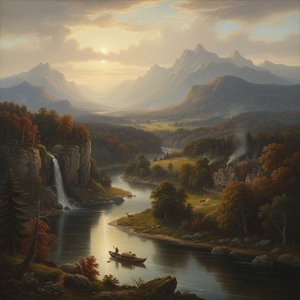
Capturing the American Spirit: A Journey Through Iconic Landscapes and the Legacy of the Hudson River School
Explore the profound beauty of American art history. From the Hudson River School to iconic landscapes, discover a curated journey through the masterpieces that defined a nation's spirit and the enduring legacy of American Romanticism.
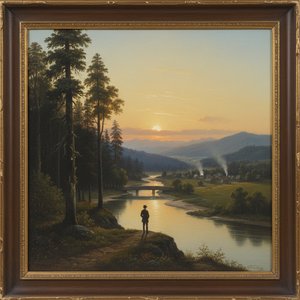
Robert Spencer: Luminism, Narrative & the American Landscape Tradition
Explore the captivating world of Luminism & the Hudson River School with our expert analysis. Discover the history, artists, and enduring beauty of 19th-century American landscape painting. Find museum-quality reproductions at OriginalUniqueArt.

Wild & Untamed: The High-Impact Energy of American Romanticism and the Hudson River School
Experience the raw power of American Romanticism. Explore the high-impact energy of the Hudson River School through premium, hand-painted oil reproductions that capture the sublime beauty and untamed spirit of the American wilderness for discerning collectors.
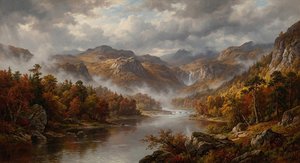
Школа реки Гудзон: 10 шедевров, изменивших американскую живопись | OriginalUniqueArt
Погрузитесь в мир Школы реки Гудзон! 10 шедевров Томаса Коула, Фредерика Чёрча и других мастеров американского романтизма. Купите репродукции картин высокого качества для вашего интерьера на OriginalUniqueArt.com.
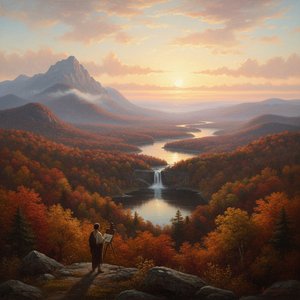
The Sublime Landscape: Exploring the Hudson River School Movement
Explore the captivating world of the Hudson River School! Discover the history, artists, and defining characteristics of this iconic American art movement. Learn about Romanticism's influence & find inspiration for your collection.


