Меню

() ·

A painting made for you, by hand

Масляная репродукция ручной работы

Картина маслом на холсте в выбранном вами размере и раме, написанная на заказ нашими художниками. ( Переключиться на печать Перейти к цифровым изображениям)

Описание предмета

Franz Marc's 'The Monkey' (1912) is an Expressionist masterpiece capturing innocence and nature’s energy. Explore its symbolism, vibrant colors, and connection to a pivotal art movement. Own a stunning reproduction today!

Биография художника

Фрэнк Марк (1880-1916) – немецкий экспрессионист, известный своими яркими живописными лошадьми и сине-голубым «Голубым Рейдером». Его работы полны духовности и символизма.

from ·

Chapter 1

How large should it be?

Slide to change the size; the wall on the left shows it at its real scale. The proportions of the original are kept.

Стандартный размер
индивидуальный заказ
CM
INCH

Выберите один из наших стандартных размеров, соответствующих оригинальным пропорциям произведения искусства.

ширина
высота

Введите необходимую ширину и высоту, чтобы репродукция подошла к вашей раме или стене. Поскольку работа выполняется вручную, при изменении пропорций художник может немного увеличить область вокруг картины или, наоборот, обрезать края — выбор за вами. Перед началом работы мы пришлем вам цифровой макет на утверждение. Изображение на этой странице не является точным результатом — увидеть реальный вид можно только на макете.

Chapter 2

How should it arrive?

Choose the edges of the stretched canvas

Choose your frame

Corner sample of the WhiteWrap canvas edge finish, stretched on массив дерева bars
White $1
Corner sample of the BlurSideWrap canvas edge finish, stretched on массив дерева bars
Blurside $1
Corner sample of the ExtendedWrap canvas edge finish, stretched on массив дерева bars
Extended $1
Corner sample of the P118B picture frame: формованный полистирол, 5 cm wide and 3 cm thick
P118B $10
Corner sample of the P118H picture frame: формованный полистирол, 5 cm wide and 3 cm thick
P118H $10
Corner sample of the P118W picture frame: формованный полистирол, 5 cm wide and 3 cm thick
P118W $10
Corner sample of the P438Z picture frame: формованный полистирол, 5.5 cm wide and 3.5 cm thick
P438Z $10
Corner sample of the P508JH picture frame: формованный полистирол, 7 cm wide and 3.5 cm thick
P508JH $12
Corner sample of the P508YH picture frame: формованный полистирол, 7 cm wide and 3.5 cm thick
P508YH $12
Corner sample of the P805H picture frame: формованный полистирол, 5 cm wide and 3.5 cm thick
P805H $10
Corner sample of the P805Z picture frame: формованный полистирол, 5 cm wide and 3.5 cm thick
P805Z $10
Corner sample of the P919BZ picture frame: формованный полистирол, 7 cm wide and 3.5 cm thick
P919BZ $10
Corner sample of the P919G picture frame: формованный полистирол, 7 cm wide and 3.5 cm thick
P919G $10
Corner sample of the P919XJ picture frame: формованный полистирол, 7 cm wide and 3.5 cm thick
P919XJ $10
Corner sample of the P959ZH picture frame: формованный полистирол, 5 cm wide and 3 cm thick
P959ZH $10
Corner sample of the P968JZ picture frame: формованный полистирол, 6 cm wide and 4 cm thick
P968JZ $12
Corner sample of the W106C picture frame: массив дерева, 5 cm wide and 3 cm thick
W106C $8
Corner sample of the W218G picture frame: массив дерева, 5 cm wide and 3 cm thick
W218G $10
Corner sample of the W218JH picture frame: массив дерева, 5 cm wide and 3 cm thick
W218JH $8
Corner sample of the W218Y picture frame: массив дерева, 5 cm wide and 3 cm thick
W218Y $10
Corner sample of the W307PJ picture frame: массив дерева, 6 cm wide and 3 cm thick
W307PJ $10
Corner sample of the W316G picture frame: массив дерева, 6 cm wide and 3 cm thick
W316G $10
Corner sample of the W316PJ picture frame: массив дерева, 6 cm wide and 3 cm thick
W316PJ $8
Corner sample of the W316Y picture frame: массив дерева, 6 cm wide and 3 cm thick
W316Y $10
Corner sample of the W398PJ picture frame: массив дерева, 5 cm wide and 3 cm thick
W398PJ $8
Corner sample of the W4111J picture frame: массив дерева, 6.5 cm wide and 3.5 cm thick
W4111J $10
Corner sample of the W500HY picture frame: массив дерева, 7 cm wide and 5 cm thick
W500HY $15
Corner sample of the W500JH picture frame: массив дерева, 7 cm wide and 5 cm thick
W500JH $15
Corner sample of the W692G picture frame: массив дерева, 8 cm wide and 4 cm thick
W692G $12
Corner sample of the W849H picture frame: массив дерева, 5 cm wide and 3 cm thick
W849H $8
Corner sample of the W940BG picture frame: массив дерева, 7.5 cm wide and 4.5 cm thick
W940BG $15
Corner sample of the W953PJ picture frame: массив дерева, 6 cm wide and 3.5 cm thick
W953PJ $8
Corner sample of the H24-GOLD picture frame: резное дерево с левкасом, 10 cm wide and 6 cm thick
H24-GOLD $30
Corner sample of the H24-SILVER picture frame: резное дерево с левкасом, 10 cm wide and 6 cm thick
H24-SILVER $30
Corner sample of the H36-GOLD picture frame: резное дерево с левкасом, 15 cm wide and 6.5 cm thick
H36-GOLD $45
Corner sample of the H36-SILVER picture frame: резное дерево с левкасом, 15 cm wide and 6.5 cm thick
H36-SILVER $45
Предпросмотр в раме
В раме

Moulding: . Overall size with the frame: .

Chapter 3

Who paints it, and should anything change?

Examples of what can be changed: Replace face with customer photo; Add pet (e.g., replace cat with dog); Include hidden message in background; Change background landscape or elements.
After order, OriginalUniqueArt.com team will email client for instructions and provide a mockup preview

Доставка по всему миру () за 3–4 недели вместо стандартных 5 недель. (29 Октябрь). Без компромиссов в качестве.

Chapter 4

The finishing touches

A nameplate, as in a museum?

Детали гравировки на бронзовой плакетке

This elegant plaque features the artist's name and the title of the artwork, finely engraved for a timeless presentation.

It is made from bronze with a refined, elegant finish. The text is precisely laser-engraved for a sharp and permanent result. Measuring 9x2 cm, the plaque is compact yet easy to read. It's built to be durable and scratch-resistant, offering a professional, museum-quality look. Mounting is simple thanks to the included adhesive backing.

Информация об акриловой табличке

The plaque includes essential engraved details such as the artist's name, the title of the artwork, the date it was created, the type of media used-like oil on canvas or watercolor-a brief description of the piece, and a QR code that links to the complete artwork information.

It is crafted from clear acrylic, offering a sleek, modern appearance. The text is UV-engraved in black to ensure strong visual contrast. With a size of 10x15 cm, it ensures optimal readability. It comes equipped with two metal hooks for secure wall mounting. The plaque is designed to be weather-resistant, making it suitable for various environments, and it includes interactive features that work seamlessly with smartphone scanning.

Информация о чёрной акриловой табличке

This elegant plaque includes engraved information such as the artist's name, the title of the artwork, the date it was created, the type of media used (like oil on canvas or watercolor), a short description of the artwork, and a QR code for quick access to more information.

The plaque itself is made from refined black acrylic with a premium finish. The text is laser-engraved in white for high contrast and readability. Its size is 10x15 cm, designed to be easy to read. It comes with two metal hooks for professional mounting. The design is sleek and fits any interior style. It is also weather-resistant and durable, with built-in digital integration for mobile compatibility.

A protective varnish?

When do you need it?

Chapter 5

Your painting, as you ordered it

The Monkey

Материал репродукции

Размер репродукции

-

Ведущий мастер элитного уровня

Более высокая детализация, изысканность и дополнительное время на создание работы

-

Рама для репродукции

-

-

Для произведений искусства или репродукций, размер которых превышает 105 см (приблизительно 41 дюйм) по любой из сторон, рама будет доставлена в разобранном виде (в виде комплекта). Этот метод обеспечивает безопасную доставку и предотвращает повреждения при транспортировке.

Требуется профессиональная сборка — это не продукт для самостоятельной сборки (DIY).
Комплект должен быть собран, а холст натянут опытным мастером по багетным рамам с использованием клеевого ПВА (не входит в комплект), струбцин для натяжки холста и зажимов, чтобы удерживать подрамник ровным до полного высыхания клея. Неправильная сборка или неравномерное натяжение холста могут привести к необратимому повреждению произведения искусства и не являются гарантийным случаем.

  • В комплект входят все бруски из массива дерева, точно вырезанные по размеру.

  • Собирается с помощью предоставляемых винтов, а также столярного клея для угловых соединений, который не входит в комплект и должен быть приобретен вашим мастером.

  • Требуются профессиональные инструменты, не входящие в комплект: щипцы для натяжки холста (натяжитель) и зажимы, чтобы удерживать рейки ровно во время высыхания клея.

Важно:
Для соединения углов требуется клей для дерева, перекладины необходимо зафиксировать струбцинами до полного высыхания клея, а для натяжки холста на собранную раму требуются щипцы для натяжки холста. Ни один из этих инструментов не входит в комплект. Пожалуйста, убедитесь в наличии опытного мастера по багетным работам перед заказом рамы такого размера.

Экспликация

-

-

Защитный лак

Глянцевый лак (насыщает цвета, защищает от воздействия света и влаги)

-

Настроить мою картину

Примеры возможных изменений: замена лица на фото клиента; добавление домашнего питомца (например, замена кошки на собаку); добавление скрытого сообщения на фоне; изменение пейзажа или элементов фона.

-

Срочно

Доставка по всему миру () за 3–4 недели вместо стандартных 5 недель. (29 Октябрь). Без компромиссов в качестве.

-

Экспресс-доставка

Доставка по всему миру () в течение 5 недель. (5 Ноябрь).

Включено

Итоговая стоимость

$ 300

Итоговая стоимость $ 300

Вариант со стеклом доступен только для размеров менее 110 см

Included with every order

  • Бесплатная экспресс-доставка по всему миру
  • Высококачественный льняной холст
  • Полное страхование при транспортировке
  • Гарантия возврата таможенных пошлин
  • Гарантия точного цветового соответствия
  • 100-дневный период возврата (только при обнаружении дефектов)
  • Гарантия возврата 100% средств
  • Скидка при заказе нескольких работ

A Moment of Serenity: Unpacking Franz Marc's "The Monkey"

Franz Marc’s 1912 painting, “The Monkey,” isn’t merely a depiction of an animal; it’s a profound meditation on innocence, nature, and the very essence of being. Created during a pivotal period in his career as a leading figure of German Expressionism, this work transcends simple representation to become a vibrant embodiment of Marc's deeply held spiritual beliefs. The painting immediately captivates with its bold palette – a riot of reds, yellows, and blues that seem to pulse with an inner life. Marc masterfully employs loose, expressive brushstrokes, creating a dynamic surface that feels both energetic and profoundly calm. It’s a deliberate contrast: the monkey, positioned centrally within a swirling backdrop, exudes a sense of serene contemplation, while the surrounding environment vibrates with restless movement.

Franz Marc - The Monkey

(Image: Franz Marc, “The Monkey,” 1912)

Expressionist Roots and the Language of Color

To fully appreciate "The Monkey," it’s essential to understand Marc's place within the Expressionist movement. Emerging alongside artists like Wassily Kandinsky, Marc sought to move beyond purely representational art, aiming instead to convey inner emotions and subjective experiences. He believed that color held a spiritual significance, capable of communicating profound truths about the world and humanity’s relationship with it. Marc's use of color isn’t arbitrary; each hue is carefully chosen to evoke specific feelings – the warm reds suggesting vitality and passion, while the blues and greens hint at tranquility and connection to nature. This deliberate manipulation of color aligns perfectly with Expressionist principles, prioritizing emotional impact over photographic realism.

Symbolism: The Monkey as a Vessel for Meaning

The monkey itself is laden with symbolic weight. Within Marc’s oeuvre, animals frequently served as metaphors for human qualities and spiritual concepts. Here, the monkey embodies innocence, curiosity, and a primal connection to the natural world. Some scholars interpret the scattered figures in the background – resembling birds or other creatures – as representing the interconnectedness of all living beings within an ecosystem. The painting can be seen as a visual representation of Marc’s belief that humans are fundamentally part of nature, not separate from it. Furthermore, the monkey's posture—sitting calmly amidst the energetic backdrop—suggests a state of detached awareness, perhaps reflecting Marc’s own spiritual quest for understanding.

A Timeless Legacy: Reproduction and Beyond

“The Monkey” continues to resonate with viewers today, offering a glimpse into the artistic vision of a truly unique artist. Franz Marc's work stands as a testament to the power of art to evoke emotion, stimulate contemplation, and explore profound philosophical questions. OriginalUniqueArt.com offers meticulously crafted, hand-painted reproductions that faithfully capture the vibrancy and spirit of this iconic painting. Owning a reproduction allows you to bring this captivating artwork into your home or office, transforming any space into a sanctuary for artistic inspiration. Explore the details and secure your own high-quality reproduction of “The Monkey” at OriginalUniqueArt.com – a journey into color, spirit, and the enduring legacy of Franz Marc.

Вопросы и ответы

Кто создал(а) «The Monkey» и в каком году?

Франц Марк создал(а) «The Monkey» в 1912 году.

Можно ли заказать масляную репродукцию картины «The Monkey»?

Вы можете заказать написанную вручную репродукцию работы «The Monkey», Франц Марк прямо на её странице Репродукция маслом ручной работы: репродукция маслом ручной работы на льняном холсте, изготовленную по индивидуальному заказу.

Является ли «The Monkey» известным произведением Expressionism?

«The Monkey», Франц Марк классифицируется как Recognized и относится к направлению Expressionism.

In numbers

  • 1912the year it was painted
  • 29frames to choose from
  • standard sizes, in its own proportions
  • 5weeks to paint and deliver it
Франц Марк

Франц Марк

1880 - 1916, Германия

Краткая справка

  • Artistic Movement Or Style: Немецкий экспрессионизм
  • Artists Or Movements Influenced By This Artist:
    • Абстрактное искусство
    • Синий Rider
  • Artists Who Influenced This Artist:
    • Ван Гог
    • Деланье
  • Date Of Birth: 8 февраля 1880 г.
  • Date Of Death: 4 марта 1916 г.
  • Full Name: Франц Moritz Wilhelm Marc
  • Nationality: Германец
  • Notable Artworks:
    • Кот на красном полотне
    • Чёрный жеребец
    • Башня синих лошадей
  • Place Of Birth: Мюнхен, Германия

Биография художника

A Life Immersed in Color and Spirit

Franz Moritz Wilhelm Marc, born in Munich in 1880, was a painter whose brief but intensely focused career irrevocably altered the course of German Expressionism. His story is one of profound spiritual seeking translated into a vibrant visual language, a quest to understand the essence of life through the purity he found in the natural world—particularly within the animal kingdom. Initially influenced by his father, Wilhelm Marc, a landscape painter, young Franz’s artistic path wasn't immediately certain. He briefly considered theology, grappling with questions of faith and existence before ultimately dedicating himself to art at the Academy of Fine Arts in Munich. These early explorations into religious thought would remain deeply embedded within his work, shaping his belief that art could be a conduit for spiritual experience. His academic training provided him with technical foundations, but it was encounters with the works of Vincent van Gogh during visits to Paris that truly ignited his artistic vision. Van Gogh’s emotive use of color and raw expression resonated profoundly with Marc, liberating him from conventional techniques and setting him on a path toward a more subjective and emotionally charged style.

The Blue Rider and a New Artistic Vision

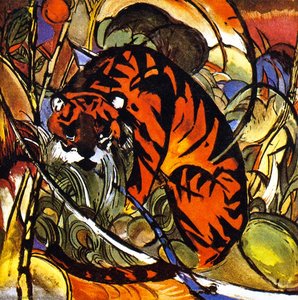
Marc's artistic development wasn’t solitary; it flourished within the dynamic context of early 20th-century Munich. He experimented with various artist groups, including the Neue Künstlervereinigung München, before co-founding *Der Blaue Reiter* (The Blue Rider) in 1911 alongside Wassily Kandinsky. This wasn’t merely a group or an exhibition series; it was a philosophical and artistic revolution. *Der Blaue Reiter* sought to move beyond mere representation, aiming instead to express inner spiritual truths through abstraction and symbolic color. The journal of the same name became a platform for disseminating these ideas, showcasing not only their own work but also that of other forward-thinking artists and exploring diverse cultural influences from folk art to primitive sculpture. Marc’s contributions during this period were pivotal. He moved away from depicting landscapes as static scenes, instead focusing on animals—horses, deer, foxes—as vessels of spiritual energy. These weren’t simply animal portraits; they were symbolic representations of innocence, harmony, and a connection to the natural world that he believed humanity had lost. The influence of Robert Delaunay’s exploration of abstract forms and vibrant colors further propelled Marc toward simplification and heightened emotional expression in his work. Paintings like *The Tiger* (1912) and *Red Deer* (1912) exemplify this shift, showcasing bold color choices and a growing focus on the inherent qualities of his subjects rather than realistic depiction.

Symbolism, Color, and the Essence of Being

Marc’s artistic style is immediately recognizable for its distinctive use of color and form. He didn't employ color descriptively; instead, he imbued it with symbolic meaning. Blue represented spirituality and masculinity, yellow signified joy and femininity, and red embodied violence and materiality. These weren’t arbitrary choices but a carefully constructed system designed to convey specific emotional and philosophical ideas. His animals aren’t merely subjects; they are embodiments of these concepts. The simplification of forms—reducing figures to their essential shapes—further emphasized the underlying spiritual essence he sought to capture. *The Tower of Blue Horses* (1913), sadly lost during World War II, is perhaps the most iconic example of this approach, a powerful and evocative composition that encapsulates his artistic vision. He believed animals possessed an inherent purity and connection to nature that humans had forfeited through societal constraints and intellectualization. By portraying them with such reverence and symbolic weight, Marc sought to remind viewers of this lost harmony and inspire a deeper appreciation for the natural world. His work wasn’t about depicting *what* he saw but rather *how* he felt—a deeply personal and spiritual response to his surroundings.

Influences and Development

Marc's artistic journey was shaped by a confluence of influences. Initially, his father’s landscape paintings provided a foundation in observation and technique. However, it was the encounter with Vincent van Gogh that truly transformed his approach. Van Gogh’s expressive brushwork, intense colors, and emotional honesty resonated deeply with Marc, liberating him from academic constraints and encouraging him to prioritize feeling over representation. The Impressionists, particularly Monet, also played a role in broadening his palette and exploring new ways of capturing light and atmosphere. Furthermore, Marc's time in Paris exposed him to the burgeoning avant-garde movements, including Cubism and Fauvism, which subtly influenced his later work. He was fascinated by the works of Paul Gauguin, particularly Gauguin’s use of symbolism and vibrant colors to convey spiritual themes. The philosophical ideas of Eastern religions—particularly Buddhism—also exerted a significant influence on Marc's thinking, informing his belief in the interconnectedness of all things and the importance of living in harmony with nature.

A Tragic End and Lasting Legacy

The outbreak of World War I in 1914 dramatically altered Marc’s life and artistic trajectory. Despite seeking exemption due to his status as an artist, he was drafted into the German army, serving as a cavalryman. The horrors of war deeply affected him, yet even amidst the chaos, he continued to paint, finding solace and meaning in his art. Tragically, Franz Marc died on March 4, 1916, at the Battle of Verdun, a devastating loss for the art world. His untimely death cut short a career brimming with potential, but it also cemented his place as a pivotal figure in modern art history. His work continues to resonate today, influencing generations of artists and captivating audiences with its emotional depth and spiritual resonance. Marc’s paintings are exhibited in major museums worldwide, including the Lenbachhaus in Munich, which holds an extensive collection of his work. He is remembered not only as a pioneer of German Expressionism but also as a visionary artist who dared to explore the profound connection between art, spirituality, and the natural world—a legacy that continues to inspire awe and contemplation. His artistic vision remains a testament to the power of art to transcend the material realm and touch upon something deeper within the human spirit.

Краткая справка

  • Subject or theme: Animal symbolism
  • Movement: Expressionism
  • Medium: Oil on canvas
  • Dimensions: 70 x 100 cm
  • Notable elements: Bold colors, Dynamic brushstrokes

Викторина по искусству

В каждом вопросе только один правильный ответ.

Вопрос 1:
What is the primary artistic style exemplified by Franz Marc’s ‘The Monkey’?
Вопрос 2:
What color is most prominently featured in the background of ‘The Monkey’?
Вопрос 3:
According to the description, what does the monkey's tail represent in the painting?
Вопрос 4:
Franz Marc was a key figure in which artistic movement?
Вопрос 5:
What is the approximate size of ‘The Monkey’?

More about this painting

Примерить в интерьере Примерить в AR Переключиться на печать Перейти к цифровым изображениям Отправить
Подробнее Руководство Добавить в избранное Скачать Похожие объекты Рентгенография Слайд-шоу Q&A Статистика