

 Примерить в интерьере
 Отправить
 Поделиться
 Подробнее
 Руководство

 Скачать
 Похожие объекты
 Рентгенография
 Слайд-шоу
 Статистика
Still Life


 Развернуть текст
Жикле / Арт-принты
Печать (жикле) или холст музейного качества с быстрыми сроками изготовления и широким выбором вариантов отделки. ( Заказать репродукцию ручной работы Перейти к цифровым изображениям)




P118B $10

P118H $10

P118W $10

P438Z $10

P508JH $12

P508YH $12

P805H $10

P805Z $10

P919BZ $10

P919G $10

P919XJ $10

P959ZH $10

P968JZ $12

W106C $8

W218G $10

W218JH $8

W218Y $10

W307PJ $10

W316G $10

W316PJ $8

W316Y $10

W398PJ $8

W4111J $10

W500HY $15

W500JH $15

W692G $12

W849H $8

W940BG $15

W953PJ $8




Выберите один из наших стандартных размеров, соответствующих оригинальным пропорциям произведения искусства.

Введите необходимую ширину и высоту, чтобы репродукция подошла к вашей раме или стене. При печати изображение можно только уменьшить, но нельзя увеличить больше оригинала, поэтому при выборе другого формата часть изображения может быть обрезана. Перед печатью мы отправим вам цифровой макет на утверждение. Изображение на этой странице не отображает реальную обрезку — ее можно увидеть только на макете.
Доставка по всему миру () за 2 недели вместо стандартных 4–5 недель. (22 Октябрь)

Бесплатная экспресс-доставка по всему миру

Высококачественный льняной холст

Полное страхование при транспортировке

Гарантия возврата таможенных пошлин

Гарантия точного цветового соответствия

100-дневный период возврата (только при обнаружении дефектов)

Гарантия возврата 100% средств

Скидка при заказе нескольких работ
 Вариант со стеклом доступен только для размеров менее 110 см

Still Life
Жикле / Арт-принты
Размер репродукции
-


Итоговая стоимость
$ 80
A Moment Frozen in Time: Ferdinand Guillaimin’s “Still Life”
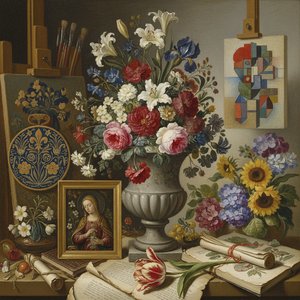
Ferdinand Guillaimin's "Still Life," painted in 1872, isn’t merely a depiction of objects arranged on a table; it’s a carefully constructed tableau brimming with quiet observation and subtle symbolism. This work, rendered in the heart of the Impressionist movement, captures a fleeting moment of domestic tranquility – a scene both familiar and imbued with an understated elegance. The painting immediately draws the eye to the central arrangement: a vase overflowing with vibrant red and yellow flowers, their petals seemingly caught mid-bloom, radiating warmth against the cooler tones that dominate the rest of the composition. Beside them rests a worn book, its pages hinting at untold stories and intellectual pursuits, while a simple bowl holds what appears to be fruit – perhaps apples or pears – adding another layer of earthly abundance.
Guillaimin’s technique is distinctly Impressionistic, prioritizing capturing the *impression* of light and color rather than precise detail. Loose brushstrokes dance across the canvas, creating an atmospheric haze that softens the edges of each object. He masterfully employs broken color – applying small dabs of paint side-by-side to build up hues and create a shimmering effect, particularly noticeable in the reflections on the table’s surface. The dark background serves not as mere backdrop but as a crucial element, intensifying the luminosity of the floral arrangement and lending the scene a sense of intimacy and depth. The artist's focus is less on photographic realism and more on conveying the *feeling* of being present within this quiet space.
The Context of Parisian Impressionism
To fully appreciate “Still Life,” it’s essential to understand the artistic climate in which Guillaimin was working. The 1870s were a period of profound change and experimentation for French art, marked by the rise of Impressionism. Artists like Monet, Renoir, and Pissarro sought to break free from the rigid conventions of academic painting, embracing plein air (outdoor) painting and capturing the ephemeral qualities of light and atmosphere. Guillaimin’s work reflects this spirit of innovation, moving away from traditional subject matter and exploring new ways of representing the world around him.
Guillaimin's connection to Pissarro is particularly noteworthy. The artist spent a significant period painting alongside Pissarro in Pontoise, a suburb of Paris, where he found inspiration in the everyday life of the region. This proximity fostered a collaborative environment, allowing Guillaimin to refine his style and develop his unique approach to capturing light and color. The Impressionists were not simply interested in depicting what they *saw*; they were driven by a desire to express their subjective experience of the world.
Symbolism and the Language of Objects
Beyond its aesthetic qualities, “Still Life” is rich with symbolic meaning. The flowers themselves represent beauty, fragility, and the fleeting nature of life – themes frequently explored in Impressionist art. The book suggests knowledge, contemplation, and a connection to the past. The bowl of fruit symbolizes abundance, nourishment, and the pleasures of earthly existence. Even the dark background can be interpreted as representing mortality or the unknown.
Guillaimin’s use of these objects is deliberate and carefully considered, inviting the viewer to engage in a process of interpretation. He doesn't offer explicit explanations; instead, he presents a series of interconnected symbols that resonate with universal themes of beauty, life, and death. The arrangement feels deliberately balanced, creating a harmonious composition that evokes a sense of peace and serenity.
A Legacy of Delicate Beauty
Ferdinand Guillaimin’s “Still Life” stands as a testament to the power of observation and the enduring appeal of simple subjects rendered with exquisite sensitivity. It's a painting that rewards close attention, revealing layers of meaning and emotional depth with each viewing. Reproductions capture much of the original atmosphere, but nothing quite replicates the subtle nuances of light and color that define Guillaimin’s masterful technique.
Today, this work is celebrated for its evocative beauty and its contribution to the development of Impressionism. It remains a poignant reminder of the quiet moments of everyday life – a timeless meditation on beauty, mortality, and the enduring power of art.
Вопросы и ответы
Какая цветовая палитра используется в работе "Still Life"?
В работе «Still Life», Фердинанд Гуилламин используется Earthy цветовая палитра. Эта палитра определяет общий цветовой характер произведения.
Есть ли работы, похожие на "Still Life"?
На странице Похожие работы для работы «Still Life», Фердинанд Гуилламин представлены похожие произведения.
Кто создал(а) «Still Life» и в каком году?
Автор произведения «Still Life» — Фердинанд Гуилламин, дата создания — 1872.
Биография художника
early life and career
Фердинанд Виктор Эюжен Делакруа был французским художником и литографом, который родился 16 февраля 1841 года в Париже. Его художественное путешествие началось в середине XIX века, когда импрессионизм набирал обороты во Франции.
Он начал свою карьеру как художник и литограф в начале своей жизни и быстро приобрел известность благодаря своим работам в жанре пейзажа и портрета. Делакруа был одним из самых ярких представителей французского импрессионизма и оказал значительное влияние на развитие этого направления.
contribution to impressionism
Делакруа был активным членом группы художников, которые стремились запечатлеть мимолетные впечатления от света и цвета в природе. Его работы отличались необыкновенной техникой и использованием ярких цветов, что было характерно для импрессионизма того времени.
Он часто работал на открытом воздухе и использовал свободные мазки кисти, чтобы передать ощущение движения и атмосферы. Делакруа был вдохновлен идеями романтизма и символизма и его творчество отражает эти тенденции.
notable works and associations
Делакруа создал множество известных картин, среди которых «Смерть Сарданапала», «Битва лошадей в конюшне» и «Свобода ведет народ». Эти работы являются шедеврами романтизма и демонстрируют мастерство художника в передаче эмоций и драматических сцен.
Он сотрудничал с другими художниками и поэтами своего времени, такими как Жорж Сьюрреаль и Эдмон Мушка, и его творчество оказало влияние на развитие искусства начала XX века. Делакруа был одним из самых выдающихся художников Франции XIX века и его работы до сих пор пользуются огромной популярностью.
legacy and remembrance
Эжен Делакруа умер в возрасте 63 лет в Париже в 1883 году, но его вклад в искусство остается незабываемым. Его картины хранятся в лучших музеях мира и являются примером высочайшего мастерства и художественного вдохновения.
Он оказал огромное влияние на развитие импрессионизма и символизма и его работы продолжают восхищать зрителей по всему миру. Делакруа считается одним из самых значительных художников Франции XIX века и его имя навсегда вошло в историю искусства.

Фердинанд Гуилламин
1841 - 1927 , Франция
Краткая справка
- Artistic Movement Or Style: Импрессионизм
- Artists Or Movements Influenced By This Artist: ['Символизм']
- Artists Who Influenced This Artist:
- Эжен Делакруа
- Клод Моне
- Date Of Birth: Февраль 16, 1841
- Date Of Death: Июнь 26, 1927
- Full Name: Jean Baptiste Armand Guillaumin
- Nationality: Франция
- Notable Artworks:
- Сад в Янвиль в июне
- Речная сцена
- Вид Дюома
- Place Of Birth: Париж, Франция
Похожие статьи

Blossoms of Time: A Historical Journey Through Flower Painting
Explore the captivating history of flower painting! Discover Dutch masters, symbolic meanings, & botanical art. Expert insights & high-quality reproductions at OriginalUniqueArt.
Blossoming Symbolism: A Historical Journey Through Flowers in Western Painting
Explore the rich history of flower symbolism in Western painting! Discover how artists from the Renaissance to Modernism used blossoms to convey meaning, emotion & beauty. Learn about iconic artworks and movements.

Топ-10 шедевров импрессионизма: искусство мгновения для вашего интерьера
Погрузитесь в мир импрессионизма! Откройте для себя 10 шедевров Моне, Ренуара и других великих мастеров. Узнайте историю создания культовых картин и вдохновитесь для декора интерьера. Репродукции музейного качества на OriginalUniqueArt.com.

Silent Narratives: Exploring the Enduring Appeal of Still Life Painting Across Centuries
Explore the rich history of still life painting with OriginalUniqueArt. Discover Dutch Masters, decode vanitas symbolism & learn about collecting timeless art. Expert insights and museum-quality reproductions.

25 Шедевров Поля Сезанна: Открывая Новую Эру в Искусстве | OriginalUniqueArt
Откройте для себя 25 величайших шедевров Поля Сезанна! Узнайте истории создания картин импрессионизма и постимпрессионизма, технику художника и вдохновение для вашего интерьера. Репродукции картин Сезанна высокого качества на OriginalUniqueArt.com.
