
 Предпросмотр
 Поделиться
 Поделиться
 Детали произведения

 Скачать
 Похожие работы
 Рентгенография
 Слайд-шоу
Untitled (Boy in Window)


 Читать далее
Жикле / Арт-принт
Печать (жикле) или холст музейного качества с быстрыми сроками изготовления и широким выбором вариантов отделки. ( Купить картину ручной работы Купить изображение)




































Выберите один из наших стандартных размеров, соответствующих оригинальным пропорциям произведения искусства.

Вы можете указать свои собственные размеры, чтобы репродукция идеально подошла под конкретную раму или пространство. Если выбранный вами размер не будет соответствовать пропорциям оригинала, мы либо обрежем произведение, либо дополним изображение зеркальным отражением краев или однотонной заливкой. Перед началом производства вам будет отправлен цифровой макет для утверждения.
Пожалуйста, обратите внимание, что предварительный просмотр на экране не отображает фактическую обрезку или расширение изображения. Только макет точно покажет финальную композицию.
Несмотря на возможность заказа индивидуальных размеров, мы рекомендуем выбирать размер из предопределенного списка, чтобы сохранить оригинальные пропорции.
Доставка по всему миру () за 2 недели вместо стандартных 4/5 недель. (13 Август)

Бесплатная экспресс-доставка по всему миру

Высококачественный льняной холст

Полное страхование доставки

Гарантия возмещения таможенных пошлин

Гарантия точного соответствия цветов

Политика возврата в течение 60 дней (только при наличии дефектов)

Гарантия возврата 100% средств

Предложение оптовых скидок
 Вариант со стеклом доступен только для размеров менее 110 см

Untitled (Boy in Window)
Жикле / Арт-принт
Размер репродукции
-


Итоговая стоимость
$ 80
Описание предмета коллекционирования
Untitled (Boy in Window) by Enrique Martínez Celaya: A Study in Introspection
- Artist: Enrique Martínez Celaya
- Date: 2009
- Style: Contemporary Realism, with Impressionistic undertones
- Medium: Oil on Canvas (likely)
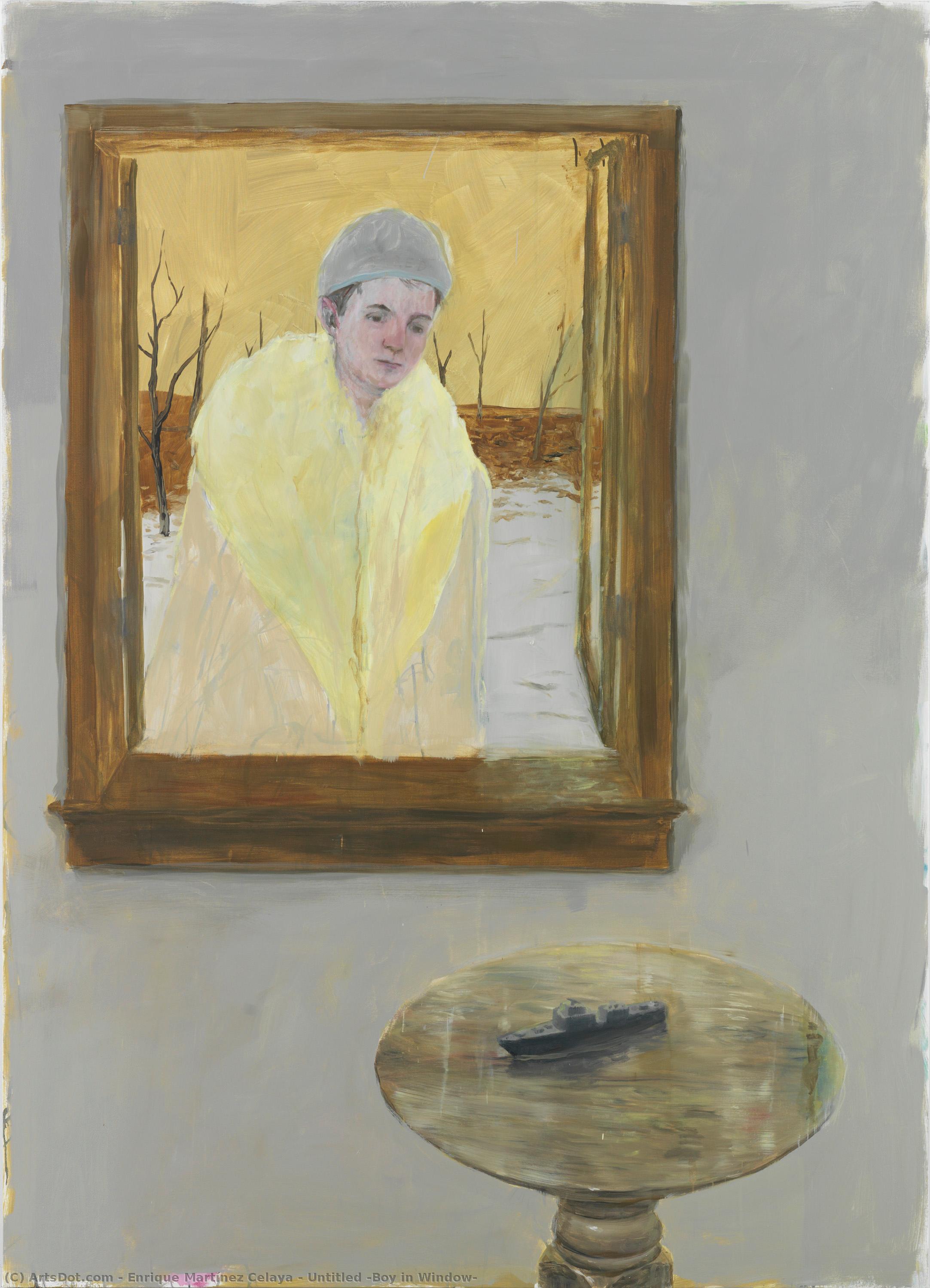
Enrique Martínez Celaya's "Untitled (Boy in Window)" presents a quietly compelling scene of introspection. The artwork depicts a young boy positioned within the frame of a window, creating an immediate sense of separation and observation. This piece isn’t about photographic accuracy; rather, it aims to capture a mood, a feeling—a moment suspended between interior thought and exterior reality.
Composition and Visual Elements
The composition is deliberately layered, drawing the viewer's eye through distinct planes. The window frame itself acts as a dominant rectangular shape, both literally containing the boy and metaphorically representing boundaries or confinement. A small table in the foreground introduces an unexpected element, adding depth and hinting at narrative possibilities. The background visible through the window reveals a sparse landscape—bare branches and what appears to be snow or dry vegetation—further emphasizing the sense of isolation.
- Color Palette: Muted and earthy tones – soft yellows, creams, grays, and browns – contribute significantly to the artwork's somber and contemplative atmosphere. The warmer browns and golds of the window frame provide a subtle contrast against the cooler background hues.
- Lines: Lines are employed in an expressive manner; the edges of the window aren’t perfectly straight, lending a slightly dreamlike quality. Gestural strokes define the branches in the landscape, suggesting movement and impermanence.
- Shapes: Rectangular shapes (window frame, table) dominate, balanced by circular forms in the table's base and the boy’s headwear, creating a visual tension between geometric simplicity and organic form.
- Lighting: Soft, diffused lighting creates a gentle glow around the boy, minimizing shadows and enhancing the overall muted atmosphere.
Symbolism and Emotional Resonance
“Untitled (Boy in Window)” is rich with symbolic potential. The window itself serves as a powerful metaphor for separation—a barrier between the boy and the world outside. His introspective gaze suggests feelings of loneliness, contemplation, or perhaps even longing. The ambiguous object on the table invites speculation; it could represent a memory, a secret, or simply an element that adds to the overall sense of mystery.
- The Window: Represents separation, confinement, observation, and the boundary between inner thought and external reality.
- The Boy: Embodies introspection, vulnerability, and perhaps a sense of displacement. His posture suggests deep contemplation or quiet sadness.
- The Object on the Table: Remains open to interpretation—a symbol of memory, loss, hope, or simply an enigmatic detail that enhances the artwork's narrative depth.
Artistic Technique and Context
Martínez Celaya’s technique appears to be oil painting, characterized by smooth textures and subtle blending of colors. While brushstrokes are visible, they aren't overly prominent, contributing to the overall sense of quietude. The flattened perspective further enhances the dreamlike quality of the artwork. Martínez Celaya, a Cuban-born artist with a background in physics, often explores themes of memory, exile, and identity in his work. This piece aligns with his broader artistic practice, which seeks to bridge the gap between art and science, exploring profound human experiences through evocative imagery.
Биография художника
The Alchemist of Memory: The Artistic Journey of Enrique Martínez Celaya
To encounter the work of Enrique Martínez Celaya is to step into a space where the boundaries between the empirical and the ethereal dissolve. Born in Havana, Cuba, in 1964, his life has been a series of profound migrations—not merely across geographic borders from Cuba to Spain and Puerto Rico, but across disciplines. Before he was an acclaimed painter and sculptor, Celaya was a man of science, a trained laser physicist who navigated the rigorous, mathematical certainties of Cornell University and the University of California, Berkeley. This scientific foundation remains an invisible architecture within his art; there is a precision in his compositions that suggests the structural integrity of the physical universe, even when he is exploring the most nebulous territories of human emotion.
His creative evolution is a testament to the tension between logic and lyricism. While his early years were marked by the discipline of physics—even patenting several laser devices—the pull of narrative and figurative painting proved irresistible. This transition was not a rejection of science, but rather an expansion of it. In his canvases, the "big gears of nature" meet the "small gears of human experience." He utilizes a technique that often marries meticulous observation with expressive, tactile layers, frequently employing oil, wax, and charcoal to create surfaces that feel as much like geological strata as they do emotional landscapes. His work does not merely depict a scene; it excavates it, pulling themes of memory, exile, and the passage of time from beneath the surface of the pigment.
Symbolism and the Landscape of the Soul
The imagery in Celaya’s oeuvre often evokes vast, desolate terrains that serve as metaphors for the internal state. His landscapes are rarely just topographical studies; they are psychological maps. Through expansive vistas and symbolic motifs, he explores the exilic imagination—the sense of displacement and the search for authenticity that characterizes much of his work. There is a haunting quality to his compositions, where a single figure or an isolated object might stand against a sweeping sky, embodying the profound solitude of individual consciousness. He approaches themes of loss and attachment not by offering easy resolutions, but by posing existential questions that resonate with a universal vulnerability.
This mastery of symbolism allows him to bridge the gap between the semi-autobiographical and the mythic. In works such as The Puppet or The Fiery Wound, the viewer is invited to contemplate the fragility of existence. His use of color is equally evocative, often employing palettes that feel both ancient and immediate, grounding his philosophical inquiries in a visceral, sensory reality. By blending the precision of his scientific training with the fluidity of contemporary painting, he creates an immersive experience where the viewer is encouraged to linger in the ambiguity of the unknown.
Legacy and International Recognition
The significance of Enrique Martínez Celaya’s contribution to contemporary art lies in his ability to resist the fragmentation of modern disciplines. He remains a polymath, working seamlessly across painting, sculpture, installation, and even literature as an accomplished author of nine books. His work has achieved immense institutional recognition, finding permanent homes in some of the world's most prestigious collections, including:
- The Metropolitan Museum of Art, New York
- The Whitney Museum of American Art, New York
- The State Hermitage Museum, St. Petersburg
- The Los Angeles County Museum of Art (LACMA)
- The Museum of Fine Arts, Houston
As a scholar and educator—serving as the first Provost Professor of Humanities and Arts at the University of Southern California—his influence extends far beyond the studio. He continues to shape the discourse on how art can serve as a vessel for philosophical inquiry, proving that the most profound truths are often found in the delicate intersection of what we can measure and what we can only feel.

enrique martínez celaya
1964 - , Cuba
Основные сведения
- Artistic Movement Or Style: Contemporary Painting
- Date Of Birth: 1964 Havana Cuba
- Date Of Death: Living
- Full Name: Enrique Martínez Celaya
- Nationality: Cuban
- Notable Artworks:
- Untitled (Boy in Window)
- The Fourth Angel
- The Dragon
- Place Of Birth: Havana Cuba
Похожие статьи
Romantic Realism's Finest: 10 Masterpieces for Your Home | OriginalUniqueArt
Explore 10 defining masterpieces of Romantic Realism! Discover Courbet, Millet & Daumier's powerful paintings—capturing emotion and social realities. Find museum-quality reproductions for your home at OriginalUniqueArt.com.
Echoes of Society: Exploring Social Realism's Enduring Legacy in Art
Explore the powerful world of Social Realism art! Discover key artists, masterpieces & its profound social commentary. Expert insights into this influential movement's history and enduring legacy.
Realism in Art: A Professional Guide to Authentic Detail and Lifelike Masterpieces for Large-Scale Interior Projects
Master the use of Realism in professional interiors. This expert guide explores 19th-century masterpieces, offering procurement managers and designers technical insights into selecting authentic, hand-painted oil reproductions for high-end hotel and corporate projects.
The Raw Truth: A Definitive Guide to the Power and Legacy of Social Realism Art
Explore the profound impact of Social Realism. Discover how masters like Courbet rejected idealism to capture the raw, socio-political truths of the working class through powerful, unvarnished art history and enduring visual critique.
The Evocative Embrace of Reality: Exploring Romantic Realism in 19th-Century Painting
Explore the captivating world of Romantic Realism! Discover key artists like Courbet & Millet, masterpieces, and the social context behind this influential art movement. Expert insights for collectors at OriginalUniqueArt.

