
 Предпросмотр
 Поделиться
 Поделиться
 Детали произведения
 Руководство

 Скачать
 Похожие предметы
 Рентгенография
 Слайд-шоу
 Вопросы и ответы
 Статистика просмотров
Tree Landscape

- 51.0 x 76.0 cm


 Читать далее
Жикле и арт-принты
Печать (жикле) или холст музейного качества с быстрыми сроками изготовления и широким выбором вариантов отделки. ( Купить картину ручной работы Перейти к цифровым изображениям)




P118B $10

P118H $10

P118W $10

P438Z $10

P508JH $12

P508YH $12

P805H $10

P805Z $10

P919BZ $10

P919G $10

P919XJ $10

P959ZH $10

P968JZ $12

W106C $8

W218G $10

W218JH $8

W218Y $10

W307PJ $10

W316G $10

W316PJ $8

W316Y $10

W398PJ $8

W4111J $10

W500HY $15

W500JH $15

W692G $12

W849H $8

W940BG $15

W953PJ $8




Выберите один из наших стандартных размеров, соответствующих оригинальным пропорциям произведения искусства.

Введите необходимую ширину и высоту, чтобы репродукция подошла к вашей раме или стене. При печати изображение можно только уменьшить, но нельзя увеличить больше оригинала, поэтому при выборе другого формата часть изображения может быть обрезана. Перед печатью мы отправим вам цифровой макет на утверждение. Изображение на этой странице не отображает реальную обрезку — ее можно увидеть только на макете.
Доставка по всему миру () за 2 недели вместо стандартных 4–5 недель. (14 Ноябрь)

Бесплатная экспресс-доставка по всему миру

Высококачественный льняной холст

Полное страхование при доставке

Гарантия возмещения таможенных пошлин

Гарантия точного цветового соответствия

100-дневная гарантия возврата (только при обнаружении дефектов)

Гарантия возврата 100% средств

Скидка при оптовом заказе
 Вариант со стеклом доступен только для размеров менее 110 см

Tree Landscape
Жикле и арт-принты
Размер репродукции
-


Итоговая стоимость
$ 81
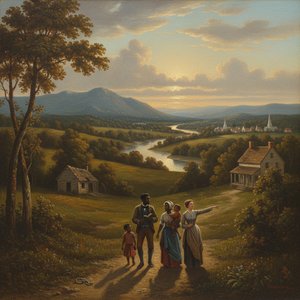
A Woodland Reverie: Exploring Edward Mitchell Bannister's "Tree Landscape"
Edward Mitchell Bannister’s “Tree Landscape,” painted in 1877, isn’t merely a depiction of a forest; it’s an immersion into a carefully constructed mood – a profound meditation on nature’s tranquility and the subtle power of light. This oil-on-canvas work, currently residing within the Smithsonian American Art Museum's collection, offers a glimpse into the tonalist movement, a style that prioritized atmospheric effects over sharp detail, mirroring the quiet introspection of the artist himself. Bannister, born in Canada and deeply rooted in both African American and European heritage, sought to capture not just what he saw, but how it *felt* – a sentiment powerfully conveyed through his masterful manipulation of color and texture.
The scene unfolds within a dense thicket of trees, predominantly dark browns and greens that immediately establish a sense of depth. These aren’t the vibrant hues of a summer forest; instead, Bannister employs a muted palette, leaning heavily on umber, sienna, and charcoal tones to create an atmosphere of subdued light and shadow. The foreground is dominated by these imposing trees, their forms rendered with broad brushstrokes that suggest both solidity and a gentle yielding to the elements. Notice how he doesn’t meticulously define each branch or leaf; rather, he uses overlapping layers of color to build volume and create a hazy, almost dreamlike quality. This deliberate ambiguity invites the viewer to step into the painting, becoming part of the woodland experience.
The Language of Tonalism: Light, Shadow, and Atmosphere
Bannister’s signature style – tonalism – is exquisitely demonstrated in “Tree Landscape.” He eschewed bright highlights and sharp contrasts, favoring instead a gradual shift between light and dark. The sunlight, filtering through the canopy above, isn't presented as a direct beam but rather as a diffused glow that casts dappled shadows across the forest floor. This subtle interplay of illumination and obscurity is crucial to the painting’s emotional impact. It evokes a sense of peace and contemplation, suggesting a timelessness and connection to something larger than oneself. The artist’s skill lies not in replicating reality with photographic accuracy but in conveying its essence – the feeling of being enveloped by nature's embrace.
The composition itself is carefully balanced, drawing the eye towards a distant clearing. This strategic use of perspective creates a sense of depth and invites the viewer to imagine what lies beyond the trees. The placement of the largest tree on the left side anchors the scene while simultaneously directing our gaze forward. Bannister’s choice of a slightly elevated vantage point further enhances this effect, offering a panoramic view of the woodland expanse.
A Legacy Rooted in Resilience and Representation
Understanding Edward Mitchell Bannister requires acknowledging the significant obstacles he faced as an African American artist in 19th-century America. Despite enduring racial prejudice and limited opportunities, he persevered, establishing himself as a respected figure within Boston’s artistic community and contributing significantly to the development of American landscape painting. “Tree Landscape” stands as a testament to his dedication and talent – a poignant reminder of his ability to capture beauty even amidst adversity. The painting's quiet dignity reflects Bannister’s own resilience, offering a powerful message about the enduring spirit of creativity in the face of societal constraints.
Furthermore, research reveals that Bannister’s work was often commissioned by members of the African American community, highlighting his role as a cultural figure and advocate for representation. The Smithsonian's collection provides valuable context to this history, ensuring that Bannister’s contributions are recognized and celebrated. The painting’s current location within the museum underscores its importance as a significant piece of American art history.
Вопросы и ответы
Какой размер и ориентацию вы рекомендуете для печати работы "Tree Landscape"?
Для «Tree Landscape» рекомендуется использовать размер Medium и Landscape ориентацию.
Какова техника и стиль произведения «Tree Landscape»?
В произведении «Tree Landscape» техника Oil On Canvas встречается с направлением Tonalist Landscape.
Какому художнику приписывают работу «Tree Landscape»?
Авторство работы «Tree Landscape» приписывается Эдвард Митчелл Баннистер.
Биография художника
Edward Mitchell Bannister: A Pioneer of Tonalism and a Voice Against Prejudice
Edward Mitchell Bannister’s life story is one of quiet resilience, artistic passion forged in the face of significant societal barriers, and ultimately, a remarkable rediscovery. Born around 1828 in St. Andrews, New Brunswick, Canada – a small settlement nestled along the St. Croix River – his early years were marked by hardship typical for individuals of African descent during the 19th century. Orphaned at a young age, Bannister navigated a world demanding unwavering strength and adaptability, taking on various jobs including working as a cook aboard merchant ships before finding his way to Boston in the late 1840s. This journey wasn’t merely geographical; it was a profound quest for artistic expression – a calling that would define his entire life despite the formidable obstacles he encountered. His heritage itself was complex, a rich blend of Barbadian ancestry through his father and European roots inherited from his mother, shaping a unique perspective that would later infuse his canvases with both sensitivity and an undeniable depth.The Seeds of Inspiration: Landscape Painting and the Barbizon School
Bannister’s artistic journey began largely without formal instruction. He was primarily self-taught, yet his dedication to honing his craft was nothing short of remarkable. Early influences included brief studies in sculpture and anatomy under Dr. William Rimmer in Boston – a foundational experience that undoubtedly informed his understanding of form and composition. However, it was the captivating world of landscape painting, particularly the principles championed by the French Barbizon school, that truly ignited his artistic imagination. Artists like Jean-François Millet, with their profound ability to capture the essence of rural life and imbue scenes with a palpable sense of atmosphere, resonated deeply with Bannister’s own sensibilities. He meticulously absorbed their emphasis on conveying mood and emotion through subtle tonal values and soft, muted hues – a characteristic that would become the hallmark of his distinctive style: Tonalism. Bannister's paintings weren’t intended as precise reproductions of nature; rather, they were carefully constructed evocations designed to stir feelings of serenity, contemplation, and perhaps even a touch of melancholy. He sought not to replicate reality with photographic accuracy but to distill its soul, presenting landscapes imbued with poetic grace and emotional resonance.Boston Years and Early Works: A Developing Style
During his time in Boston, Bannister’s artistic practice evolved significantly. He initially held various menial jobs – a barber, a ship steward – while simultaneously pursuing his passion for painting. His early works reflected the influence of Robert S. Duncanson, another pioneering Black artist who had achieved considerable success and served as an inspiration during this period. Bannister's paintings from the 1850s and 1860s began to exhibit a growing maturity, incorporating elements of Barbizon-inspired techniques while developing his own unique voice. These early pieces often depicted scenes of urban life – bustling streets, busy markets – rendered with a quiet dignity and observational skill. He also explored pastoral themes, capturing the beauty of the Rhode Island countryside, demonstrating an increasing mastery of tonal values and atmospheric perspective.A Defining Moment: The Philadelphia Centennial Exposition
The year 1876 marked a pivotal moment in Bannister’s career – a watershed event that propelled him into the national spotlight. He submitted *Under the Oaks* to the Philadelphia Centennial Exhibition, a world's fair celebrating America’s centennial anniversary. To the astonishment of many, his painting won first prize in the category of landscape painting. However, this triumph was immediately followed by controversy. Upon discovering Bannister’s African American heritage, some judges attempted to rescind the award, citing racial prejudice. Despite these attempts to undermine his achievement, Bannister's skill and artistic merit were ultimately recognized, solidifying his place as the first Black artist to receive a national art award in America. This event, though fraught with injustice, served as a powerful symbol of perseverance and a testament to the enduring value of talent regardless of race.Beyond Recognition: Providence and a Lasting Legacy
Following the Philadelphia Centennial Exhibition, Bannister relocated to Providence, Rhode Island, where he established himself as a leading artist for nearly three decades. He became a founding member of the Providence Art Club and actively participated in the local art scene. His style continued to evolve during this period, reflecting his deep connection to the Rhode Island landscape – its rolling hills, serene waterways, and vibrant autumnal colors. Bannister’s paintings from the 1870s and 1880s are characterized by their quiet beauty, masterful use of tonal values, and evocative depictions of rural life. Despite achieving considerable success during his lifetime, Bannister's work largely faded into obscurity after his death in 1901. For decades, he remained a forgotten figure, overshadowed by the dominant narratives of art history.Rediscovery and Reassessment: A New Appreciation
Remarkably, Bannister’s artistic legacy was not entirely lost to time. During the Civil Rights Movement of the 1960s and 70s, renewed interest in African American contributions to art emerged, leading to a reassessment of Bannister's work. In 1978, Rhode Island College dedicated its art gallery in his honor, accompanied by an exhibition titled “Four from Providence ~ Alston, Bannister, Jennings & Prophet,” marking a significant step towards reclaiming his rightful place within the annals of American art history. Today, Bannister’s paintings are proudly displayed in major museums and collections across the country – including the Smithsonian American Art Museum and the Walters Art Museum – serving as a powerful reminder of his artistic vision, his unwavering determination, and his enduring legacy as a pioneer who challenged racial barriers and paved the way for future generations of Black artists. His story continues to inspire, reminding us that true artistry transcends prejudice and that talent deserves recognition regardless of circumstance.- Barbizon School: Deeply influenced by the French Barbizon school of painting, particularly artists like Jean-François Millet.
- Tonalism: His style aligns with Tonalism, emphasizing mood, atmosphere, and subtle tonal values.
- Pioneering Spirit: Bannister broke racial barriers in the art world, achieving recognition during a time of significant discrimination.
- Rediscovery: His work was rediscovered during the Civil Rights Movement, leading to renewed appreciation and inclusion in major museums.

Эдвард Митчелл Баннистер
1828 - 1901 , Канада
Об авторе
- Artistic Movement Or Style: Тонализм, Барбизонская школа
- Artists Or Movements Influenced By This Artist: ['Барбизонская школа']
- Artists Who Influenced This Artist: ['Жан-Франсуа Милле']
- Date Of Birth: 1828 г.
- Date Of Death: 9 января 1901
- Full Name: Edward Mitchell Bannister
- Nationality: Канадско-американский
- Notable Artworks:
- Под дубами
- Улица Бостона
- Мальчик с газетой
- Place Of Birth: Сент-Эндрюс, Канада
Похожие статьи
Robert Seldon Duncanson: Landscape, Abolitionism & Shaping American Identity
Discover Robert Seldon Duncanson, the first internationally acclaimed African American landscape artist. Explore his connection to the Hudson River School, abolitionism, and enduring legacy through serene vistas & powerful symbolism.

The Art of Suggestion: Mastering Atmosphere and Mood in Tonalist Landscapes
Master the moody essence of Tonalist landscapes through expert analysis of light and texture. Explore these breathtaking masterpieces now.

Tonalism Explained: Mastering Atmosphere, Mood, and the Art of Muted Light in Landscape Painting
Discover the profound beauty of Tonalism. Explore how masters like Whistler and Weir used muted palettes and atmospheric light to evoke mood. Learn about this influential movement and find museum-quality, hand-painted oil reproductions for your professional or private collection.

Edward Mitchell Bannister: A Pioneer of American Landscape Painting & Artistic Recognition
Discover the remarkable life & art of Edward Mitchell Bannister, a pioneering African American landscape painter. Explore his journey overcoming barriers to achieve recognition and lasting impact on 19th-century American art.

Atmospheric Precision: The Nuanced Light and Shadow of Tonalist Landscapes
Explore the technical mastery of American Tonalism and its atmospheric light. Discover the secrets of this evocative art movement now.