- Главная

- Цифровое изображение
- Д Dwight Уильям Трион
- Evening, New Bedford Harbor
 Preview
 Заказать принт Заказать репродукцию
 Поделиться
 Поделиться
 Детали произведения
 Добавить в избранное

 Скачать
 Похожие работы
 Рентгенография
 Слайд-шоу
Evening, New Bedford Harbor
 Oil On Canvas
- WallArt
- Tonalist Painting
 1890
1890- 19th Century
 51.0 x 80.0 cm
 Музей Метрополитен
 Читать далее
Приобретите цифровое изображение высокого разрешения в улучшенном качестве, которое значительно превосходит онлайн-превью.
Каждый файл тщательно подготавливается нашими специалистами с использованием передовых инструментов и экспертной ручной ретуши. Мы гарантируем исключительную четкость, точную цветопередачу и детальную проработку каждого изображения.
Финальный файл доставляется по электронной почте в течение 72 часов и оптимизирован для немедленного использования в профессиональной среде, при верстке и печати. Это тот же уровень качества, которому доверяют ведущие дизайнерские студии, издательства и галереи.
Цифровое изображение
Скачайте файл высокого разрешения для личного использования, печати и творческих проектов.
Включено в каждый заказ цифровых изображений
Гарантия экспертной цифровой доставки
Выбирая OriginalUniqueArt.com, вы получаете не просто изображение — вы приобретаете профессионально обработанное цифровое произведение искусства, созданное с безупречной точностью и под защитой гарантии качества. Вот всё, что автоматически входит в ваш заказ:

Мгновенная доставка по e-mail
Ваш цифровой файл в высоком разрешении будет отправлен вам по электронной почте в течение 72 часов после оформления заказа — и сразу станет доступен для использования.

Цифровой файл с ИИ-улучшением
Ваше произведение искусства проходит профессиональную оптимизацию с использованием передовых инструментов ИИ и ручной обработки, что гарантирует максимальную детализацию, четкость и точность цветопередачи.

Бессрочная бесплатная повторная доставка
Случайно удалили или потеряли файл? Не беспокойтесь — мы отправим его вам повторно в любое время и совершенно бесплатно.

Без импортных пошлин — навсегда
Наслаждайтесь вашим произведением искусства мгновенно без таможенных пошлин, сборов или затрат на доставку — цифровые загрузки всегда не облагаются налогом.

Гарантия точности цветопередачи
Мы гарантируем, что ваше цифровое изображение максимально точно передает оригинальные цвета благодаря использованию профессиональных инструментов и систем управления цветом.

Гарантия удовлетворения в течение 60 дней
Если вы останетесь не удовлетворены покупкой цифрового изображения, мы внесем в него правки или вернем 100% стоимости в течение 60 дней — без лишних вопросов.

100% Гарантия возврата средств
Не удовлетворены покупкой? Мы гарантируем полный возврат средств в течение 60 дней после получения вашего цифрового файла — без лишних вопросов.

Скидки на оптовые заказы
Купите 3 изображения, сэкономьте 10% — Купите 5, сэкономьте 15% — Купите 10+, сэкономьте 20%. Отличное решение для творческих проектов, галерей и агентств.
Описание коллекции
A Moment of Quietude: The Essence of Dwight William Tryon’s “Evening, New Bedford Harbor”
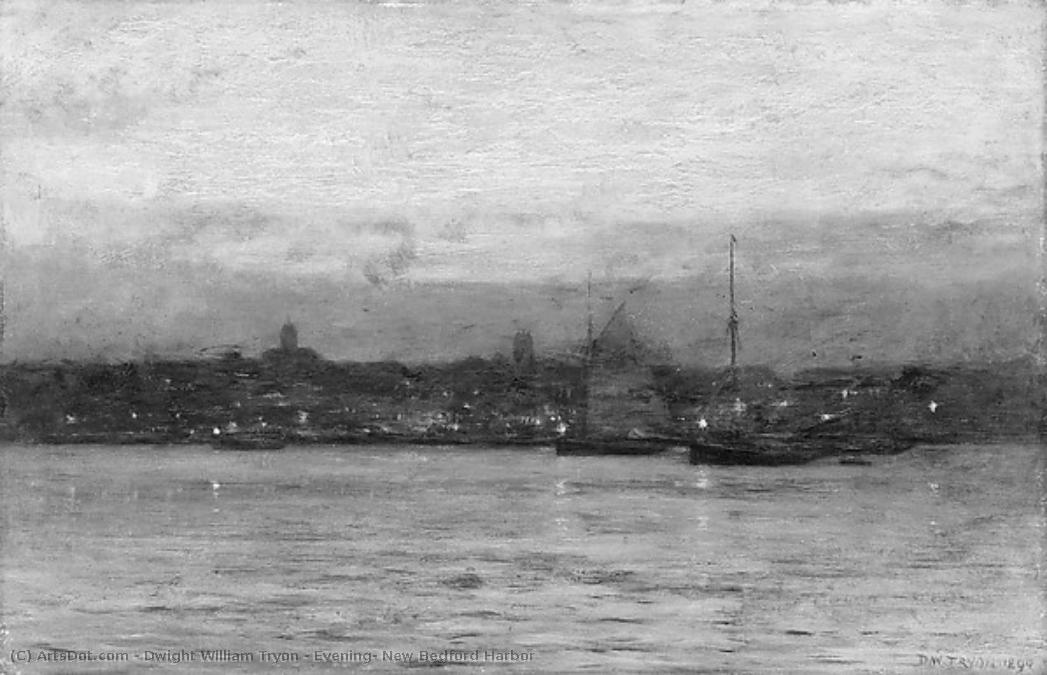
Dwight William Tryon's "Evening, New Bedford Harbor" isn’t merely a depiction of a maritime scene; it’s an immersion into a specific time and mood. Painted in 1890, this oil on wood canvas captures the profound stillness of twilight over the harbor, offering a glimpse into the lives intertwined with the sea and the quiet dignity of a fading day. The painting immediately draws the viewer in with its monochromatic palette – a carefully orchestrated dance of grays, blacks, and whites that eschews traditional color for an exploration of light, shadow, and atmosphere. It’s a testament to Tryon's mastery of tonalism, an American art movement he embraced wholeheartedly, prioritizing emotional resonance over precise representation.
The composition itself is remarkably balanced, dividing the canvas into distinct yet harmonious zones. The foreground, dominated by the dark, reflective waters of the harbor, anchors the scene and establishes a sense of depth. Beyond this lies the middle ground, populated with several ships – not rendered as individual entities but rather as suggestive forms, blending seamlessly into the hazy distance. Finally, the background reveals the faint outline of New Bedford’s cityscape, softened by atmospheric perspective and appearing almost dreamlike. This careful arrangement creates a feeling of spaciousness and invites contemplation, mirroring the quiet solitude of the scene.
The Language of Tone: Tryon's Tonalist Technique
Tryon’s technique is characterized by an exquisite sensitivity to light and texture. He achieves this through meticulous blending and layering of oil paints – a process that results in surfaces that appear incredibly smooth, almost velvety to the touch. There’s no visible brushstroke; instead, the paint seems to melt into one another, creating subtle gradations of tone that mimic the diffused light of dusk. This deliberate softness contributes significantly to the painting's overall atmosphere of tranquility and melancholy. The artist skillfully utilizes the absence of strong highlights or shadows, relying instead on the nuanced interplay of light and dark to define form and create a sense of volume.
The choice of a monochromatic palette is not arbitrary; it’s integral to Tryon's artistic vision. By stripping away color, he forces the viewer to engage with the painting on a purely sensory level – focusing on the subtle shifts in tone, the play of light and shadow, and the overall mood conveyed by the scene. This approach aligns perfectly with the principles of tonalism, which sought to capture the essence of a subject through its emotional impact rather than its literal appearance.
Symbolism and Emotional Resonance: A Portrait of a Working Harbor
“Evening, New Bedford Harbor” is more than just a landscape; it’s a poignant meditation on labor, community, and the passage of time. The scene evokes the quiet dignity of the fishermen and sailors who worked tirelessly in the harbor, their lives inextricably linked to the rhythms of the sea. The muted colors and soft lighting suggest a sense of weariness and reflection – perhaps a moment of respite before returning to the demands of the next day. The distant cityscape hints at the bustling life of New Bedford, while the vast expanse of water symbolizes both opportunity and uncertainty.
Furthermore, the painting’s overall mood is imbued with a subtle sense of nostalgia. It's as if Tryon is inviting us to step back in time and witness a moment that has long since vanished – a reminder of a bygone era when life revolved around the sea and its bounty. The piece resonates with a quiet beauty, prompting viewers to contemplate their own relationship to nature, community, and the enduring power of memory.
A Legacy of Tonalist Beauty: Tryon’s Enduring Appeal
Dwight William Tryon's "Evening, New Bedford Harbor" stands as a remarkable example of American tonalism – a testament to the artist’s skill and sensitivity. Its evocative atmosphere, meticulous technique, and subtle symbolism continue to captivate viewers today. Reproductions of this masterpiece offer a unique opportunity to bring this serene scene into your home or office, allowing you to experience its quiet beauty and emotional resonance firsthand. It's a piece that speaks volumes without uttering a single word, inviting contemplation and offering a moment of respite from the complexities of modern life.
Биография художника
Dwight William Tryon: The Silent Symphony of Light and Shadow
Dwight William Tryon, born in Hartford, Connecticut, on August 13th, 1849, emerged from the quiet beauty of New England as a painter deeply attuned to the subtle rhythms of nature. His early life, marked by the sudden loss of his father, instilled within him a profound appreciation for solitude and observation – qualities that would profoundly shape his artistic vision. Raised primarily on his grandparents’ farm in East Hartford, Tryon developed an intimate connection with the rural landscape, sketching its fields, forests, and waterways from a young age. These early studies weren't merely exercises in drawing; they were a nascent exploration of light, color, and atmosphere – the very elements he would master throughout his career. Without formal training initially, Tryon’s innate talent blossomed organically, fueled by self-study and a deep reverence for the natural world. He found solace and instruction within the walls of a local bookstore, poring over instructional manuals and absorbing artistic principles from printed sources, alongside frequent visits to observe the works of masters in the Wadsworth Atheneum gallery.The Parisian Awakening: Influences and Early Style
Driven by a desire for formal education and seeking to refine his skills, Tryon embarked on a transformative journey to France in 1876. This pivotal move marked a significant turning point in his artistic development, exposing him to the vibrant currents of European art and allowing him to study under esteemed masters. He enrolled at the École des Beaux-Arts in Paris, immersing himself in the techniques and philosophies of established artists. However, Tryon’s education extended far beyond the confines of the classroom; he actively sought guidance from luminaries like Jacquesson de la Chevreuse, Charles-François Daubigny, Henri Harpignies, and Jean Baptiste-Antoine Guillemet – figures who profoundly influenced his approach to color, composition, and atmospheric perspective. Initially, Tryon’s style leaned towards Luminism, a movement characterized by its emphasis on capturing the effects of light and shadow, often employing soft, diffused tones to evoke a sense of serenity and tranquility. The works of George Inness and Alexander Wyant, both prominent luminist painters, undoubtedly resonated with him during this period. Yet, as he spent time in France, Tryon became increasingly drawn to the principles of the Barbizon School – a movement that prioritized direct observation of nature and a more subdued palette, rejecting the grand scale and dramatic lighting favored by earlier Romantic artists. This shift reflected a growing desire to capture not just the appearance of a scene but also its underlying mood and emotional resonance.The Barbizon Aesthetic: Harmony and Atmospheric Depth
Tryon’s artistic evolution culminated in a distinctive style that became his hallmark – a masterful synthesis of Luminist techniques and Barbizon principles. His paintings are characterized by a remarkable ability to evoke atmosphere, creating a sense of depth and tranquility through subtle gradations of color and light. He frequently employed a carefully orchestrated composition, often featuring a grouping or broken row of trees positioned in the middle distance, acting as a visual bridge between a luminous sky above and a foreground marsh or pasture below. These scenes were rarely depicted with sharp detail; instead, Tryon favored a more impressionistic approach, capturing the fleeting effects of light and shadow on the landscape. His palette was typically restrained, dominated by muted greens, blues, browns, and grays – colors that contributed to the overall sense of harmony and serenity. Works like *Salt-Marsh, December* exemplify this style perfectly, showcasing his talent for conveying the quiet beauty of a winter landscape through delicate color harmonies and subtle atmospheric effects. The painting’s success at the Tennessee Centennial Exposition in 1897 further cemented his reputation as a leading American tonalist painter.Recognition and Legacy: A Patron's Support and Enduring Influence
Throughout his career, Tryon enjoyed increasing recognition within the art world. He was admitted to the National Academy of Design in 1873, marking a significant milestone in his artistic journey. His work gained further prominence through exhibitions at prestigious venues such as the Pennsylvania Academy of Fine Arts and the Montross Gallery. Crucially, Tryon’s career benefited significantly from the patronage of Charles Lang Freer, an influential art collector who recognized Tryon's unique talent and provided him with invaluable support. Freer acquired numerous paintings from Tryon’s oeuvre, contributing to their visibility and ensuring their preservation for future generations. In 1908, Tryon received the prestigious Carnegie Prize at the Carnegie Exhibition – a testament to his artistic merit and enduring influence. He also established a summer home in South Dartmouth, Massachusetts, where he continued to paint and refine his craft until his death on July 1st, 1925. Today, Dwight William Tryon’s paintings are held in prominent collections around the world, including the Smithsonian American Art Museum and the Freer Gallery of Art, ensuring that his legacy as a master of tonalism continues to inspire and captivate audiences. His work stands as a poignant reminder of the power of observation, the beauty of simplicity, and the enduring appeal of capturing the silent symphony of light and shadow in the natural world.Key Works
* *Salt-Marsh, December* (1879) * *Springtime* (1895) * *Newbury Haystacks in Moonlight* (c. 1880) * *The First Leaves* (1889 - Carnegie Prize Winner)
Д Dwight Уильям Трион
1849 - 1925 , США
Основные сведения
- Artistic Movement Or Style: Тонализм, Барбизонская школа
- Artists Or Movements Influenced By This Artist: ['Американский тонализм']
- Artists Who Influenced This Artist:
- Чарльз-Филипп Дабни
- Уистлер
- Гарпинье
- Date Of Birth: 13 августа 1849
- Date Of Death: 1 июля 1925
- Full Name: Dwight William Tryon
- Nationality: Американский
- Notable Artworks:
- Солончак, декабрь
- Весна
- Полевые холмы в лунном свете
- Place Of Birth: Гартифорд, США

