Меню
БЕСПЛАТНАЯ КОНСУЛЬТАЦИЯ ПО ИСКУССТВУ
ПредпросмотрПредпросмотр Предпросмотр в ARПредпросмотр в AR Купить принт Купить принтКупить изображение Купить изображение ПоделитьсяПоделиться
Детали произведенияДетали произведения Добавить в избранное Добавить в избранное СкачатьСкачать Похожие работыПохожие работы РентгенографияРентгенография Слайд-шоуСлайд-шоу

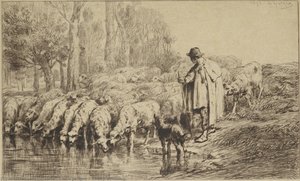
On the Pasture

Charles-Émile Jacque's 'On the Pasture' captures a serene rural scene of a man and sheep under a tree, showcasing the Barbizon School’s idyllic landscapes and masterful detail.

Charles-Émile Jacque (1813-1894): Barbizon School painter of idyllic rural scenes, sheep & livestock. Masterful engravings & a key figure in Realism.

Масляная репродукция ручной работы

Картина маслом на холсте в выбранном вами размере и раме, написанная на заказ нашими художниками. (Купить принт Купить принтКупить изображение Купить изображение)

P118B $10
P118H $10
P118W $10
P438Z $10
P508JH $12
P508YH $12
P805H $10
P805Z $10
P919BZ $10
P919G $10
P919XJ $10
P959ZH $10
P968JZ $12
W106C $8
W218G $10
W218JH $8
W218Y $10
W307PJ $10
W316G $10
W316PJ $8
W316Y $10
W398PJ $8
W4111J $10
W500HY $15
W500JH $15
W692G $12
W849H $8
W940BG $15
W953PJ $8

Standard
custom
CM
INCH

Выберите один из наших стандартных размеров, соответствующих оригинальным пропорциям произведения искусства.

ширина
высота

Вы можете указать собственные размеры, чтобы картина идеально вписалась в выбранную раму или пространство. Если выбранный вами размер не соответствует пропорциям оригинала, мы либо обрежем полотно, либо расширим его за счет дополнительных элементов, написанных вручную. Цифровой макет будет отправлен вам на утверждение перед началом производства.
Обратите внимание, что предварительный просмотр на экране не отражает фактическую обрезку или расширение. Только макет точно покажет окончательную композицию.
Хотя доступны индивидуальные размеры, мы рекомендуем выбирать вариант из предопределенного списка, чтобы сохранить исходные пропорции.

Примеры того, что можно изменить: заменить лицо на фото клиента; добавить домашнее животное (например, заменить кошку на собаку); добавить скрытое послание на фон; изменить пейзаж или детали фона.
После оформления заказа команда OriginalUniqueArt.com свяжется с клиентом по электронной почте для уточнения деталей и предоставит предварительный макет

Доставка по всему миру () за 3–4 недели вместо стандартных 5 недель. (17 Август). Без компромиссов в качестве.

why_choose_icon
Бесплатная экспресс-доставка по всему миру
why_choose_icon
Высококачественный льняной холст
why_choose_icon
Полное страхование доставки
why_choose_icon
Гарантия возмещения таможенных пошлин
why_choose_icon
Гарантия точного соответствия цветов
why_choose_icon
Политика возврата в течение 60 дней (только при наличии дефектов)
why_choose_icon
Гарантия возврата 100% средств
why_choose_icon
Предложение оптовых скидок

Общая стоимость

$ 300

reproduction

On the Pasture

Техника репродукции

Размер репродукции

-

Итоговая стоимость

$ 300

Основные сведения

  • Medium: Oil on canvas
  • Influences: Van Ostade
  • Year: 1860
  • Location: Szépmûvészeti Múzeum
  • Artistic style: Realism
  • Title: On the Pasture
  • Notable elements: Pastoral scene

Тест по искусству

В каждом вопросе только один правильный ответ.

Вопрос 1:
What is the primary subject depicted in Charles-Émile Jacque’s painting, ‘On the Pasture’?
Вопрос 2:
In what artistic movement was Charles-Émile Jacque primarily associated?
Вопрос 3:
According to the provided information, what was Charles-Émile Jacque’s early career before pursuing painting?
Вопрос 4:
What year does the description state that Charles-Émile Jacque was born?
Вопрос 5:
The description mentions that Jacque’s work influenced Jean-François Millet. What characteristic of Jacque's style is highlighted in this connection?

Описание произведения

A Pastoral Moment Frozen in Time: Charles-Émile Jacque’s “On the Pasture”

Charles-Émile Jacque's "On the Pasture" is more than just a depiction of a rural scene; it’s a poignant meditation on tranquility, connection to nature, and the quiet dignity of everyday life. Painted in 1860 during his time with the Barbizon School, this oil on canvas transports us to a sun-drenched field in France, where a solitary figure finds solace beneath the shade of an ancient tree while sheep graze peacefully around him. The painting immediately evokes a sense of serenity—a deliberate antidote to the burgeoning industrialization and urban sprawl that were rapidly reshaping 19th-century Europe.

Jacque’s artistic journey was surprisingly unconventional, beginning not with brushes and canvas but with the meticulous craft of map engraving for the French army. This early training instilled in him a remarkable attention to detail, a precision of observation, and an appreciation for capturing subtle nuances – qualities that would later become hallmarks of his pastoral paintings. He transitioned into painting after serving his military duty, initially exploring illustration before finding his true voice within the Barbizon School’s embrace of direct observation and rejection of academic conventions.

The Barbizon School: A Return to Nature

To understand “On the Pasture,” one must appreciate the context of the Barbizon School. Emerging in the 1850s, this movement represented a deliberate rebellion against the rigid formality of the French Salon system and the prevailing academic style. Artists like Jacque, Millet, and Corot sought to capture the essence of rural France—its landscapes, its people, and its rhythms—with an unprecedented level of realism and immediacy. They eschewed studio work in favor of *plein air* painting, directly observing nature and translating it onto canvas with bold brushstrokes and a focus on capturing light and atmosphere.

Unlike the idealized landscapes favored by earlier Romantic painters, the Barbizon School’s depictions were often rough-hewn and unpolished. Jacque's work is particularly notable for its earthy palette—a symphony of muted greens, browns, and ochres—that perfectly captures the weathered beauty of the French countryside. The composition itself is deceptively simple: a central tree acting as a visual anchor, framing the scene and drawing the viewer’s eye to the solitary figure and the grazing sheep.

Symbolism and Emotional Resonance

The lone man beneath the tree isn't merely an observer; he embodies a quiet contemplation, a connection to something larger than himself. He is not actively engaged in labor or social interaction—rather, he seems lost in thought, absorbing the peace of the natural world. The sheep, symbols of innocence and simplicity, further reinforce this theme of pastoral harmony. The painting’s emotional impact is profoundly calming; it invites us to slow down, breathe deeply, and appreciate the beauty of a moment suspended in time.

Furthermore, Jacque's work reflects a broader cultural shift—a growing awareness of the importance of rural life and a yearning for an escape from the pressures of modern society. The painting speaks to a desire for authenticity, for connection with the land, and for a simpler way of being.

Technical Details and Legacy

Jacque’s masterful technique is evident in his skillful rendering of texture—the rough bark of the tree, the soft wool of the sheep, the undulating grass of the field. He employs loose, expressive brushstrokes that convey both a sense of immediacy and a deep understanding of light and shadow. The painting's size – approximately 81 x 65 cm – allows for a remarkable level of detail while maintaining an overall feeling of spaciousness and tranquility.

“On the Pasture” remains a powerful example of Barbizon School art, showcasing Jacque’s unique ability to capture the essence of rural France. It's a timeless depiction of human connection with nature, offering a poignant reminder of the beauty and serenity that can be found in the simplest of moments. Reproductions of this evocative work continue to resonate with viewers today, transporting them to a world of quiet contemplation and pastoral charm.


Биография художника

A Life Rooted in the French Countryside

Charles-Émile Jacque, born in Paris in 1813, wasn’t destined for a conventional artistic path. His early life took an unexpected turn with seven years of service in the French army. Yet, even within the regimented structure of military life, his innate talent found expression – not through painting initially, but through the meticulous skill of map engraving. This foundational training, demanding precision and observation, would prove surprisingly pivotal to his later artistic endeavors, instilling a dedication to detail that became a hallmark of his work. It was an unlikely beginning for a painter who would become synonymous with the idyllic beauty of rural France, yet it speaks volumes about Jacque’s adaptability and inherent artistry. Upon leaving the army, he briefly pursued illustration and caricature, contributing to Parisian journals before finding his true calling in the realm of etching and painting.

Embracing Barbizon and a Pastoral Vision

The mid-19th century saw Jacque drawn towards Barbizon, a small village that would become the epicenter of a revolutionary artistic movement. Fleeing cholera epidemics plaguing Paris, he joined Jean-François Millet and other like-minded artists in seeking inspiration directly from nature. This marked a decisive shift away from academic conventions and toward a more honest, realistic portrayal of life. Jacque wholeheartedly embraced this new approach, dedicating himself to capturing the essence of rural existence – the quiet dignity of shepherds tending their flocks, the gentle rhythm of farm labor, the simple beauty of livestock in sun-dappled fields. His paintings weren’t merely depictions of scenes; they were imbued with a deep sense of tranquility and harmony, reflecting a profound appreciation for the natural world. He wasn't simply *painting* sheep or barns; he was conveying a feeling, an atmosphere—a reverence for the pastoral life that resonated deeply with audiences.

Master of Mediums: Painting and Printmaking

Jacque’s artistic prowess extended beyond painting. He became renowned as a master etcher and engraver, reviving 17th-century techniques and pushing the boundaries of printmaking. His etchings were lauded for their boldness and well-conceived subject matter, earning him praise from critics like Charles Baudelaire. Henri Béraldi distinguished two distinct periods in Jacque’s graphic work: an early phase inspired by Dutch vignettes, characterized by spontaneity, and a later period marked by larger, more detailed plates demonstrating meticulous craftsmanship. This dual mastery – of both brush and burin – allowed him to reach a wider audience and solidify his reputation as a significant figure in the art world. He didn’t see painting and printmaking as separate disciplines but rather as complementary avenues for expressing his artistic vision. His illustrations for literary classics, including editions of Goldsmith's *The Vicar of Wakefield* and Wordsworth’s *Picturesque Greece*, further showcased his versatility and skill.

Legacy and Lasting Influence

Charles-Émile Jacque died in 1894, leaving behind a rich artistic legacy that continues to captivate viewers today. He played a vital role in shaping the development of Realism in French art, paving the way for future generations of artists who sought to depict life with honesty and sensitivity. His dedication to portraying rural life elevated genre painting – scenes from everyday existence – to a position of prominence within the artistic landscape.
  • A Pioneer of Etching Revival: Jacque’s revival of 17th-century etching techniques significantly impacted printmaking.
  • Influence on Millet: His early work and etchings profoundly influenced his friend and fellow Barbizon School artist, Jean-François Millet.
  • Champion of Rural Life: He immortalized the beauty and dignity of rural life in France, creating a lasting visual record of a disappearing way of existence.
Jacque’s paintings and engravings offer more than just picturesque scenes; they provide a window into a bygone era, inviting us to contemplate the enduring connection between humanity and nature. His work remains a testament to the power of art to capture not only what we see but also how we feel.
Charles-Émile Jacque

Charles-Émile Jacque

1813 - 1894 , France

Основные сведения

  • Artistic Movement Or Style: Barbizon School
  • Artists Or Movements Influenced By This Artist: ['Realism']
  • Artists Who Influenced This Artist: ['Adriaen van Ostade']
  • Date Of Birth: 1813
  • Date Of Death: 1894
  • Full Name: Charles-Émile Jacque
  • Nationality: French
  • Notable Artworks:
    • Little Blue Boy
    • The Sheepfold
    • Shepherdess
  • Place Of Birth: Paris, France
Откройте для себя произведения искусства, подобранные по темам, стилям и характеристикам.