

 Примерить в интерьере
 Отправить
 Поделиться
 Подробнее
 Руководство

 Скачать
 Похожие объекты
 Рентгенография
 Слайд-шоу
 Статистика
Kairuan III


 Развернуть текст
Жикле / Арт-принты
Печать (жикле) или холст музейного качества с быстрыми сроками изготовления и широким выбором вариантов отделки. ( Заказать репродукцию ручной работы Перейти к цифровым изображениям)




P118B $10

P118H $10

P118W $10

P438Z $10

P508JH $12

P508YH $12

P805H $10

P805Z $10

P919BZ $10

P919G $10

P919XJ $10

P959ZH $10

P968JZ $12

W106C $8

W218G $10

W218JH $8

W218Y $10

W307PJ $10

W316G $10

W316PJ $8

W316Y $10

W398PJ $8

W4111J $10

W500HY $15

W500JH $15

W692G $12

W849H $8

W940BG $15

W953PJ $8




Выберите один из наших стандартных размеров, соответствующих оригинальным пропорциям произведения искусства.

Введите необходимую ширину и высоту, чтобы репродукция подошла к вашей раме или стене. При печати изображение можно только уменьшить, но нельзя увеличить больше оригинала, поэтому при выборе другого формата часть изображения может быть обрезана. Перед печатью мы отправим вам цифровой макет на утверждение. Изображение на этой странице не отображает реальную обрезку — ее можно увидеть только на макете.
Доставка по всему миру () за 2 недели вместо стандартных 4–5 недель. (22 Октябрь)

Бесплатная экспресс-доставка по всему миру

Высококачественный льняной холст

Полное страхование при транспортировке

Гарантия возврата таможенных пошлин

Гарантия точного цветового соответствия

100-дневный период возврата (только при обнаружении дефектов)

Гарантия возврата 100% средств

Скидка при заказе нескольких работ
 Вариант со стеклом доступен только для размеров менее 110 см

Kairuan III
Жикле / Арт-принты
Размер репродукции
-


Итоговая стоимость
$ 80
Kairouan III: A Fragment of Urban Harmony
August Macke’s “Kairouan III,” painted in 1914, isn't merely a cityscape; it’s a fleeting moment captured with an almost feverish intensity. Created during a pivotal period of artistic experimentation – a time when German Expressionism was grappling with new forms and the burgeoning influence of movements like Orphism – this watercolor offers a glimpse into Macke’s evolving vision, a synthesis of observation and deeply felt emotion. The painting depicts a bustling street scene in Kairouan, Tunisia, a location that profoundly impacted Macke's artistic sensibilities during his travels. It’s a place he described as “a paradise,” a vibrant hub of color and life that served as a crucial catalyst for his later work.
Macke’s style at this time is characterized by a remarkable blend of influences. While rooted in the Impressionist techniques he initially absorbed, particularly the use of broken brushstrokes to capture light and atmosphere, “Kairouan III” demonstrates a clear shift towards a more expressive and simplified approach. The forms are not meticulously rendered but rather suggested with bold, confident strokes, prioritizing color and composition over photographic realism. This is evident in the flattened perspective, the exaggerated scale of certain buildings, and the almost dreamlike quality of the scene. The painting’s energy isn't derived from detailed observation, but from Macke’s subjective experience of the place – a distillation of its essence into a vibrant, emotionally charged composition.
Orphism and the Language of Color
“Kairouan III” is deeply intertwined with the principles of Orphism, a movement pioneered by Robert Delaunay and Sonia Delaunay. Orphism sought to liberate color from its traditional role as a descriptive element, instead using it purely for its aesthetic qualities – its ability to evoke emotion and create visual harmony. Macke embraced this approach wholeheartedly, employing a dazzling array of colors that seem almost luminous against the paper’s surface. The palette is dominated by intense blues, greens, yellows, and reds, layered in overlapping planes and creating a dynamic sense of movement and depth. Notice how he uses complementary colors – blue and orange, yellow and violet – to intensify each hue and generate visual excitement.
The technique itself contributes significantly to the painting’s effect. Macke employs loose, gestural brushstrokes, often applying paint directly from the tube with minimal blending. This creates a sense of immediacy and spontaneity, as if he were capturing the scene in real-time. The layering of colors is also crucial; each hue builds upon the previous one, creating a shimmering surface that seems to vibrate with energy. This technique isn’t about precise representation but rather about conveying the *feeling* of being immersed in this vibrant urban landscape.
Symbolism and the Human Element
While “Kairouan III” is primarily concerned with color and composition, it also subtly hints at deeper symbolic meanings. The densely packed buildings, rendered with a sense of both dynamism and claustrophobia, suggest the complexities of modern urban life. The figures – though largely indistinct – represent the human element within this environment, adding scale and suggesting activity without explicitly defining their roles or relationships. Macke’s focus is less on individual portraits and more on capturing the collective experience of a place.
Furthermore, the painting's title itself—Kairouan—references an ancient city in Tunisia, steeped in history and religious significance. This connection adds another layer of meaning to the work, suggesting a dialogue between the past and the present, tradition and modernity. Macke’s choice of subject matter reflects his interest in exploring themes of cultural exchange and the transformative power of travel.
A Window into a Lost World
August Macke's “Kairouan III” is more than just a beautiful painting; it’s a poignant testament to a brilliant artist whose life was tragically cut short during World War I. Painted in the midst of his most innovative period, this work encapsulates his evolving artistic vision and his profound engagement with color, form, and symbolism. It offers a rare glimpse into a world brimming with energy, emotion, and a deep appreciation for the beauty of everyday life – a world that vanished all too soon. Reproductions of “Kairouan III” capture not only its visual splendor but also the artist’s unique spirit, making it a compelling addition to any collection or a captivating focal point in any interior space.
Вопросы и ответы
Какова воспринимаемая яркость произведения «Kairuan III», Август Макке?
С точки зрения воспринимаемой яркости, «Kairuan III», Август Макке — это brilliant.
Какое национальное происхождение лежит в основе Expressionist Cityscape произведения «Kairuan III»?
Работа в стиле Expressionist Cityscape «Kairuan III» была создана художником, уроженцем Германия.
Где лучше всего повесить репродукцию «Kairuan III», Август Макке?
Формат Landscape для работы «Kairuan III», Август Макке рекомендуется размещать в Living Room. Формат и пространство вместе помогают определить идеальное место для репродукции.
Биография художника
A Life Cut Short: The Vibrant World of August Macke
August Robert Ludwig Macke, a name forever intertwined with the brief but intensely brilliant flowering of German Expressionism, lived a life tragically curtailed by the horrors of the First World War. Born in 1887 in Meschede, a small town nestled within the Westphalian countryside, his artistic journey was one of rapid evolution and profound exploration – a relentless pursuit to capture not just what he *saw*, but how he *felt* about it. Macke’s early years were marked by a quiet determination, a yearning for creative expression that propelled him from his hometown to Bonn, where he began to hone his nascent talent under the guidance of local educators. Though formally trained at the Düsseldorf Art Academy between 1904 and 1906, under the tutelage of Adolf Maennchen, it was through independent study, travel, and a deep immersion in the artistic currents of the time that his unique voice truly began to emerge. These formative years were characterized by an absorption of Impressionist and Post-Impressionist techniques – a careful study of light, color, and brushwork – laying a foundation for the bolder, more emotionally charged expressions he would later develop. He supplemented his income with stage design work, a demanding profession that sharpened his compositional skills and cultivated a keen eye for visual harmony.Influences and Artistic Development: A Synthesis of Styles
Macke’s artistic trajectory was profoundly shaped by encounters with key figures and movements of the early 20th century – a confluence of influences that ultimately forged his distinctive style. A pivotal moment arrived in Paris in 1912, where he met Robert Delaunay, a leading proponent of Orphism – a branch of Cubism focused on pure abstraction and vibrant color harmonies. This encounter proved transformative, introducing Macke to the concept of simultaneous contrast and influencing his work towards a more dynamic and non-representational approach. He began experimenting with broken planes of color and abstracted forms, seeking to convey not just what he saw, but how he *felt* about what he saw – a core tenet of Expressionism. Simultaneously, his close friendship with Franz Marc, a fellow artist and member of the influential group Der Blaue Reiter (The Blue Rider), drew him into the orbit of Wassily Kandinsky and other avant-garde thinkers. While Macke’s style remained distinct from Kandinsky's more purely abstract explorations, he embraced the group’s spirit of artistic freedom and spiritual inquiry. His paintings began to reflect a growing interest in depicting the emotional resonance of landscapes and everyday life, imbued with a sense of joy and optimism. The influence of Matisse was also significant; Macke adopted the Fauves’ bold use of color and expressive brushstrokes, injecting energy and vitality into his compositions. He wasn't simply copying these styles; he was synthesizing them, creating something entirely new – a visual language uniquely his own.The Blue Rider and Beyond: A Unique Expressionist Vision
As an integral member of Der Blaue Reiter, Macke contributed significantly to the group’s exhibitions and publications, helping to disseminate its radical ideas about art and spirituality. However, he wasn't simply a follower; he forged his own unique path within the movement. Unlike some of his colleagues who leaned towards darker, more angst-ridden themes – often reflecting the anxieties of the time – Macke consistently sought to portray beauty and harmony in the world around him. His paintings, such as Bathing Girls with Town in the Background, exemplify this approach – vibrant colors, simplified forms, and a sense of idyllic tranquility characterize his work. He masterfully blended elements of Fauvism, Cubism, and Futurism into a distinctly personal style, creating compositions that are both visually striking and emotionally resonant. Woman in a Green Jacket, painted in 1913, is another prime example – a portrait radiating warmth and vitality through its bold color palette and confident brushwork. His later works, like Türkisches Café, demonstrate his luminist approach, capturing the play of light and shadow with remarkable sensitivity. The artist’s job, he wrote, was to explore and express the human soul - our inner life - via representation of form and use of (non-naturalistic) color.Major Achievements: A Legacy of Color and Emotion
August Macke's artistic achievements are characterized by a remarkable ability to capture the essence of modern experience through vibrant color, dynamic composition, and an underlying sense of optimism. His paintings – landscapes, portraits, still lifes, and scenes of everyday life – are imbued with a palpable energy that reflects both the beauty and the anxieties of his time. He was particularly adept at depicting the natural world, transforming ordinary landscapes into evocative expressions of emotion. Bathing Girls with Town in the Background is perhaps his most famous work, a testament to his ability to capture the fleeting moments of joy and connection within the urban landscape. His portraits, such as Woman in a Green Jacket, are equally compelling, radiating warmth and vitality through their bold color palettes and confident brushwork. Macke’s influence extended beyond Germany, inspiring artists across Europe who were seeking new ways to express themselves in the wake of World War I. His work continues to be exhibited and studied today, serving as a reminder of the power of art to illuminate the human condition.A Tragic End and Lasting Legacy
The outbreak of World War I brought a sudden and devastating end to Macke’s promising career. Driven by patriotic fervor, he volunteered for military service in 1914. Tragically, he was killed in action just weeks later, on September 26th, at the front near Champagne, France, at the young age of 27. His final painting, Farewell, poignantly captures the somber mood that descended upon Europe as war engulfed the continent. Despite his untimely death, August Macke’s legacy endures. He remains a significant figure in the history of Expressionism, celebrated for his vibrant colors, dynamic compositions, and optimistic vision. His paintings offer a glimpse into a world on the cusp of change, imbued with a sense of beauty and hope amidst growing uncertainty. Exploring his works today reveals an artist who not only captured the spirit of his time but also created timeless images that continue to resonate with viewers across generations.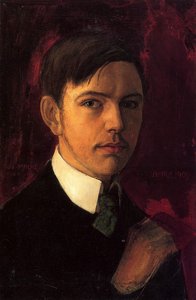
Август Макке
1887 - 1914 , Германия
Краткая справка
- Artistic Movement Or Style: Экспрессионизм
- Artists Or Movements Influenced By This Artist: ['Синий рыцарь']
- Artists Who Influenced This Artist:
- Роберт Делаunay
- Франц Марк
- Date Of Birth: 3 января 1887 г.
- Date Of Death: 26 сентября 1914 г.
- Full Name: August Robert Ludwig Macke
- Nationality: Немецкий
- Notable Artworks:
- Женщина в зеленом пальто
- Батающие девушки на фоне города
- Турецкий кафе
- Place Of Birth: Ме́схеде, Германия
Похожие статьи

Ephemeral Visions: Exploring the Artistic Legacy & Nuances of Watercolor Painting
Explore the captivating world of watercolor painting! Discover its rich history, essential techniques, influential artists & collecting tips from art experts. A comprehensive guide for enthusiasts.

Ephemeral Visions: Exploring the History & Emotional Resonance of Watercolor Painting
Explore the captivating history of watercolor painting, from ancient techniques to modern masters like Kandinsky & Blake. Discover essential artists, collecting tips & the emotional power of this luminous medium. Expert insights for art enthusiasts.

Ephemeral Visions: Exploring the Artistic Legacy & Contemporary Practice of Watercolor Painting
Explore the captivating world of watercolor painting! Discover its rich history, essential techniques, influential artists & collecting tips. A comprehensive guide for art enthusiasts from OriginalUniqueArt.

Топ-25 шедевров Ренуара: искусство, история и вдохновение для интерьера
Погрузитесь в мир Ренуара! 🎨 Откройте топ-25 шедевров импрессионизма, историю создания картин и вдохновляющую красоту. Купите репродукции высокого качества для вашего интерьера на OriginalUniqueArt.com – музейное искусство онлайн!

Топ-10 легендарных акварелей, изменивших искусство навсегда | OriginalUniqueArt
Погрузитесь в мир акварели! Откройте топ-10 легендарных картин Turner, Monet и других великих художников. История искусства, техники живописи и вдохновение для вашего интерьера. Репродукции музейного качества на OriginalUniqueArt.com.


