

 Примерить в интерьере
 Отправить
 Поделиться
 Подробнее
 Руководство

 Скачать
 Похожие объекты
 Рентгенография
 Слайд-шоу
 Статистика
Misty Moonlight
 Oil On Canvas
- WallArt
- Tonalism & Symbolism
 1885
1885- 19th Century
 28.0 x 29.0 cm
 Crystal Bridges Museum of American Art
 Развернуть текст
Масляная репродукция ручной работы
Картина маслом на холсте в выбранном вами размере и раме, написанная на заказ нашими художниками. ( Переключиться на печать Перейти к цифровым изображениям)




P118B $10

P118H $10

P118W $10

P438Z $10

P508JH $12

P508YH $12

P805H $10

P805Z $10

P919BZ $10

P919G $10

P919XJ $10

P959ZH $10

P968JZ $12

W106C $8

W218G $10

W218JH $8

W218Y $10

W307PJ $10

W316G $10

W316PJ $8

W316Y $10

W398PJ $8

W4111J $10

W500HY $15

W500JH $15

W692G $12

W849H $8

W940BG $15

W953PJ $8




Выберите один из наших стандартных размеров, соответствующих оригинальным пропорциям произведения искусства.

Введите необходимую ширину и высоту, чтобы репродукция подошла к вашей раме или стене. Поскольку работа выполняется вручную, при изменении пропорций художник может немного увеличить область вокруг картины или, наоборот, обрезать края — выбор за вами. Перед началом работы мы пришлем вам цифровой макет на утверждение. Изображение на этой странице не является точным результатом — увидеть реальный вид можно только на макете.
После оформления заказа команда OriginalUniqueArt.com свяжется с клиентом по электронной почте для уточнения деталей и предоставит предварительный макет
Доставка по всему миру () за 3–4 недели вместо стандартных 5 недель. (25 Октябрь). Без компромиссов в качестве.

Бесплатная экспресс-доставка по всему миру

Высококачественный льняной холст

Полное страхование при транспортировке

Гарантия возврата таможенных пошлин

Гарантия точного цветового соответствия

100-дневный период возврата (только при обнаружении дефектов)

Гарантия возврата 100% средств

Скидка при заказе нескольких работ
 Вариант со стеклом доступен только для размеров менее 110 см

Misty Moonlight
Материал репродукции
Размер репродукции
-


Итоговая стоимость
$ 300
A Nocturne of Shadows and Light
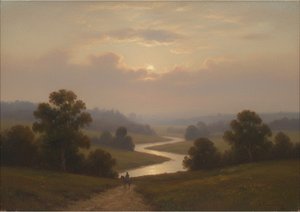
In the quietude of the late nineteenth century, few artists captured the ephemeral essence of the American night as profoundly as Albert Pinkham Ryder. His masterpiece, Misty Moonlight (1885), serves as a hauntingly beautiful window into the soul of Tonalism, offering much more than a mere depiction of a seascape. The painting presents a serene yet melancholic vision of a nocturnal world, where a solitary sailing ship drifts through a sea of deep blacks and greenish grays. A luminous crescent moon hangs suspended in the hazy atmosphere, casting a soft, ethereal glow that seems to dissolve the boundaries between the water and the sky. This is not a scene of action, but one of profound stillness, inviting the viewer into a state of meditative contemplation.
The emotional resonance of this work lies in its ability to evoke a sense of mystery and longing. The sparse composition—a delicate dance of geometric forms including the rectangular expanse of the sea, the triangular silhouette of the vessel, and the circular moon—prevents any specific narrative from taking hold. Instead, the viewer is left to wander through the artist's dreamscape, feeling the weight of the heavy, damp air and the rhythmic, silent pulse of the tide. For the collector or interior designer, this piece offers a sophisticated anchor for a room, providing a focal point that commands attention through subtlety rather than spectacle.
The Alchemy of Unconventional Technique
To understand the mesmerizing texture of Misty Moonlight, one must look closely at Ryder’s radical approach to the medium. Eschewing the polished, academic precision favored by his contemporaries, Ryder embraced a method of deliberate instability. He was known for applying successive layers of oil paint while the underlying coats were still wet, a technique that allowed colors to bleed and merge in unpredictable ways. This process created the "gauzy" and atmospheric quality that defines his most celebrated works.
This layering does more than just create visual depth; it imbues the canvas with a physical materiality that feels alive. The resulting surface is often thick and textured, capturing light in a way that mimics the shifting mists of a coastal night. This mastery of atmosphere—achieved through what some might call "controlled chaos"—is precisely what makes a high-quality reproduction of this work so captivating. When rendered with care, the interplay of dark tones and soft highlights can transform a modern living space into a sanctuary of historical depth and artistic intrigue.
A Legacy of Symbolism and Inspiration
Ryder’s inspiration was deeply rooted in his formative years in New Bedford, Massachusetts, a bustling whaling port where the sea was an ever-present character in daily life. The maritime motifs found in Misty Moonlight are not merely decorative; they are echoes of a childhood spent amidst salt spray and moonlight. This connection to the American coast lends the painting an authentic, grounded spirit, even as it drifts into the realms of Symbolism.
As a pioneer of American Symbolism, Ryder used the landscape to represent internal emotional states. The ship, often a recurring motif in his oeuvre, can be seen as a symbol of the human journey through the unknown, navigating the murky waters of existence under the watchful eye of a distant, celestial light. For those seeking to decorate with purpose, incorporating such a piece allows for the introduction of profound storytelling into an environment. It is an invitation to look beyond the surface and find beauty in the shadows, making it an enduring choice for any curated collection of fine art.
Вопросы и ответы
Какая цветовая гармония представлена в работе «Misty Moonlight», Альберт Пинхэм Райдер?
В работе «Misty Moonlight», Альберт Пинхэм Райдер представлена Unified Palette цветовая гармония.
Какой цвет преобладает в композиции «Misty Moonlight», Альберт Пинхэм Райдер?
Преобладающий цвет произведения «Misty Moonlight», Альберт Пинхэм Райдер — Phthalo Green (#2d2c27).
Какова насыщенность цветов в работе «Misty Moonlight», Альберт Пинхэм Райдер?
Насыщенность работы «Misty Moonlight», Альберт Пинхэм Райдер составляет Subtle Color.
Биография художника
Albert Pinkham Ryder (1847–1917): A Visionary of American Romanticism
Albert Pinkham Ryder, born March 19, 1847, in New Bedford, Massachusetts, remains a somewhat enigmatic figure in American art history. Details of his childhood are scarce, shrouded in the mists that would later become so characteristic of his paintings. However, it is known that he began to explore his artistic inclinations early on, capturing the landscapes of his native New Bedford with nascent skill. This coastal upbringing, steeped in the atmosphere of a bustling whaling port, undoubtedly left an indelible mark on his imagination and would resurface throughout his career as a recurring source of inspiration.In the late 1860s, Ryder’s family relocated to New York City, where his brother managed the renowned Hotel Albert in Greenwich Village. This move placed young Albert within a vibrant cultural milieu, offering opportunities for artistic development and exposure to new ideas. While assisting with family responsibilities, he continued to pursue his passion for painting, laying the groundwork for his future artistic journey.
Formal Training and European Influences
Ryder’s formal art education began with studies under William Edgar Marshall in New York City. He then enrolled at the National Academy of Design, attending between 1870 and 1875, where he exhibited his first work in 1873 and forged a lifelong friendship with fellow artist Julian Alden Weir. These formative years provided him with a solid foundation in traditional techniques and introduced him to the established art world.
However, Ryder’s artistic vision extended beyond conventional academic training. Between 1877 and 1903, he embarked on four journeys to Europe, immersing himself in the artistic currents of the Old World. He was particularly drawn to the French Barbizon school, with its emphasis on naturalism and plein air painting, and the Dutch Hague School, known for its atmospheric landscapes and muted color palettes. These influences profoundly shaped his aesthetic sensibilities, contributing to the development of his unique style.
A Painter's Soul: Ryder’s Distinctive Style
Ryder’s artistic signature is instantly recognizable—a captivating blend of Symbolism, Tonalism, and a deeply personal vision. His paintings are not mere representations of reality but rather evocative interpretations of nature infused with mood, mystery, and spiritual resonance. He favored broad, often ill-defined shapes and stylized figures set within dreamlike landscapes or seascapes, creating an atmosphere that is both ethereal and haunting.
Light plays a crucial role in Ryder’s work. His scenes are frequently illuminated by dim sunlight filtering through eerie clouds or the soft glow of moonlight, casting long shadows and enhancing the sense of drama and introspection. He masterfully manipulated color to create subtle variations and atmospheric effects, often employing a limited palette to achieve maximum emotional impact.
Notable Works and Legacy
Ryder’s most celebrated paintings include Misty Moonlight (ca. 1893), which captures the sublime beauty of coastal New Bedford under an overcast sky—a testament to his ability to distill nature's essence into a single, unforgettable image. Also noteworthy are The Race Track (1894) and Siegfried & Rhine Maidens (1896), where Ryder explored mythological themes with symbolic imagery and expressive brushwork.
Ryder’s influence extends far beyond his immediate contemporaries. His emphasis on form, color, and emotional expression paved the way for later generations of artists, including Jackson Pollock, who acknowledged Ryder as a significant precursor to Abstract Expressionism. He remains celebrated as a pioneer of American Tonalism and Symbolism, an artist whose mystical paintings continue to inspire awe and wonder.
Lloyd Goodrich says that Ryder is “one of the few authentic religious painters of his period” in whom religion was not mere conformity, but deep personal emotion. The life of Christ moved him to some of his most tender and impressive works.

Альберт Пинхэм Райдер
1847 - 1917 , США
Краткая справка
- Artistic Movement Or Style: Тонализм и Символизм
- Artists Who Influenced This Artist:
- Вильям Эдгар Маршалл
- Дж. Эйлен Уир
- Date Of Birth: Марч 19, 1847
- Date Of Death: Марч 28, 1917
- Full Name: Albert Pinkham Ryder
- Nationality: Американский
- Notable Artworks:
- Морской туман
- Сигильфред и Рейнская дева
- Place Of Birth: Нью-Берфорд, США
Похожие статьи

10 Шедевров Американского Реализма: Искусство Правды и Жизни | OriginalUniqueArt
Погрузитесь в мир американского реализма! 10 шедевров от Эндрю Уайета, Эдварда Хоппера и других. История искусства, техники живописи и вдохновение для вашего интерьера. Купите репродукции картин на OriginalUniqueArt.com!

Grant Wood & American Regionalism: Identity, Myth & the Rural Landscape
Explore the world of Grant Wood & American Regionalism with OriginalUniqueArt. Discover the symbolism behind 'American Gothic', recurring themes, and the movement's lasting impact on art history. High-quality reproductions available.
Atmospheric Visions: Exploring Tonalism in American Painting
Explore the captivating world of American Tonalism! Discover its history, key artists like Whistler & Inness, techniques, and lasting influence on art. Expert insights for collectors & enthusiasts.

Albert Bierstadt: Luminosity, Landscape & the American Ideal
Explore the breathtaking landscapes of Albert Bierstadt, master of the American West & a leading figure in the Hudson River School. Discover his luminous style and iconic paintings – a timeless investment for art lovers.

American Regionalism: A Crucible of Identity – Exploring Themes of Place, Labor & Social Commentary
Explore American Regionalism's powerful depiction of the American heartland during the Great Depression. Discover Grant Wood, Thomas Hart Benton & more. Expert analysis & high-quality art reproductions at OriginalUniqueArt.
