

 Примерить в интерьере
 Отправить
 Поделиться
 Подробнее
 Руководство

 Скачать
 Похожие объекты
 Рентгенография
 Слайд-шоу
 Статистика
Conveying a Child
 Oil On Canvas
- WallArt
- Realism
 1879
1879- 19th Century
 204.0 x 120.0 cm
 Художественный музей Аteneum
 Развернуть текст
Жикле / Арт-принты
Печать (жикле) или холст музейного качества с быстрыми сроками изготовления и широким выбором вариантов отделки. ( Заказать репродукцию ручной работы Перейти к цифровым изображениям)




P118B $10

P118H $10

P118W $10

P438Z $10

P508JH $12

P508YH $12

P805H $10

P805Z $10

P919BZ $10

P919G $10

P919XJ $10

P959ZH $10

P968JZ $12

W106C $8

W218G $10

W218JH $8

W218Y $10

W307PJ $10

W316G $10

W316PJ $8

W316Y $10

W398PJ $8

W4111J $10

W500HY $15

W500JH $15

W692G $12

W849H $8

W940BG $15

W953PJ $8




Выберите один из наших стандартных размеров, соответствующих оригинальным пропорциям произведения искусства.

Введите необходимую ширину и высоту, чтобы репродукция подошла к вашей раме или стене. При печати изображение можно только уменьшить, но нельзя увеличить больше оригинала, поэтому при выборе другого формата часть изображения может быть обрезана. Перед печатью мы отправим вам цифровой макет на утверждение. Изображение на этой странице не отображает реальную обрезку — ее можно увидеть только на макете.
Доставка по всему миру () за 2 недели вместо стандартных 4–5 недель. (22 Октябрь)

Бесплатная экспресс-доставка по всему миру

Высококачественный льняной холст

Полное страхование при транспортировке

Гарантия возврата таможенных пошлин

Гарантия точного цветового соответствия

100-дневный период возврата (только при обнаружении дефектов)

Гарантия возврата 100% средств

Скидка при заказе нескольких работ
 Вариант со стеклом доступен только для размеров менее 110 см

Conveying a Child
Жикле / Арт-принты
Размер репродукции
-


Итоговая стоимость
$ 80
Albert Edelfelt’s ‘Conveying a Child’: A Window into Finnish Life and Sorrow
Albert Edelfelt's “Conveying a Child” (1879) is more than just a depiction of a boat journey; it’s a poignant meditation on mortality, family, and the quiet dignity found in accepting life’s inevitable sorrows. Painted during a pivotal moment in Edelfelt’s artistic development – his fervent embrace of plein-air realism – this large oil on canvas transports us to Haikko near Porvoo, Finland, a place steeped in both beauty and profound melancholy.
The scene unfolds with remarkable clarity. A group of individuals, rendered with meticulous detail, are gathered within a sturdy rowing boat navigating the waters of the Gulf of Finland. Men and women, dressed in the attire of the late 19th century, engage in conversation or simply bask in the tranquility of the moment. Two boats – a larger vessel dominating the foreground and a smaller one positioned to the right – add depth and visual interest to the composition. Edelfelt’s skill lies not just in his technical proficiency but in capturing the genuine warmth and connection between these figures, suggesting a shared experience of comfort and companionship.
Plein-Air Realism and the Rise of Finnish Art
“Conveying a Child” represents a significant shift in Edelfelt’s artistic approach. Following his time studying in Antwerp and Paris, he became increasingly committed to painting directly from nature – a revolutionary concept at the time. This dedication to *plein-air* realism was driven by a desire to capture the authentic essence of Finnish life, moving away from the idealized historical subjects favored by many of his contemporaries. Edelfelt’s decision to paint entirely outdoors, as evidenced by this work, aligns with the broader movement towards naturalism gaining traction within the European art world.
This commitment to realism was particularly important for Edelfelt, who sought to elevate Finnish culture on the international stage. His work served as a powerful visual record of rural life in Finland, showcasing its beauty and resilience – a crucial step toward establishing a distinct national identity amidst growing political pressures.
A Symbol of Loss and Remembrance
The inclusion of a coffin within the scene is undeniably the painting’s most arresting element. It immediately introduces an undercurrent of sadness and mortality, transforming what might otherwise be a simple depiction of leisure into a profound meditation on death and remembrance. The young girl in the boat, holding the coffin, adds to the emotional weight of the image – she represents innocence lost, a poignant reminder of life’s fragility.
Edelfelt's use of light and shadow further enhances this sense of solemnity. The soft, diffused sunlight creates an atmosphere of quiet contemplation, while the dark tones of the coffin contrast sharply with the brighter hues of the surrounding landscape. This juxtaposition amplifies the painting’s emotional impact, inviting viewers to reflect on themes of grief, loss, and the cyclical nature of life.
Technical Mastery and a Lasting Legacy
"Conveying a Child" is a testament to Edelfelt's mastery of oil paint. His brushwork is both precise and expressive, capturing the textures of the boat’s wood, the ripples on the water, and the subtle nuances of human expression. The painting’s scale – 204 x 120 cm – allows for a deeply immersive experience, drawing the viewer into the scene and fostering a powerful connection with the subjects.
Today, this remarkable artwork continues to resonate with audiences worldwide. Its timeless themes, combined with Edelfelt's exceptional artistic skill, ensure its place as a cornerstone of Finnish art history – a poignant reminder of life’s beauty and the inevitability of loss. OriginalUniqueArt offers a meticulously hand-painted reproduction that faithfully captures the essence of this iconic masterpiece, allowing you to bring its profound emotion into your own space.
Вопросы и ответы
Какую атмосферу передает «Conveying a Child»?
Произведение «Conveying a Child», Альберт ЭдELFель характеризуется Calm настроением. Такая классификация поможет подобрать подходящий интерьер для этой работы.
Какое настроение и эмоции воплощены в «Conveying a Child»?
В работе «Conveying a Child» Calm настроение сочетается с Reflective эмоцией.
Каковы размеры оригинала «Conveying a Child», Альберт ЭдELFель?
Размер оригинала произведения «Conveying a Child», Альберт ЭдELFель составляет 204 x 120 cm.
Биография художника
Early Life and Education
Albert Gustaf Aristides Edelfelt, a luminary of Finnish art history, was born on July 21, 1854, in Porvoo, Finland—a city steeped in Swedish heritage. His parents, Carl Albert Edelfelt, a respected civil servant, and Alexandra Edelfelt (née Brandt), were prominent figures within their community, fostering an environment that nurtured his artistic inclinations from a young age. From the outset, Edelfelt possessed an innate fascination for visual arts, propelling him to pursue formal studies at the Drawing School of the Finnish Art Society in Helsinki as early as 1869. This formative experience laid the groundwork for his future endeavors and cemented his dedication to mastering the craft of painting.Artistic Journey
Edelfelt’s artistic trajectory unfolded across several distinguished institutions, each contributing significantly to his evolving skillset and broadening his artistic horizons. He commenced his studies at Antwerp Academy of Art in Belgium during 1873-74, immersing himself in the traditions of history painting—a genre favored by luminaries like Jean-Léon Gérôme—and honing his technique under masterful guidance. Subsequently, he embarked on a transformative period at École nationale des beaux-arts in Paris (1874-78), where he continued to refine his artistic vision and absorb the influences of Impressionism. Notably, he benefited from the mentorship of Gérôme once more, solidifying his position within the Parisian art scene. A brief excursion to Saint Petersburg in 1881-82 exposed him to the vibrant cultural landscape of Russia, enriching his understanding of diverse artistic styles and perspectives.Rise to Prominence and Notable Works
Edelfelt’s ascent to artistic acclaim arrived with a resounding success at the Paris Universal Exposition of 1889—a pivotal moment that catapulted him into international recognition. His captivating portrait of Louis Pasteur, executed in 1886, garnered considerable praise and secured him the prestigious Legion of Honor—a testament to his exceptional talent and unwavering dedication. Furthermore, Edelfelt’s evocative depiction of “Young Woman in Her Boudoir” captured the delicate beauty and intimacy of feminine life with remarkable precision. Perhaps his most enduring masterpiece is “Under the Birches,” a poignant landscape painting that embodies the spirit of Finnish wilderness—a scene imbued with symbolic resonance and executed with masterful brushstrokes.Legacy and Impact
As one of Finland’s foremost artists of the era, Albert Edelfelt indelibly shaped the course of realist art in his homeland. His influence extended far beyond his own lifetime, inspiring younger generations of Finnish painters—including Akseli Gallen-Kallela and Gunnar Berndtson—who achieved considerable success in Paris under his guidance. Edelfelt’s unwavering commitment to portraying life with honesty and sensitivity established him as a cornerstone of Finnish artistic identity.Museum Collections and Commemoration
Edelfelt's artworks are proudly displayed in esteemed museums across Finland, most notably the Ateneum Museum in Helsinki—where visitors can immerse themselves in the splendor of his oeuvre. To honor his enduring legacy, a commemorative €100 Albert Edelfelt coin was minted in 2004—celebrating the centenary of his birth and reaffirming his place within Finnish cultural heritage.
Альберт ЭдELFель
1854 - 1905 , Финляндия
Краткая справка
- Artistic Movement Or Style: Реализм
- Artists Or Movements Influenced By This Artist: ['Аксели Галлен-Каллела']
- Artists Who Influenced This Artist:
- Жан-Леон Жерьом
- Эрик Эдельфельт сын
- Date Of Birth: Июль 21, 1854
- Date Of Death: 1905
- Full Name: Albert Gustaf Aristides Edelfelt
- Nationality: Финский
- Notable Artworks:
- Портрет Луи Пастера
- Молодая женщина в будоире
- Под березами
- Place Of Birth: Порвоо, Финляндия
Похожие статьи

Capturing Ephemeral Light: Plein Air Painting from Impressionism to Today
Explore the history of plein air painting, from its origins with the Barbizon school to Impressionism's revolution & contemporary practice. Discover techniques, artists like Monet & Renoir, and find museum-quality reproductions at OriginalUniqueArt.
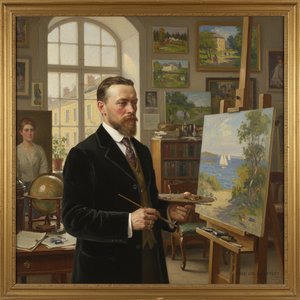
Albert Edelfelt: A Pioneer of Finnish Realism & International Impressionist Circles
Explore the life & work of Albert Edelfelt, a pioneering Finnish Realist painter who bridged Impressionism & national identity. Discover his masterpieces and lasting influence on art history.

Capturing Ephemeral Light: A Comprehensive Exploration of Plein Air Painting's History & Enduring Legacy
Explore the rich history of plein air painting, from its origins to Impressionism & beyond. Discover key artists, techniques, and the enduring legacy of capturing light in landscape art. Find museum-quality reproductions at OriginalUniqueArt.
The Allure of Open Airs: Exploring Representations of Outdoors in Art History
Explore the rich history of outdoor painting! From Romantic landscapes to Impressionism's revolution, discover key artists, techniques & the enduring legacy of capturing light and nature in art. Learn more at OriginalUniqueArt.

Capturing Ephemeral Light: A Comprehensive Exploration of Plein Air Painting's History & Enduring Legacy
Explore the rich history of plein air painting, from its origins with Constable & Corot to Impressionism's revolution. Discover techniques, key artists, and the enduring legacy of capturing light outdoors. Learn more at OriginalUniqueArt.
