Portretul lui Henry Scott Tuke

The 100 Most Famous Henry Scott Tuke Paintings, a Gallery Selection

Actualizat Octombrie 2026 · clasat în funcție de scorul nostru de popularitate (căutări, vizite și comenzi pentru fiecare operă) · 204 lucrări ale lui Henry Scott Tuke în catalogul nostru

In short

Of all the originals Henry Scott Tuke left, the most famous is The Critics (1927). Close behind it come Morning splendour (1921) and Summer Dreams (sketch). Our catalog holds 204 works by Henry Scott Tuke; the gallery has kept the 100 the world admires most, each shown with its date, its museum and its story.

1858 – 1929, York Impressionism Cele mai multe lucrări: Royal Cornwall Polytechnic Society

Henry Scott Tuke's top 10 paintings: the gallery's choice

1
The Critics (1927) de Henry Scott Tuke

The Critics

1927 · Oil

In this 1927 work, we find ourselves on the shores of Falmouth, caught in a quiet, luminous afternoon. The scene is one of profound stillness, where the heat of the sun seems to settle heavily upon the sand. Two young men recline on the beach, their backs to us, anchored by the sheer weight of their relaxation. They gaze toward the horizon, lost in a shared moment of repose. From…

2
Morning splendour (1921) de Henry Scott Tuke

Morning splendour

1921 · Oil On Canvas

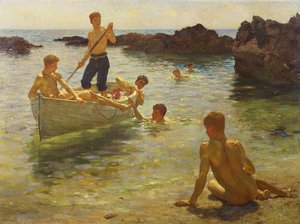
“Morning Splendour,” painted in 1921 by the esteemed English artist Henry Scott Tuke, is a captivating depiction of youthful exuberance and seaside tranquility. This artwork transports viewers to a sun-drenched coastal scene where figures engage in leisurely activities – swimming, rowing, and simply enjoying the warmth of the morning light. More than just a picturesque view, "Morning Splendour" embodies Tuke's signature style and offers a window into early 20th-century British…

3
Summer Dreams (sketch) de Henry Scott Tuke

Summer Dreams (sketch)

Oil On Panel

Summer Dreams (sketch) is an oil on panel work by Henry Scott Tuke. This piece is categorized as a sketch, capturing a specific moment of repose. The artist, Henry Scott Tuke, was a British painter known for his figurative works and his ability to render the human form within natural settings.

4
Nude Boy on Rocks (1907) de Henry Scott Tuke

Nude Boy on Rocks

1907 · Oil On Canvas

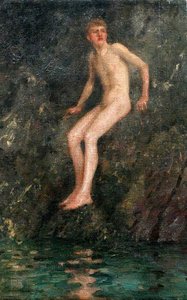
Nude Boy on Rocks is an oil on canvas painting created by Henry Scott Tuke in 1907. The work depicts a single nude boy positioned upon rocks situated within a body of water. The subject is seated in a natural setting, appearing to look toward something located off-camera. This posture leaves the figure exposed to the elements of the coastal environment.

5
Green and Gold (1920) de Henry Scott Tuke

Green and Gold

1920 · Oil On Canvas

In the gentle embrace of Henry Scott Tuke’s 1920 masterpiece, "Green and Gold," the viewer is invited to step away from the frantic pace of modern life and into a realm of profound stillness. The painting presents a scene of quiet contemplation, centered around a solitary figure seated upon rugged rocks at the water's edge. With his back turned toward us, the man becomes an avatar for the viewer’s own…

6
Reefing the Mainsail (sketch) (1903) de Henry Scott Tuke

Reefing the Mainsail (sketch)

1903 · Oil

The sea is never still, and here, the water churns in restless, muted blues and browns. A small fishing boat tosses upon the waves, caught in a moment of heavy labor under a thick, overcast sky. Onboard, a fisherman and a young boy move with the rhythmic necessity of those who live by the tides. They are focused on the task at hand, perhaps repairing equipment or securing the vessel…

7
Under the Western Sun (1917) de Henry Scott Tuke

Under the Western Sun

1917 · Oil

Under the Western Sun is a painting by Henry Scott Tuke, created in 1917. The work captures a quiet moment on a beach near the ocean, where the light of the early 20th century settles upon the shore. Two naked men occupy the scene, their forms grounded by the salt and the sand. One man stands while holding a towel, while the other is seated nearby. They exist in a…

8
Nude Boy (1881) de Henry Scott Tuke

Nude Boy

1881 · Oil

Henry Scott Tuke produced Nude Boy in 1881. This work emerged during a period when the artist was traveling through Italy, a journey that followed his formal training at the Slade School of Art in London. The piece reflects the early development of his technical approach to the human form and natural light.

9
Dinner Time Ambrose Rouffignac in the Sail Loft (1883) de Henry Scott Tuke

Dinner Time Ambrose Rouffignac in the Sail Loft

1883 · Oil · Penlee House, Penzance

The oil painting titled Dinner Time Ambrose Rouffignac in the Sail Loft was created by the artist Henry Scott Tuke. This work dates to 1883. The subject of the piece is a young boy positioned within a maritime setting. He is dressed in a blue sweater and brown pants, seated upon a wooden bench. The boy holds a small object in his hands while looking toward the viewer.

10
A Holiday (1914) de Henry Scott Tuke

A Holiday

1914 · Watercolor

Created in 1914, A Holiday is a watercolour by Henry Scott Tuke. This work captures a sense of serenity within a seaside setting, focusing on the quietude of the coast. Through his delicate application of the medium, Tuke explores the subtle nuances of light and the natural environment.

The Henry Scott Tuke selection continues, 11 to 100

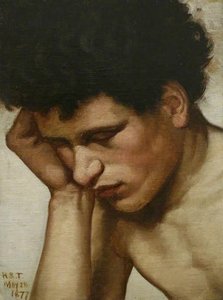
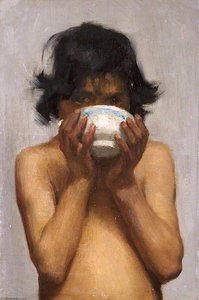
11Looking Out To Sea (1885) de Henry Scott TukeLooking Out To Sea1885 12Julie of Nantes (sketch) (1884) de Henry Scott TukeJulie of Nantes (sketch)1884 13The Bathing Cove de Henry Scott TukeThe Bathing Cove 14In Tow (1893) de Henry Scott TukeIn Tow1893 15Colin Goodwyn (1903) de Henry Scott TukeColin Goodwyn1903 16Steering the Punt (1909) de Henry Scott TukeSteering the Punt1909 17A Bathing Group (1914) de Henry Scott TukeA Bathing Group1914 · Royal Academy of Arts 18Noonday Heat (1902) de Henry Scott TukeNoonday Heat1902 19Hermes at The Pool (sketch) (1900) de Henry Scott TukeHermes at The Pool (sketch)1900 20Gleaming waters (1910) de Henry Scott TukeGleaming waters1910 21In the meadow (1906) de Henry Scott TukeIn the meadow1906 22On the Dunes (1906) de Henry Scott TukeOn the Dunes1906 23Portrait of Charlie Mitchell (1909) de Henry Scott TukePortrait of Charlie Mitchell1909 24Return from fishing (1907) de Henry Scott TukeReturn from fishing1907 25A Holiday (1921) de Henry Scott TukeA Holiday1921 26Lyndon Lodge de Henry Scott TukeLyndon Lodge 27Lord Ronald Sutherland Gower (1897) de Henry Scott TukeLord Ronald Sutherland Gower1897 · National Portrait Gallery 28Portrait of a Young Man with Open Collar (1885) de Henry Scott TukePortrait of a Young Man with Open Collar1885 · Yale Center for British Art 29The silk gown (also known as Portrait of Maria Tuke Sainsbury) (1885) de Henry Scott TukeThe silk gown (also known as Portrait of Maria Tuke Sainsbury)1885 30Sailors playing cards (1890) de Henry Scott TukeSailors playing cards1890 · Colecțiile Statale de Pictură din Bavaria 31The bathers (1889) de Henry Scott TukeThe bathers1889 · Leeds Art Gallery 32The Steering Lesson (1892) de Henry Scott TukeThe Steering Lesson1892 33William J. Martin (1890) de Henry Scott TukeWilliam J. Martin1890 34The Lighthouse de Henry Scott TukeThe Lighthouse 35Two-Funnelled Steamer (1895) de Henry Scott TukeTwo-Funnelled Steamer1895 36Study for „August Blue“ (1893) de Henry Scott TukeStudy for „August Blue“1893 37The sun worshipper (In the morning sun) (1904) de Henry Scott TukeThe sun worshipper (In the morning sun)1904 · Dublin City Gallery The Hugh Lane 38Keeping her off (1900) de Henry Scott TukeKeeping her off1900 39Stowing the headsails (1914) de Henry Scott TukeStowing the headsails1914 40A Cadet (possibly T. E. Lawrence) at Newporth Beach, near Falmouth (1921) de Henry Scott TukeA Cadet (possibly T. E. Lawrence) at Newporth Beach, near Falmouth1921 · Clouds Hill 41Companions (1924) de Henry Scott TukeCompanions1924 · Auckland Art Gallery Toi o Tāmaki 42Lovers of the Sun (1923) de Henry Scott TukeLovers of the Sun1923 43Windjammers lying at their moorings de Henry Scott TukeWindjammers lying at their moorings 44A sailor's yarn (1887) de Henry Scott TukeA sailor's yarn1887 · Art Gallery of New South Wales 45Mrs Florence Humphris (1892) de Henry Scott TukeMrs Florence Humphris1892 · Tate Gallery 46The Fisherman de Henry Scott TukeThe Fisherman 47Hermes at The Pool (sketch) (1900) de Henry Scott TukeHermes at The Pool (sketch)1900 · Royal Cornwall Polytechnic Society 48From the Lido de Henry Scott TukeFrom the Lido 49Tobacco Caye. Brit. Honduras de Henry Scott TukeTobacco Caye. Brit. Honduras 50Charlie Mitchell de Henry Scott TukeCharlie Mitchell 51Grey and Green de Henry Scott TukeGrey and Green 52Venetian Sails de Henry Scott TukeVenetian Sails 53The Bather de Henry Scott TukeThe Bather 54Portrait of a Youth (1877) de Henry Scott TukePortrait of a Youth1877 55Italian Landscape (1881) de Henry Scott TukeItalian Landscape1881 56A Morning Gossip (1885) de Henry Scott TukeA Morning Gossip1885 57Fisher Boys, Falmouth (1885) de Henry Scott TukeFisher Boys, Falmouth1885 58George Stacey Gibson (1880) de Henry Scott TukeGeorge Stacey Gibson1880 59Portrait of an Italian Youth (1881) de Henry Scott TukePortrait of an Italian Youth1881 60Self Portrait (1881) de Henry Scott TukeSelf Portrait1881 61George Stacey Gibson (1880) de Henry Scott TukeGeorge Stacey Gibson1880 62Elizabeth Gibson, née Tuke (1880) de Henry Scott TukeElizabeth Gibson, née Tuke1880 63The Misses Santley (1880) de Henry Scott TukeThe Misses Santley1880 · York Art Gallery 64The Good Samaritan (1879) de Henry Scott TukeThe Good Samaritan1879 65James Paterson, Artist (1883) de Henry Scott TukeJames Paterson, Artist1883 66Drinking (1881) de Henry Scott TukeDrinking1881 67Nude Italian Boy (1881) de Henry Scott TukeNude Italian Boy1881 68Liz (1884) de Henry Scott TukeLiz1884 69Ship Builders (1883) de Henry Scott TukeShip Builders1883 70Our Jack (1886) de Henry Scott TukeOur Jack1886 71Going aloft (1886) de Henry Scott TukeGoing aloft1886 72Carnations (1890) de Henry Scott TukeCarnations1890 73The Old Sea Dog (1888) de Henry Scott TukeThe Old Sea Dog1888 74William J. Martin (1890) de Henry Scott TukeWilliam J. Martin1890 75William J. Martin (1890) de Henry Scott TukeWilliam J. Martin1890 76Jack Rolling (1887) de Henry Scott TukeJack Rolling1887 77Denny Mending a Sail (1890) de Henry Scott TukeDenny Mending a Sail1890 78Rounding the Manacle Buoy (1888) de Henry Scott TukeRounding the Manacle Buoy1888 79Jack Rolling (1888) de Henry Scott TukeJack Rolling1888 80Georgie and Richard (1889) de Henry Scott TukeGeorgie and Richard1889 81Taking a Spell (1886) de Henry Scott TukeTaking a Spell1886 82A Corfu Garden (study) (1892) de Henry Scott TukeA Corfu Garden (study)1892 83The Look Out (1886) de Henry Scott TukeThe Look Out1886 84Mrs Florence Humphris (1892) de Henry Scott TukeMrs Florence Humphris1892 85Jack Rolling (1887) de Henry Scott TukeJack Rolling1887 · Royal Cornwall Polytechnic Society 86The Look Out (1886) de Henry Scott TukeThe Look Out1886 87The Message (1890) de Henry Scott TukeThe Message1890 88Head of a Boy (1890) de Henry Scott TukeHead of a Boy1890 89The Missionary Boat (1894) de Henry Scott TukeThe Missionary Boat1894 90William Hayler Bishop (1898) de Henry Scott TukeWilliam Hayler Bishop1898 91Miss Muriel Lubbock (1898) de Henry Scott TukeMiss Muriel Lubbock1898 92Two Children on Deck (1894) de Henry Scott TukeTwo Children on Deck1894 93Tying the sail (1901) de Henry Scott TukeTying the sail1901 94Seascape with Sailing Craft (1904) de Henry Scott TukeSeascape with Sailing Craft1904 95Esther Maria Tuke (sketch) (1903) de Henry Scott TukeEsther Maria Tuke (sketch)1903 96Sketch for 'The Three Companions' (1904) de Henry Scott TukeSketch for 'The Three Companions'1904 97French Barque in Falmouth Bay (1902) de Henry Scott TukeFrench Barque in Falmouth Bay1902 98The Run Home (1902) de Henry Scott TukeThe Run Home1902 99William Hawk (1905) de Henry Scott TukeWilliam Hawk1905 100Sketch for 'Summer Evening' (1900) de Henry Scott TukeSketch for 'Summer Evening'1900

Henry Scott Tuke's famous paintings, period by period

Late Period

1884 – 1927 · 3 lucrări în această listă

The subjects that held Henry Scott Tuke's eye

The four subjects that come back most often in these originals, each with its finest example.

The museums that keep Henry Scott Tuke's originals

Cele 8 muzee care dețin cele mai multe dintre picturile de pe această pagină.

Muzeu Oraș Lucrări lui Henry Scott Tuke Picturi din această listă
Royal Cornwall Polytechnic Society, FalmouthRoyal Cornwall Polytechnic Society Falmouth 4 Hermes at The Pool (sketch), Jack Rolling
Royal Academy of Arts, LondraRoyal Academy of Arts Londra 2 A Bathing Group
Penlee House, PenzancePenlee House Penzance 1 Dinner Time Ambrose Rouffignac in the Sail Loft
National Portrait Gallery, LondraNational Portrait Gallery Londra 1 Lord Ronald Sutherland Gower
Yale Center for British Art, New HavenYale Center for British Art New Haven 1 Portrait of a Young Man with Open Collar
Colecțiile Statale de Pictură din Bavaria, MunchenColecțiile Statale de Pictură din Bavaria Munchen 1 Sailors playing cards
Leeds Art Gallery, LeedsLeeds Art Gallery Leeds 1 The bathers
Dublin City Gallery The Hugh Lane, DublinDublin City Gallery The Hugh Lane Dublin 1 The sun worshipper (In the morning sun)

Henry Scott Tuke decade by decade: the original that defines each

Lucrări pe deceniu

Pick a decade to see the original that defines it.

Collectors' questions about Henry Scott Tuke's paintings

Which work is Henry Scott Tuke most famous for?Reveal the answer

The Critics (1927). Morning splendour (1921) and Summer Dreams (sketch) come next.

What age was Henry Scott Tuke when The Critics was made?Reveal the answer

69 years old: The Critics dates from 1927, and Henry Scott Tuke was born in 1858.

What are the ten most famous Henry Scott Tuke paintings?Reveal the answer

The Critics, Morning splendour, Summer Dreams (sketch), Nude Boy on Rocks, Green and Gold, Reefing the Mainsail (sketch), Under the Western Sun, Nude Boy, Dinner Time Ambrose Rouffignac in the Sail Loft și A Holiday. The ranking above gives each one's year and museum.

How many paintings did Henry Scott Tuke leave?Reveal the answer

Our catalog holds 204 works by Henry Scott Tuke, dated from 1877 to 1927.

In which museums do Henry Scott Tuke's masterpieces hang?Reveal the answer

Mostly in Royal Cornwall Polytechnic Society (Falmouth), Royal Academy of Arts (Londra) și Penlee House (Penzance). The museum table above lists them all.

In which years did Henry Scott Tuke paint the most famous works?Reveal the answer

In 1880s: 33 of the 100 works on this page were made then, Nude Boy among them.

What are the first and the last famous originals of Henry Scott Tuke?Reveal the answer

On this page, the earliest is Portrait of a Youth (1877) and the latest The Critics (1927).

Which subjects did Henry Scott Tuke choose most often?Reveal the answer

Water (5), Beach (5) și Ocean (4), across the 100 works on this page.

Which technique did Henry Scott Tuke use most?Reveal the answer

Oil On Canvas, for 8 of the 100 works on this page.

To which art movement does Henry Scott Tuke belong?Reveal the answer

Impressionism, judging by the originals on this page.

Which Henry Scott Tuke works hang at the Royal Cornwall Polytechnic Society?Reveal the answer

Hermes at The Pool (sketch) și Jack Rolling: the Royal Cornwall Polytechnic Society, Falmouth holds 2 of the works on this page.

Can I commission a reproduction of a Henry Scott Tuke painting?Reveal the answer

Yes, as a reproduction: the original stays in its museum, but any painting on this page can be painted by hand for you, made to order one at a time, from the painting's own page.

Henry Scott Tuke: life and work

Primii ani, familia și educația

Henry Scott Tuke s-a născut pe 12 iunie 1858, în Lawrence Street, York, crescând într-o familie quakeră de mare respectabilitate. Tatăl său, Daniel Hack Tuke, era un medic renumit, specializat în psihiatrie. Încă de la o vârstă fragedă, Henry Scott Tuke a fost încurajat să țină în mână pensula și să exploreze universul desenului și al picturii, inclinații timpurii care i-au modelat destinul artistic mult înainte de a începe studiile formale.

În anul 1874, mutarea la Londra l-a condus către Slade School of Art, unde a studiat sub îndrumarea lui Alphonse Legros și a lui Sir Edward Poynter. Perioada petrecută la Slade a fost marcată de o dezvoltare constantă a abilităților sale tehnice, iar succesul său a fost consacrat în 1877, când a câștigat o bursă de studii. Această realizare i-a permis să își continue formarea la Slade și, ulterior, să călătorească în Italia în anul 1880.

Dezvoltarea artistică în Paris și Italia

După perioada de instruire inițială din Londra, Henry Scott Tuke s-a îndreptat spre continent, călătorind în Italia între anii 1880 și 1881. Această etapă de studiu i-a oferit temelia necesară înainte de a ajunge în Paris, în 1881. A rămas în capitala franceză până în 1883, un interval de timp în care atmosfera vibrantă a orașului a început să îi modeleze abordarea asupra luminii și a picturii în aer liber. În acei ani de formare, el a studiat sub îndrumarea pictorului de istorie francez Jean-Paul Laurens.

În timpul șederii sale la Paris, Tuke a avut ocazia să îl întâlnească pe Jules Bastien-Lepage. Această întâlnire a fost cea care l-a încurajat să își scoată treptele în afara atelierului și să practice pictura en plein air. Această schimbare de paradigmă, spre pictarea direct din natură, i-a transformat modul în care observa lumea înconjurătoare. În acea perioadă petrecută în metropolă, el a trecut și prin drumul pictorului american John Singer Sargent. Aceste întâlniri și lecțiile prețioase învățate în studiourile pariziene i-au ajutat să își rafineze tehnica și să își aprofundeze înțelegerea modului în care lumina interacționează cu subiectul său.

Viața și creația în Newlyn și Falmouth

După perioada petrecută în Franța, Henry Scott Tuke a călători spre coasta Cornwellului pentru a se alătura Școlii de la Newlyn. Acest grup de artiști prefera directezul picturii en plein air, căutând să surprindă atmosfera coastelor exact în momentul în care aceasta se desfășura. Până în 1885, acesta se stabilise în portul de pescuit Falmouth, unde lumina și obiceiurile locale ale satului au devenit fundalul vieții sale cotidiene. Într-un gest de totală devotare artistică, a achiziționat chiar o barcă de pescuit pe care a transformat-o într-un atelier, creând un spațiu de lucru liber de constrângerile tradiționale ale unui studio situat pe uscat.

Marea a fost o prezență constantă în existența sa. În Falmouth, a descoperit obiceiul scăltului în nud în apă, o practică pe care a menținut-o cu pasiune până la vârsta înaintată. Această legătură profundă cu elementul acvatic și cu realitatea fizică a litoralului i-au modelat întregul univers vizual. Trăind printre pescari și sub influența aerului sărat, Henry Scott Tuke a găsit o identitate artistică plină de sens în peisajul sălbatic și impunător al Cornwellului.

Tehnică și Stil Artistic

Mâna lui Henry Scott Tuke mișca pensula cu un scop dual, aproape dualist. El a reușit să îmbine brushwork-ul liber, care căuta mereu lumina, specific impresionismului, cu fundațiile disciplinate și structurate ale tehnicii academice. Această abordare i-a permis să surprindă modul în care lumina solară lovește pielea sau apa, fără a pierde însă forma solidă a subiectelor sale. A fost un pictor figurativ care înțelegea greutatea corpului uman, însă, în același timp, căuta adesea să dizolve acea greutate în atmosfera vibrantă a mediului în aer liber. Perioada petrecută la Paris i-a învățat valoarea picturii en plein air, un obicei care i-a definit anii de maturitate în Cornwall.

Privirea sa nu era limitată doar la suprafața pânzii. În calitate de fotograf, Henry Scott Tuke poseda o înțelegere profundă a luminii și a compoziției, elemente care i-au influențat profund picturile. Această precizie tehnică s-a extins și asupra lucrărilor sale maritime. A fost un artist maritim consacrat, capabil să redargă texturile specifice ale navelor cu pânze și mișcarea constantă a mării. Fie că se concentra pe anatomia unui tânăr sau pe mecanismul de catarguri al unei nave, opera sa rămânea întotdeauna ancorată într-o observație directă a lumii fizice.

Modul în care a gestionat culoarea a reflectat adesea condițiile schimbătoare ale coastei. El căuta adevărul în lumina naturală, lucrând frecvent în aer liber pentru a surprinde claritatea specifică a unei după-amiezi de vară. Această obsesie pentru lumină și pentru forma umană a devenit, în cele din urmă, modul său fundamental de a vede de la lumea înconjurătoare.

Opere cheie și tematică

Privirea lui Henry Scott Tuke se așeza adesea asupra formei umane în cea mai naturală stare a sa. Își petrecea mare parte din timp pictând băieți și tineri în nud, plasându-i frecvent în peisajele aspre și negrăbite ale coastei. Aceste figuri sunt rareori amenajate pentru un portret formal; în schimb, îi vedem înotând sau pescuit, uneori singuratici, alteori în grupuri mici. Multe dintre aceste subiecte apar pe barci sau de-a lungul țărmului, în timp ce pielea lor captează lumina pură a cerului deschis.

Muncile sale surprind adesea o senzație de activitate liniștită. Te poți întâlni cu un tânăr în mijlocul unui înot sau cu un grup de marinari care se odihnesc pe lângă apă. Accentul rămâne pe interacțiunea dintre corp și elementele naturii — sarea, soarele și marea. Una dintre cele mai recunoscute picturi ale sale, August Blue (aprox. 1893–94), ilustrează această preocupare pentru lumină și pentru forma juvenilă într-un mod care a definit cea mai mare parte a creației sale artistice.

Unde pot fi admirate operele sale astăzi

Pentru a descoperi picturile sale, privirea se îndreaptă adesea către marile instituții din Londra. Tate Gallery găzduiește câteva dintre piesele sale emblematice, în timp ce National Portrait Gallery păstrează portretele realizate de artist. Aceste colecții oferă o oportunitate rară de a observa modul în care Henry Scott Tuke a capturat lumina ce mângâie pielea și mișcarea hipnotică a mării prin prisma sa unică de artist.

În Cornwall, prezența sa rămâne palpabilă prin intermediul colecțiilor locale care reflectă legătura profundă cu coasta. Penlee House din Penzance adăpostește lucrări care evocă perioada sa petrecută în această regiune. De asemenea, estetica sa poate fi regăsită în cadrul Royal Cornwall Polytechnic Society din Falmouth. Aceste locații mențin studiile sale despre forma umană și viața maritimă într-un dialog continuu cu mediile care i-au servit drept inspirație.

Toate cele 204 de lucrări ale lui Henry Scott Tuke →