Portretul lui Filippo Lippi

Cele 100 cele mai faimoase picturi ale lui Filippo Lippi, fiecare unică în felul ei

Actualizat Octombrie 2026 · clasat în funcție de scorul nostru de popularitate (căutări, vizite și comenzi pentru fiecare operă) · 277 lucrări ale lui Filippo Lippi în catalogul nostru

Pe scurt

Madonna cu Pruncul și Îngerii (1460) este pictură lui Filippo Lippi care atrage cele mai multe priviri. După aceasta, privirea se îndreaptă către Adoration of the Magi (1445) și The Annunciation (1435). Dintre cele 277 opere ale lui Filippo Lippi din catalogul nostru, acestea 100 sunt cele mai celebre, fiecare fiind o piesă unică, prezentată împreună cu anul creării, muzeul deținător și motivul pentru care aceasta rămâne memorabilă.

1406 – 1469, Florența Renașterea timpurie Cele mai multe lucrări: Duomo

Cele mai importante 10 picturi ale lui Filippo Lippi, prin ochii galeriei

1
Madonna cu Pruncul și Îngerii (1460) de Filippo Lippi

Madonna cu Pruncul și Îngerii

1460 · Pictură în ulei

Madonna cu Pruncul și Îngerii este o pictură uluitoare creată de renumitul artist italian Fra Filippo Lippi în anul 1460. Această operă de artă de o frumusețe rară este o dovadă a talentului și măiestriei artistului în stilul Renașterii timpurii. Tabloul o înfățișează pe Fecioara Maria ținând în brațe copilul ei, fiind înconjurată de doi îngeri, fapt ce creează o atmosferă sobră, senină și plină de pace. Artistul și stilul…

2
Adoration of the Magi (1445) de Filippo Lippi

Adoration of the Magi

1445 · Tempera On Panel · National Gallery of Art, Washington

In the heart of the Florentine Renaissance, a masterpiece emerged that would bridge the gap between the ethereal spirituality of the Middle Ages and the burgeoning humanism of a new era. The Adoration of the Magi is not merely a painting; it is a breathtaking visual symphony, a circular tondo that captures the very moment the divine intersects with the earthly. As your eyes wander through this complex composition, you…

3
The Annunciation (1435) de Filippo Lippi

The Annunciation

1435 · Oil · National Gallery of Art, Washington

Fra Filippo Lippi's 1435 tempera painting, “The Annunciation,” is more than just a depiction of a pivotal biblical moment; it’s a profound exploration of faith, humility, and the burgeoning humanism of the early Renaissance. Housed within the National Gallery of Art in Washington D.C., this work transcends its historical context to resonate with viewers centuries later, offering a glimpse into the artist's exceptional skill and deeply considered vision.

4
The Annunciation - tempera on wood - (1440) de Filippo Lippi

The Annunciation - tempera on wood -

1440 · Tempera

The Divine Encounter: An Exploration of Lippi's Annunciation To stand before The Annunciation by Fra Filippo Lippi is to step across the threshold of time and into a moment suspended between the earthly and the divine. This exquisite work, executed in 1440 using the delicate medium of tempera on wood, captures the pivotal instant when the Archangel Gabriel announces to Mary that she shall conceive the Son of God. It…

5
Madonna and Child Enthroned with Saints (detail) (1430) de Filippo Lippi

Madonna and Child Enthroned with Saints (detail)

1430 · Oil On Canvas · Museo della Collegiata, Empoli

To gaze upon this detail from Filippo di Tommaso Lippi’s Madonna and Child Enthroned with Saints is to step directly into the luminous heart of the early Renaissance. The scene unfolds with an almost palpable sense of reverence, drawing the viewer into a sacred moment captured in oil paint. At the core, the Virgin Mary presides with serene majesty, her presence anchoring the entire composition. Before her kneels a figure,…

6
Madonna della Cintola (detail) (1455) de Filippo Lippi

Madonna della Cintola (detail)

1455 · Oil On Panel · Museo Civico, Prato

To stand before a detail from Filippo di Tommaso Lippi’s Madonna della Cintola is to step directly into the luminous, deeply spiritual atmosphere of the early Italian Renaissance. This painting, executed around 1455, is not merely a depiction of sacred figures; it is a profound meditation on faith, lineage, and divine grace. The composition immediately draws the eye to the central grouping—the venerable male figure holding his staff, flanked by…

7
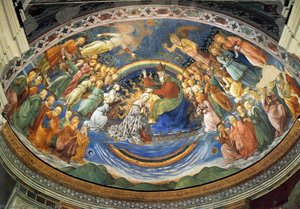
Coronation of the Virgin (detail) (18) (1467) de Filippo Lippi

Coronation of the Virgin (detail) (18)

1467 · Acrylic On Canvas · Duomo, Spoleto

Filippo di Tommaso Lippi's “Coronation of the Virgin,” painted in 1467, isn’t merely a depiction of a religious scene; it’s an immersive experience, a window into the heart of Renaissance Florence and the fervent spirituality of its artists. This exquisite fresco, currently housed within the Uffizi Gallery in Florence, captures a pivotal moment – Mary's divine coronation – with a breathtaking blend of realism, symbolic richness, and masterful technique. Lippi,…

8
Coronation of the Virgin (detail) (1441) de Filippo Lippi

Coronation of the Virgin (detail)

1441 · Tempera On Panel · Galleria degli Uffizi, Florența

The Coronation of the Virgin is a renowned painting by the Italian artist Fra Filippo Lippi, created in 1441. This tempera on panel artwork is housed at the Galleria degli Uffizi in Florence, Italy, and is considered one of the most significant works of the Early Renaissance. The Painting's Composition and Style The painting depicts a religious scene with a group of figures dressed in medieval clothing, including angels, saints,…

9
Funeral of St Jerome (1460) de Filippo Lippi

Funeral of St Jerome

1460 · Tempera · Duomo, Prato

To stand before Fra Filippo Lippi’s Funeral of St. Jerome is to step across the threshold of time and into a moment suspended by profound reverence. This monumental canvas, executed in 1460, does more than merely depict a funeral; it captures the very essence of spiritual transition—the solemn passage from earthly life to eternal rest. The scene unfolds with an almost palpable weight, drawing the viewer into the hushed gathering…

10
Madonna Enthroned with Saints (detail) (1445) de Filippo Lippi

Madonna Enthroned with Saints (detail)

1445 · Tempera On Panel · Galleria degli Uffizi, Florența

In this detail from the 1445 panel, the Virgin Mary occupies the central space, seated upon a monumental throne. Her face is rendered with a soft, rounded form, and she holds the infant Jesus against her chest. Behind her, two men are positioned in a vertical arrangement. One figure stands closely behind the throne, while another man appears further back, creating a sense of layered depth within the religious scene.…

Păiți celebrele picturi ale lui Filippo Lippi, de la numărul 11 la 100

11Madonna Enthroned with Saints (detail) (1445) de Filippo LippiMadonna Enthroned with Saints (detail)1445 · Galleria degli Uffizi 12Annunciation (detail) (1443) de Filippo LippiAnnunciation (detail)1443 · Alte Pinakothek 13The Beheading of John the Baptist (1452) de Filippo LippiThe Beheading of John the Baptist1452 · Duomo 14Adoration of the Magi (detail) (1445) de Filippo LippiAdoration of the Magi (detail)1445 · National Gallery of Art 15Madonna with Child and Two Angels (1465) de Filippo LippiMadonna with Child and Two Angels1465 · Galleria degli Uffizi 16Coronation of the Virgin (detail) (13) (1441) de Filippo LippiCoronation of the Virgin (detail) (13)1441 · Galleria degli Uffizi 17Madonna Enthroned (1437) de Filippo LippiMadonna Enthroned1437 · Galleria Nazionale d'Arte Antica 18St Michael (detail) (1456) de Filippo LippiSt Michael (detail)1456 · Cleveland Museum of Art 19Coronation of the Virgin (detail) (15) (1441) de Filippo LippiCoronation of the Virgin (detail) (15)1441 · Galleria degli Uffizi 20Annunciation (1445) de Filippo LippiAnnunciation1445 · Basilica di San Lorenzo 21Madonna and Child (detail) (1440) de Filippo LippiMadonna and Child (detail)1440 · National Gallery of Art 22Madonna and Child Enthroned with Two Angels (detail) (1437) de Filippo LippiMadonna and Child Enthroned with Two Angels (detail)1437 · Metropolitan Museum of Art 23Coronation of the Virgin (detail) (11) (1441) de Filippo LippiCoronation of the Virgin (detail) (11)1441 · Galleria degli Uffizi 24Coronarea Virginiei (1467) de Filippo LippiCoronarea Virginiei1467 · Duomo 25Madonna Enthroned with Saints (detail) (1445) de Filippo LippiMadonna Enthroned with Saints (detail)1445 · Galleria degli Uffizi 26Virgin and Child Surrounded by Angels with St. Frediano and St. Augustine (The Barbadori Altarpiece) (1437) de Filippo LippiVirgin and Child Surrounded by Angels with St. Frediano and St. Augustine (The Barbadori Altarpiece)1437 · Muzeul Luvru 27Madona şi copilul tronat cu doi îngeri (1437) de Filippo LippiMadona şi copilul tronat cu doi îngeri1437 · Metropolitan Museum of Art 28Coronation of the Virgin (detail) (17) (1467) de Filippo LippiCoronation of the Virgin (detail) (17)1467 · Duomo 29Annunciation (detail) (14) (1443) de Filippo LippiAnnunciation (detail) (14)1443 · Alte Pinakothek 30Annunciation (detail) (18) (1445) de Filippo LippiAnnunciation (detail) (18)1445 · Basilica di San Lorenzo 31Annunciation (1445) de Filippo LippiAnnunciation1445 · Basilica di San Lorenzo 32Death of the Virgin (1467) de Filippo LippiDeath of the Virgin1467 · Duomo 33Coronation of the Virgin (detail) (1441) de Filippo LippiCoronation of the Virgin (detail)1441 · Galleria degli Uffizi 34Spoleto-Coronation of the Virgin (1469) de Filippo LippiSpoleto-Coronation of the Virgin1469 35Vision of St Augustine in his Cell (1438) de Filippo LippiVision of St Augustine in his Cell1438 · Galleria degli Uffizi 36Herod's Banquet (1452) de Filippo LippiHerod's Banquet1452 · Duomo 37Coronation of the Virgin (detail) (16) (1441) de Filippo LippiCoronation of the Virgin (detail) (16)1441 · Galleria degli Uffizi 38of a Man and a Woman (1450) de Filippo Lippiof a Man and a Woman1450 39Madonna with Child, saints and angels, known as (Madonna Trivulzio) (1432) de Filippo LippiMadonna with Child, saints and angels, known as (Madonna Trivulzio)1432 · Castelul Sforzesco 40Madonna and Child Enthroned with Saints (detail) (1430) de Filippo LippiMadonna and Child Enthroned with Saints (detail)1430 · Museo della Collegiata 41Female Figure (Prophetess.) (1430) de Filippo LippiFemale Figure (Prophetess.)1430 · Muzeul de Artă Harvard 42Sts Augustine and Ambrose (detail) (1437) de Filippo LippiSts Augustine and Ambrose (detail)1437 · Albertina Academy of Fine Arts 43Female Saint with a Flail (Saint Walburga?) (1450) de Filippo LippiFemale Saint with a Flail (Saint Walburga?)1450 · Courtauld Gallery 44Death of the Virgin (detail) (1467) de Filippo LippiDeath of the Virgin (detail)1467 · Duomo 45Virgin and Child with Angels (1460) de Filippo LippiVirgin and Child with Angels1460 · Cleveland Museum of Art 46Panel from a Triptych: St. Anthony Abbot (1458) de Filippo LippiPanel from a Triptych: St. Anthony Abbot1458 · Cleveland Museum of Art 47Saint Dominic (1460) de Filippo LippiSaint Dominic1460 · Courtauld Gallery 48Saint James the Less (1460) de Filippo LippiSaint James the Less1460 · Courtauld Gallery 49Saint Peter (1460) de Filippo LippiSaint Peter1460 · Courtauld Gallery 50The enthroned St. Francis presents the rule of the order to St. Clare (1467) de Filippo LippiThe enthroned St. Francis presents the rule of the order to St. Clare1467 · Gemäldegalerie 51Mary as the Mother of Mercy / Protective Mantle Madonna (1460) de Filippo LippiMary as the Mother of Mercy / Protective Mantle Madonna1460 · Gemäldegalerie 52Saint Jerome in the Desert with Saints John the Baptist and Ansanus (1455) de Filippo LippiSaint Jerome in the Desert with Saints John the Baptist and Ansanus1455 · Harvard Art Museums 53St Alberto of Trapani (1452) de Filippo LippiSt Alberto of Trapani1452 · Duomo 54Disputation in the Synagogue (detail) (1452) de Filippo LippiDisputation in the Synagogue (detail)1452 · Duomo 55The Funeral of St Stephen (1460) de Filippo LippiThe Funeral of St Stephen1460 · Duomo 56Funeral of St Jerome (detail) (1460) de Filippo LippiFuneral of St Jerome (detail)1460 · Duomo 57St Stephen is Born and Replaced by Another Child (detail) (1452) de Filippo LippiSt Stephen is Born and Replaced by Another Child (detail)1452 · Duomo 58The Funeral of St Stephen (detail) (1460) de Filippo LippiThe Funeral of St Stephen (detail)1460 · Duomo 59Madonna della Cintola (detail) (1455) de Filippo LippiMadonna della Cintola (detail)1455 · Museo Civico 60Madona şi Fiul cu Sfântul Fredianus şi Sfântul Augustin (1437) de Filippo LippiMadona şi Fiul cu Sfântul Fredianus şi Sfântul Augustin1437 · Muzeul Luvru 61Adoration of the Magi (detail) (1445) de Filippo LippiAdoration of the Magi (detail)1445 · National Gallery of Art 62Tester bed (601) de Filippo LippiTester bed601 63Annunciation (detail) (17) (1445) de Filippo LippiAnnunciation (detail) (17)1445 · Basilica di San Lorenzo 64Funeral of St Jerome (detail) (1460) de Filippo LippiFuneral of St Jerome (detail)1460 · Duomo 65Madonna with the Child and Scenes from the Life of St Anne (1452) de Filippo LippiMadonna with the Child and Scenes from the Life of St Anne1452 66Madonna and Child Enthroned with Saints (1430) de Filippo LippiMadonna and Child Enthroned with Saints1430 · Museo della Collegiata 67Sfântul Gheorghe și Sfântul Ieremia (detaliu) (1437) de Filippo LippiSfântul Gheorghe și Sfântul Ieremia (detaliu)1437 · Albertina Academy of Fine Arts 68Disputation in the Synagogue (detail) (8) (1452) de Filippo LippiDisputation in the Synagogue (detail) (8)1452 · Duomo 69Madonna della Cintola (detail) (1455) de Filippo LippiMadonna della Cintola (detail)1455 · Museo Civico 70Head of a Woman (1452) de Filippo LippiHead of a Woman1452 · Galleria degli Uffizi 71Herod's Banquet (detail) (1452) de Filippo LippiHerod's Banquet (detail)1452 · Duomo 72Figure study (1452) de Filippo LippiFigure study1452 · Galleria degli Uffizi 73Confirmation of the Carmelite Rule (detail) (1432) de Filippo LippiConfirmation of the Carmelite Rule (detail)1432 · Museo di Santa Maria del Carmine 74The Nativity (1445) de Filippo LippiThe Nativity1445 75of the Virgin (detail) (1440) de Filippo Lippiof the Virgin (detail)1440 76Saints (1440) de Filippo LippiSaints1440 77The Adoration of the Magi (1445) de Filippo LippiThe Adoration of the Magi1445 78Virgin and Child (1445) de Filippo LippiVirgin and Child1445 79the annunciation - - (1440) de Filippo Lippithe annunciation - -1440 80The Funeral of St Stephen (detail) (9) (1460) de Filippo LippiThe Funeral of St Stephen (detail) (9)1460 · Duomo 81Prato-The Saint's Funeral (1466) de Filippo LippiPrato-The Saint's Funeral1466 82Prato-Birth and Naming St John (1466) de Filippo LippiPrato-Birth and Naming St John1466 83Prato-St Stephen is Born and Replaced by Another Child (1466) de Filippo LippiPrato-St Stephen is Born and Replaced by Another Child1466 84St Alberto of Trapani (1452) de Filippo LippiSt Alberto of Trapani1452 · Duomo 85Prato-Disputation in the Synagogue (detail) (1466) de Filippo LippiPrato-Disputation in the Synagogue (detail)1466 86Prato-Herod's Banquet (1466) de Filippo LippiPrato-Herod's Banquet1466 87Madonna and Child with Angels - - (1465) de Filippo LippiMadonna and Child with Angels - -1465 88Herod's Banquet (detail) (1452) de Filippo LippiHerod's Banquet (detail)1452 · Duomo 89Prato-View of the fresco cycle (1466) de Filippo LippiPrato-View of the fresco cycle1466 90Prato-Herod's Banquet (detail)3 (1466) de Filippo LippiPrato-Herod's Banquet (detail)31466 91The Funeral of St Stephen (detail) (1460) de Filippo LippiThe Funeral of St Stephen (detail)1460 · Duomo 92Prato-Herod's Banquet (detail) (1466) de Filippo LippiPrato-Herod's Banquet (detail)1466 93St John Taking Leave of His Parents (1452) de Filippo LippiSt John Taking Leave of His Parents1452 · Duomo 94View of the Apse of the Cathedral (1467) de Filippo LippiView of the Apse of the Cathedral1467 · Cathedral 95Birth and Naming St John (detail) (1452) de Filippo LippiBirth and Naming St John (detail)1452 · Duomo 96View of the left (north) wall of the main chapel (1452) de Filippo LippiView of the left (north) wall of the main chapel1452 · Duomo 97The Martyrdom of St Stephen (1460) de Filippo LippiThe Martyrdom of St Stephen1460 · Duomo 98Prato-Disputation in the Synagogue (detail)2 (1466) de Filippo LippiPrato-Disputation in the Synagogue (detail)21466 99St John Taking Leave of his Parents (detail) (1452) de Filippo LippiSt John Taking Leave of his Parents (detail)1452 · Duomo 100Madonna with the Child and Scenes from the Life of St Anne (detail) (1452) de Filippo LippiMadonna with the Child and Scenes from the Life of St Anne (detail)1452

Piesele celebre ale lui Filippo Lippi, perioadă cu perioadă

Subiectele care i-au captivat privirea lui Filippo Lippi

Cele patru teme care revin cel mai des în aceste opere originale, fiecare având cel mai sublim exemplu.

Muzeele care păstrează originalele lui Filippo Lippi

Cele 8 muzee care dețin cele mai multe dintre picturile de pe această pagină.

Muzee Oraș Lucrări lui Filippo Lippi Picturi din această listă
Duomo, PratoDuomo Prato 34 Funeral of St Jerome, The Beheading of John the Baptist, Herod's Banquet
Galleria degli Uffizi, FlorențaGalleria degli Uffizi Florența 17 Coronation of the Virgin (detail), Madonna Enthroned with Saints (detail), Madonna Enthroned with Saints (detail)
National Gallery of Art, WashingtonNational Gallery of Art Washington 8 Adoration of the Magi, The Annunciation, Adoration of the Magi (detail)
Duomo, SpoletoDuomo Spoleto 8 Coronation of the Virgin (detail) (18), Coronarea Virginiei, Coronation of the Virgin (detail) (17)
Basilica di San Lorenzo, FlorentinaBasilica di San Lorenzo Florentina 5 Annunciation, Annunciation (detail) (18), Annunciation
Courtauld Gallery, LondraCourtauld Gallery Londra 4 Female Saint with a Flail (Saint Walburga?), Saint Dominic, Saint James the Less
Museo Civico, PratoMuseo Civico Prato 7 Madonna della Cintola (detail), Madonna della Cintola (detail), Madonna della Cintola (detail)
Cleveland Museum of Art, ClevelandCleveland Museum of Art Cleveland 5 St Michael (detail), Virgin and Child with Angels, Panel from a Triptych: St. Anthony Abbot

Filippo Lippi de-a lungul deceniilor: o piesă unică pentru fiecare

Lucrări pe deceniu

Alege o deceniu pentru a descoperi opera originală care îl definește.

Picturile lui Filippo Lippi: întrebări pentru galerie

Care este cea mai celebră operă a lui Filippo Lippi?Află răspunsul

Madonna cu Pruncul și Îngerii (1460). Urmează Adoration of the Magi (1445) și The Annunciation (1435).

La ce vârstă a creat Filippo Lippi Madonna cu Pruncul și Îngerii?Află răspunsul

54 ani: Madonna cu Pruncul și Îngerii datează din 1460, iar Filippo Lippi s-a născut în 1406.

Care sunt cele mai celebre zece picturi ale lui Filippo Lippi?Află răspunsul

Madonna cu Pruncul și Îngerii, Adoration of the Magi, The Annunciation, The Annunciation - tempera on wood -, Madonna and Child Enthroned with Saints (detail), Madonna della Cintola (detail), Coronation of the Virgin (detail) (18), Coronation of the Virgin (detail), Funeral of St Jerome și Madonna Enthroned with Saints (detail). Clasamentul de mai sus indică anul și muzeul pentru fiecare piesă.

Câte lucrări ale lui Filippo Lippi sunt cunoscute?Află răspunsul

Catalogul nostru cuprinde 277 lucrări ale lui Filippo Lippi, datate între 1430 și 1469.

Unde pot fi vizualizate originalele celor mai faimoși Filippo Lippi?Află răspunsul

În principal în Duomo (Prato), Galleria degli Uffizi (Florența) și National Gallery of Art (Washington). Tabelul cu muzee de mai sus le enumeră pe toate.

În ce perioadă a creat Filippo Lippi cele mai cunoscute picturi?Află răspunsul

În 1460s: 33 dintre cele 100 lucrări de pe această pagină au fost realizate atunci, fiind Madonna cu Pruncul și Îngerii dintre acestea.

Care este cea mai veche și care este cea mai recentă pictură a lui Filippo Lippi?Află răspunsul

Pe această pagină, cea mai veche lucrare datează din Madonna and Child Enthroned with Saints (detail) (1430), iar cea mai recentă este din Spoleto-Coronation of the Virgin (1469).

Ce teme prefera Filippo Lippi?Află răspunsul

Virgin mary (22), Renaissance (21) și Renaissance art (16), din cele 100 lucrări de pe această pagină.

Cu ce materiale a pictat cel mai des Filippo Lippi?Află răspunsul

Tempera On Panel, pentru 29 dintre cele 100 lucrări de pe această pagină.

Din ce curent artistic face parte opera lui Filippo Lippi?Află răspunsul

Renașterea timpurie și Renaștere, judecând după originalele de pe această pagină.

Ce originale de Filippo Lippi pot vedea la Duomo?Află răspunsul

Funeral of St Jerome, The Beheading of John the Baptist și Herod's Banquet: Duomo, Prato deține 21 dintre lucrările de pe această pagină.

Filippo Lippi: un portret al artistului

A Florentine Rebel: The Life and Art of Filippo Lippi

Filippo di Tommaso Lippi, cunoscut pe nume Fra Filippo Lippi, a fost o figură atât binecuvântată de geniu artistic, cât și umbrită de o viață plină de scandaluri și alegeri neconvenționale. Născut în Florența în 1406, din familia unui brutar, primele sale experiențe au fost marcate de pierdere: orfanat la doar doi ani, a fost plasat sub tutela surorii sale, Mona Lapaccia. Această situație l-a dus, la vârsta de opt ani, în mănăstirea Carmelitilor – o cale care nu numai că a modelat dezvoltarea sa artistică, ci și a definit complexitățile personalității sale. În acele ziduri claustrofobice, tânărul Filippo a început educația sa formală și, mai presus de toate, a descoperit pasiunea pentru pictură. Influența acestui mediu este palpabilă în multe dintre operele sale – un echilibru delicat între devoțiunea spirituală și o sensibilitate tot mai umanistă.

De Vows Religioase la Inovație Artistică

Intrarea lui Lippi în Ordinul Carmelitilor în 1420 nu a fost doar o consecință a circumstanțelor, ci părea să aprindă în el un impuls artistic fervent. A luat asupra sa angajamentele religioase la vârsta de șaisprezece ani și a fost tuns preot în jurul anului 1425, rămânând în prioria până în 1432. Este în această perioadă că artistorul Giorgio Vasari relatează cum Lippi a fost captivat de frescele revoluționare ale lui Masaccio în Capela Brancacci – o întâlnire care s-a dovedit crucială. Impactul naturalismului și utilizarea inovatoare a luminii a lui Masaccio sunt vizibile clar în primele lucrări ale lui Lippi, cum ar fi *Tarquinia Madonna*, unde o realism nou apare. Cu toate acestea, Lippi nu a fost doar un imitator; el a dezvoltat rapid propriul său stil distinctiv, caracterizat de grație lirică, culoare delicată și o profunzime emoțională subtilă care îl diferenția de contemporanii săi. A început să infuzeze scenele religioase cu un sentiment de intimitate și conexiune umană, îndepărtându-se de formalismul mai rigid al artei devotamentale anterioare.

Un Maestru al Compoziției și al Controversei

Cariera artistică a lui Lippi a prosperat în Florența, atrăgând comenzi de la familii proeminente precum familia Medici. Lucrări precum *Anunțarea și cei Șapte Sfinți* demonstrează capacitatea sa de a crea compoziții complexe pline de semnificație simbolică și detalii elegante. *Coronarea Virginiei*, finalizată în 1441 pentru surorile din Sant'Ambrogio, este deosebit de notabilă; prezintă o figură jumătate-lungime care mulți o consideră un autoritativ portret al lui Lippi însuși – o aserțiune îndrăzneață a identității artistice într-un context religios. Dar viața sa nu a fost liniștită. A fost adesea implicat în dificultăți financiare, dispute legale și acuzații de falsificare. Cel mai scandalos episod a fost abducția lui Lucrezia Buti, o călugăriță din Prato, cu care a avut o relație îndelungată și, în cele din urmă, s-a căsătorit după ani de scandal și controversă. Acest act, deși șocant pentru acea vreme, vorbește despre spiritul rebel al lui Lippi și despre dorința sa de a sfida normele societății în urmărirea fericirii personale.

Moștenire și Influență

În ciuda turbulențelor vieții sale, Filippo Lippi a lăsat o amprentă indelebilă asupra artei renascentiste. A fost un pictor solicitat de mulți, iar atelierul său a devenit un teren fertil pentru viitorii maeștri. Printre elevii săi cei mai distinși s-au numărat Sandro Botticelli și Francesco di Pesello (Pesellino), ambii dintre care au ajuns să obțină recunoaștere semnificativă în propriile lor drepturi. Influența lui Lippi poate fi văzută în frumusețea lirică și expresivitatea emoțională care caracterizează multe dintre picturile florentine din sfr. XIV-XV sec. A pus capăt lacunelor dintre naturalismul timpurii renascentiste al lui Masaccio și estetica mai rafinată a Renașterii înalte, deschizând calea pentru o nouă generație de artiști să exploreze posibilitățile formei umane și ale emoției. Abilitatea sa de a combina credința religioasă cu realismul lumii, combinată cu compozițiile sale inovatoare și tehnica excepțională, i-a consolidat locul ca una dintre cele mai importante și captivante figuri ale Renașterii italiene. A murit în Spoleto în 1469, lăsând în urmă o moștenire care continuă să inspire uimire și admirație secole după secol. Arta sa rămâne un testament al puterii creativității umane și al farmecului etern al frumuseții.

Influente

Lippi a fost influențat de Masaccio, în special prin utilizarea luminii și a perspectivei. De asemenea, a fost influențat de tradițiile pictorilor florentini din secolul XIV, precum Donatello.