Portretul lui Spencer Frederick Gore

Cele 89 cele mai faimoase picturi ale lui Spencer Frederick Gore, o selecție de galerie

Actualizat Noiembrie 2026 · clasat în funcție de scorul nostru de popularitate (căutări, vizite și comenzi pentru fiecare operă) · 89 lucrări ale lui Spencer Frederick Gore în catalogul nostru

Pe scurt

Dintre toate originalele lăsate de Spencer Frederick Gore, cea mai faimoasă este Mornington Crescent, London (1911). Imediat după acestea urmează Panshanger Park (1908) și Harold Gilman's House at Letchworth, Hertfordshire (1912). Catalogul nostru cuprinde 89 lucrări ale lui Spencer Frederick Gore; galeria a păstrat cele 89 pe care lumea le admiră cel mai mult, fiecare fiind prezentată împreună cu data, muzeul și povestea sa.

1878 – 1914, Epsom Post-impressionism Cele mai multe lucrări: Tate Gallery

Cele mai importante 10 picturi ale lui Spencer Frederick Gore: selecția galeriei

1
Mornington Crescent, London (1911) de Spencer Frederick Gore

Mornington Crescent, London

1911 · Oil On Canvas

Mornington Crescent, London is an oil on canvas work by Spencer Gore, dating to 1911. This piece captures a specific moment in the urban development of the city, focusing on the bustling activity of the Mornington Crescent area during the early twentieth century. The scene provides a view into the daily rhythms of London, documenting the transition of transportation methods as horse-drawn carriages share the street with early motor vehicles…

2
Panshanger Park (1908) de Spencer Frederick Gore

Panshanger Park

1908 · Oil On Canvas

In this 1908 oil on canvas, Spencer Gore presents us with Panshanger Park. The work captures a quiet moment within a forest landscape, where the natural world meets the subtle presence of human leisure. It is a scene defined by its greenery and the sprawling reach of the trees that populate the setting.

3
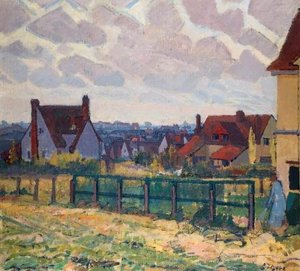
Harold Gilman's House at Letchworth, Hertfordshire (1912) de Spencer Frederick Gore

Harold Gilman's House at Letchworth, Hertfordshire

1912 · Oil On Canvas

The scene unfolds in the quietude of 1912, captured through the eyes of Spencer Gore in his painting, Harold Gilman's House at Letchworth, Hertfordshire. This work emerges from a period of intense creative movement, a moment when the artist is actively shaping the visual language of a new era. Gore, born in Epsom, United Kingdom, in 1878, brings a specific, lived perspective to this landscape. He moves through the world…

4
From a Canal Bridge, Chalk Farm Road (1913) de Spencer Frederick Gore

From a Canal Bridge, Chalk Farm Road

1913 · Watercolor

In "From a Canal Bridge, Chalk Farm Road" by Spencer Gore, a watercolor captures a slice of urban life from about 1913. A canal cuts through the center of the scene, flanked by buildings that line the water's edge. In the distance, a large brick building anchors the background, its heavy presence watching over the waterway. Several boats rest upon the surface, some drifting near the foreground while others recede…

5
The Toilet de Spencer Frederick Gore

The Toilet

Oil On Canvas

In The Toilet, Spencer Gore turns his gaze toward the quietude of a private interior. The painting centers on a nude female figure, captured in a moment of stillness. She stands within the confines of a bedroom, a space defined by the soft geometry of domestic life. To her side, a bed is draped in white linens, their folds catching the light in the dimness of the room.

6
Inez and Taki (1910) de Spencer Frederick Gore

Inez and Taki

1910 · Oil On Canvas · Tate Gallery, Londra

In the heart of 1910, Spencer Frederick Gore captured more than just a street scene; he distilled the very essence of a burgeoning bohemian era. “Inez and Taki” serves as a vibrant window into a world where the urban bustle of Paris meets the intimate, artistic spirit of London’s Camden Town Group. The painting presents a captivating tableau: a musician, perhaps a self-portrait of Gore himself, lost in performance, playing…

7
The Frenchwoman (1910) de Spencer Frederick Gore

The Frenchwoman

1910 · Oil On Canvas · Fenton House, London

In The Frenchwoman by Spencer Gore, the subject is anchored firmly in a centered composition. She occupies the majority of the foreground and middle ground, pressing close to the viewer through a frontal, close-up perspective. This proximity creates a shallow depth of field, where the background feels immediate and compressed. The woman is draped in clothing of bright whites and pale pinks, her form defined by the interplay of light…

8
Mrs Spencer Frederick Gore in the Garden of Rowlandson House (1911) de Spencer Frederick Gore

Mrs Spencer Frederick Gore in the Garden of Rowlandson House

1911 · Oil On Canvas · Scottish National Gallery of Modern Art, Edinburgh

The air feels heavy with the scent of damp earth and summer leaves as we find ourselves in the secluded garden of Rowlandson House. A woman sits in profile, her gaze drifting toward something unseen beyond the frame. She is Mary Joanna Kerr, captured in a moment of stillness that feels almost fragile. The light does not strike her directly; instead, it filters through a dense canopy of foliage, creating…

9
Conversation Piece and Self-Portrait (1910) de Spencer Frederick Gore

Conversation Piece and Self-Portrait

1910 · Oil · Scottish National Gallery of Modern Art, Edinburgh

Conversation Piece and Self-Portrait is an oil painting by the artist Spencer Gore. This work was created about 1910. The composition integrates a large, semi-transparent face of a man into the background, functioning as a self-portrait, while the foreground features two smaller figures seated in a manner suggesting a conversation piece. One figure wears a dark blue cloak and the other a yellow patterned dress.

10
Landscape with Pond (1913) de Spencer Frederick Gore

Landscape with Pond

1913 · Black and White Photography · National Gallery of Canada, Ottawa

This 1913 black and white documentary photograph captures a rural scene of agricultural labor. The composition centers on a horse-drawn cart heavily laden with hay, moving along a dirt path. Two men are seated atop the mound, looking toward the camera. The perspective is from a slightly low angle, emphasizing the scale of the load. The lighting is natural and diffused, creating a high-key, hazy atmosphere. The textures range from…

Selecția pentru Spencer Frederick Gore continuă, de la 11 la 89

11The Fig Tree (1912) de Spencer Frederick GoreThe Fig Tree1912 12The Artist’s Wife (1913) de Spencer Frederick GoreThe Artist’s Wife1913 13The Blue Petticoat (1912) de Spencer Frederick GoreThe Blue Petticoat1912 14The Green Dress (1908) de Spencer Frederick GoreThe Green Dress1908 · Fitzwilliam Museum 15Panshanger Park (1908) de Spencer Frederick GorePanshanger Park1908 16The Gas Cooker (1913) de Spencer Frederick GoreThe Gas Cooker1913 · Tate Gallery 17Portrait of a Lady (1830) de Spencer Frederick GorePortrait of a Lady1830 · Metropolitan Museum of Art 18Mary Ann Garrits (1834) de Spencer Frederick GoreMary Ann Garrits1834 · Metropolitan Museum of Art 19Frances Ludlum Morris (Mrs. Robert Morris) (?) (1838) de Spencer Frederick GoreFrances Ludlum Morris (Mrs. Robert Morris) (?)1838 · National Gallery of Art 20The Britannia Ballet, the Alhambra (1907) de Spencer Frederick GoreThe Britannia Ballet, the Alhambra1907 · Fenton House 21Autumn, Sussex (1907) de Spencer Frederick GoreAutumn, Sussex1907 · Art Gallery of South Australia 22Tennis In Mornington Crescent Gardens (1910) de Spencer Frederick GoreTennis In Mornington Crescent Gardens1910 · Auckland Art Gallery Toi o Tāmaki 23Ballet Scene from "On the Sands" (1910) de Spencer Frederick GoreBallet Scene from "On the Sands"1910 · Yale Center for British Art 24Tennis at Hertingfordbury (1910) de Spencer Frederick GoreTennis at Hertingfordbury1910 · Yale Center for British Art 25An Extensive Landscape in Yorkshire (1907) de Spencer Frederick GoreAn Extensive Landscape in Yorkshire1907 · Yale Center for British Art 26Mornington Crescent (1911) de Spencer Frederick GoreMornington Crescent1911 · Muzeul de Artă Plastică din Boston 27Yorkshire Landscape (1907) de Spencer Frederick GoreYorkshire Landscape1907 28The Garden City, Letchworth de Spencer Frederick GoreThe Garden City, Letchworth 29Rule Britannia (1910) de Spencer Frederick GoreRule Britannia1910 30Landscape, Somerset (1909) de Spencer Frederick GoreLandscape, Somerset1909 31The Cricket Match (1909) de Spencer Frederick GoreThe Cricket Match1909 32Panshanger Park, Hertfordshire (1909) de Spencer Frederick GorePanshanger Park, Hertfordshire1909 33The Mimrain, Panshanger Park, Hertfordshire (1910) de Spencer Frederick GoreThe Mimrain, Panshanger Park, Hertfordshire1910 34Hertfordshire Landscape (1909) de Spencer Frederick GoreHertfordshire Landscape1909 35The Garden, Hertingfordbury (1909) de Spencer Frederick GoreThe Garden, Hertingfordbury1909 36Mornington Crescent (1911) de Spencer Frederick GoreMornington Crescent1911 · Amgueddfa Cymru - Muzeul Național din Țara Berriei 37Interior with Nude (1907) de Spencer Frederick GoreInterior with Nude1907 38Hertingfordbury, Hertfordshire (1908) de Spencer Frederick GoreHertingfordbury, Hertfordshire1908 39Interior, Mornington Crescent (1910) de Spencer Frederick GoreInterior, Mornington Crescent1910 40Someone who Waits (1907) de Spencer Frederick GoreSomeone who Waits1907 41Somerset Landscape (1909) de Spencer Frederick GoreSomerset Landscape1909 42Garden at Hertingfordbury (1908) de Spencer Frederick GoreGarden at Hertingfordbury1908 43Portrait of the Artist's Wife (1911) de Spencer Frederick GorePortrait of the Artist's Wife1911 · Birmingham Museum and Art Gallery 44Mornington Crescent (1911) de Spencer Frederick GoreMornington Crescent1911 · Tate Gallery 45Landscape (1907) de Spencer Frederick GoreLandscape1907 46The Garden of Rowlandson House (1911) de Spencer Frederick GoreThe Garden of Rowlandson House1911 47View from a Window (1909) de Spencer Frederick GoreView from a Window1909 48Somerset Landscape (1910) de Spencer Frederick GoreSomerset Landscape1910 49Self portrait (1906) de Spencer Frederick GoreSelf portrait1906 · Birmingham Museum and Art Gallery 50The Cinder Path (1912) de Spencer Frederick GoreThe Cinder Path1912 51The Beanfield, Letchworth (1912) de Spencer Frederick GoreThe Beanfield, Letchworth1912 52Cambrian Road, Richmond (1913) de Spencer Frederick GoreCambrian Road, Richmond1913 · Yale Center for British Art 53Design for Deer Hunting Mural in the Cabaret Theatre Club (1912) de Spencer Frederick GoreDesign for Deer Hunting Mural in the Cabaret Theatre Club1912 · Yale Center for British Art 54Blue and Green Bottles and Orange (1914) de Spencer Frederick GoreBlue and Green Bottles and Orange1914 · Yale Center for British Art 55Back Gardens from Houghton Place (1913) de Spencer Frederick GoreBack Gardens from Houghton Place1913 · Muzeul de Artă Plastică din Boston 56The Pond (1912) de Spencer Frederick GoreThe Pond1912 57Study for a Mural Decoration for 'The Cave of the Golden Calf' (1912) de Spencer Frederick GoreStudy for a Mural Decoration for 'The Cave of the Golden Calf'1912 58Letchworth Station (1912) de Spencer Frederick GoreLetchworth Station1912 59Richmond Park (1914) de Spencer Frederick GoreRichmond Park1914 · Tate Gallery 60In Berkshire (1912) de Spencer Frederick GoreIn Berkshire1912 61Icknield Way (1912) de Spencer Frederick GoreIcknield Way1912 · Art Gallery of New South Wales 62Still Life with Apples (1912) de Spencer Frederick GoreStill Life with Apples1912 · Ferens Art Gallery 63Letchworth, The Road (1912) de Spencer Frederick GoreLetchworth, The Road1912 64Wood in Richmond Park (1914) de Spencer Frederick GoreWood in Richmond Park1914 · Birmingham Museum and Art Gallery 65Harold Gilman's House at Letchworth (1912) de Spencer Frederick GoreHarold Gilman's House at Letchworth1912 66Self portrait (1914) de Spencer Frederick GoreSelf portrait1914 · National Portrait Gallery 67Harrington Square from No.2 Houghton Place (1913) de Spencer Frederick GoreHarrington Square from No.2 Houghton Place1913 68A Singer at the Bedford Music Hall (1912) de Spencer Frederick GoreA Singer at the Bedford Music Hall1912 · Tate Gallery 69The Terrace Gardens (1912) de Spencer Frederick GoreThe Terrace Gardens1912 70Letchworth (1912) de Spencer Frederick GoreLetchworth1912 · Tate Gallery 71Suburban Street (1913) de Spencer Frederick GoreSuburban Street1913 72North London Girl (1911) de Spencer Frederick GoreNorth London Girl1911 · Tate Gallery 73Interior, 31, Mornington Crescent, London (1910) de Spencer Frederick GoreInterior, 31, Mornington Crescent, London1910 74The Garden Path, Garth House (1910) de Spencer Frederick GoreThe Garden Path, Garth House1910 75Richmond Park (1914) de Spencer Frederick GoreRichmond Park1914 · Ashmolean Museum 76Houghton Place (1912) de Spencer Frederick GoreHoughton Place1912 · Tate Gallery 77Mornington Crescent, London (1911) de Spencer Frederick GoreMornington Crescent, London1911 78Harbour Scene (1906) de Spencer Frederick GoreHarbour Scene1906 · Ashmolean Museum 79The Garden, Garth House (1908) de Spencer Frederick GoreThe Garden, Garth House1908 · Walker Art Gallery 80Hampstead Road, Camden Town (1910) de Spencer Frederick GoreHampstead Road, Camden Town1910 · Te Papa 81Interior de Spencer Frederick GoreInterior 82The Gravel Pit de Spencer Frederick GoreThe Gravel Pit 83Nearing Euston Station de Spencer Frederick GoreNearing Euston Station 84Marie Hayes de Spencer Frederick GoreMarie Hayes 85Harold Gilman's House at Letchworth, Hertfordshire de Spencer Frederick GoreHarold Gilman's House at Letchworth, Hertfordshire 86A View from the Window at 6 Cambrian Road, Richmond de Spencer Frederick GoreA View from the Window at 6 Cambrian Road, RichmondFitzwilliam Museum 87Reclining Nude de Spencer Frederick GoreReclining Nude 88From a Window in Cambrian Road, Richmond (1913) de Spencer Frederick GoreFrom a Window in Cambrian Road, Richmond1913 · Tate Gallery 89Letchworth, Hertfordshire (1912) de Spencer Frederick GoreLetchworth, Hertfordshire1912

Piesele celebre ale lui Spencer Frederick Gore, perioadă cu perioadă

Subiectele care i-au captivat privirea lui Spencer Frederick Gore

Cele patru teme care revin cel mai des în aceste opere originale, fiecare având cel mai sublim exemplu.

Muzeele care păstrează originalele lui Spencer Frederick Gore

Cele 8 muzee care dețin cele mai multe dintre picturile de pe această pagină.

Muzee Oraș Lucrări lui Spencer Frederick Gore Picturi din această listă
Tate Gallery, LondraTate Gallery Londra 9 Inez and Taki, The Gas Cooker, Mornington Crescent
Yale Center for British Art, New HavenYale Center for British Art New Haven 6 Ballet Scene from "On the Sands", Tennis at Hertingfordbury, An Extensive Landscape in Yorkshire
Birmingham Museum and Art Gallery, BirminghamBirmingham Museum and Art Gallery Birmingham 3 Portrait of the Artist's Wife, Self portrait, Wood in Richmond Park
Fenton House, LondonFenton House London 2 The Frenchwoman, The Britannia Ballet, the Alhambra
Scottish National Gallery of Modern Art, EdinburghScottish National Gallery of Modern Art Edinburgh 2 Mrs Spencer Frederick Gore in the Garden of Rowlandson House, Conversation Piece and Self-Portrait
Fitzwilliam MuseumFitzwilliam Museum 2 The Green Dress, A View from the Window at 6 Cambrian Road, Richmond
Metropolitan Museum of Art, New YorkMetropolitan Museum of Art New York 2 Portrait of a Lady, Mary Ann Garrits
Muzeul de Artă Plastică din Boston, BostonMuzeul de Artă Plastică din Boston Boston 2 Mornington Crescent, Back Gardens from Houghton Place

Spencer Frederick Gore an de an: originalele care definesc fiecare perioadă

Doar într-un deceniu, de la 1906 la 1914, a oferit lumii fiecare lucrare originală datată a lui Spencer Frederick Gore din această selecție: iată-le, an de an.

Lucrări pe an

Alege un an pentru a vedea originalele acestuia.

Întrebări ale colecționarilor despre picturile lui Spencer Frederick Gore

Pentru ce operă este cel mai cunoscut Spencer Frederick Gore?Află răspunsul

Mornington Crescent, London (1911). Urmează Panshanger Park (1908) și Harold Gilman's House at Letchworth, Hertfordshire (1912).

Ce vârstă avea Spencer Frederick Gore când a fost creată Mornington Crescent, London?Află răspunsul

33 ani: Mornington Crescent, London datează din 1911, iar Spencer Frederick Gore s-a născut în 1878.

Care sunt cele mai celebre zece picturi ale lui Spencer Frederick Gore?Află răspunsul

Mornington Crescent, London, Panshanger Park, Harold Gilman's House at Letchworth, Hertfordshire, From a Canal Bridge, Chalk Farm Road, The Toilet, Inez and Taki, The Frenchwoman, Mrs Spencer Frederick Gore in the Garden of Rowlandson House, Conversation Piece and Self-Portrait și Landscape with Pond. Clasamentul de mai sus indică anul și muzeul pentru fiecare piesă.

Câte picturi a lăsat Spencer Frederick Gore?Află răspunsul

Catalogul nostru cuprinde 89 lucrări ale lui Spencer Frederick Gore, datate între 1906 și 1914.

În ce muzee sunt expuse capodoperele lui Spencer Frederick Gore?Află răspunsul

În principal în Tate Gallery (Londra), Yale Center for British Art (New Haven) și Birmingham Museum and Art Gallery (Birmingham). Tabelul cu muzee de mai sus le enumeră pe toate.

În ce ani a pictat Spencer Frederick Gore cele mai cunoscute opere?Află răspunsul

În 1912: 19 dintre cele 89 lucrări de pe această pagină au fost realizate atunci, fiind Harold Gilman's House at Letchworth, Hertfordshire dintre acestea.

Care sunt prima și ultima pictură originală celebră a lui Spencer Frederick Gore?Află răspunsul

Pe această pagină, cea mai veche lucrare datează din Self portrait (1906), iar cea mai recentă este din Blue and Green Bottles and Orange (1914).

Ce subiecte a ales cel mai des Spencer Frederick Gore?Află răspunsul

Landscape (11), Woman (8) și Gardens and parks (8), din cele 89 lucrări de pe această pagină.

Ce tehnică a folosit cel mai des Spencer Frederick Gore?Află răspunsul

Oil On Canvas, pentru 18 dintre cele 89 lucrări de pe această pagină.

Din ce mișcare artistică face parte Spencer Frederick Gore?Află răspunsul

Post-impressionism, judecând după originalele de pe această pagină.

Ce lucrări ale lui Spencer Frederick Gore sunt expuse la Tate Gallery?Află răspunsul

Inez and Taki, The Gas Cooker și Mornington Crescent: Tate Gallery, Londra deține 9 dintre lucrările de pe această pagină.

Spencer Frederick Gore: viață și operă

Spencer Gore (1878 – 1914): Un pionier al Camden Town

Spencer Frederick Gore a fost un pictor britanic care a devenit una dintre cele mai importante figuri ale grupului emergent Camden Town, marcând un moment crucial în arta britanică de la începutul secolului al XX-lea. Născut pe 26 mai 1878, în Epsom, Surrey, el a descins dintr-o familie profund înradăcinată în tradiția artistică – tatăl său, Spencer Gore (campionul de tenis de la Wimbledon), era el însuși pictor, iar fratele său, Charles Gore, era teolog, creând astfel un mediu care a hrănid creativitatea și curiozitatea intelectuală. Anii săi formativi au fost modelați de studiile de la școala Harrow, unde și-a perfecționat abilitățile de observație înainte de a urma instruirea formală la Slade School of Fine Art, alături de contemporani precum Harold Gilman, consolidându-și astfel legătura cu idealurile impresioniste.
  • Influențe timpurii: Sensibilitățile artistice ale lui Gore au fost profund afectate de postimpresioniști precum Claude Monet și Vincent van Gogh, ale căror explorări ale culorii și luminii au servit drept trampolină pentru propriul său stil distinctiv.
  • Grupul Camden Town: El a condus formarea Grupului Camden Town în 1904, alături de Walter Sickert, Lucien Pisarro, Harold Gilman și Charles Ginner — un colectiv dedicat capturării atmosferei districtului boem din Londra, prin pincete îndrăznești și palete vibrante.
  • Opere notabile: Opera lui Gore cuprinde o colecție remarcabilă de peisaje, scene de music-hall și interioare, caracterizate printr-un detaliu meticulos și un angajament neclintit de a portretiza frumusețea naturală. Sunt deosebit de remarcabile cele treizeci și două de pânze din Richmond Park, finalizate în ultimele luni ale vieții sale — o mărturie a fascinației sale durabile pentru peisajul englezesc.

Tehnică și stil: Îmbrățișarea construcției picturale

Abordarea artistică a lui Gore s-a remarcat printr-o adoptare deliberată a construcției picturale, oglindind inovațiile stilistice susținute de impresioniști și postimpresioniști. El a utilizat cu măiestrie tehnici de suprapunere — aplicând adesea glazuri subțiri peste straturile de bază — pentru a obține efecte luminoase și pentru a conferi pânzelor sale profunzime și rezonanță. Această atenție meticuloasă la detalii a depășit simpla reprezentare; Gore a căutat să transmită nu doar ceea ce vedea, ci și ceea ce simțea, reflectând intensitatea emoțională inerentă capturării momentelor trecătoare ale experienței. Tablourile sale, precum „Hartington Square”, exemplifică acest angajament stilistic, demonstrând o stăpânire magistrală a culorii și formei.
  • Paleta cromatică: Gore prefera paletele armonioase, dominate de nuanțe de verde, albastru și galben mat — culori care evocau liniștea și măreția lumii naturale.
  • \\
  • Tratamentul pincetei: Pincetele sale erau caracterizate prin fluiditate și spontaneitate, capturând dinamismul luminii și al aerului, transmițând în același timp un sentiment de liniște și contemplare.

Peisajele din Richmond Park: O moștenire a observației

Seria Richmond Park reprezintă opusul său magnum — o cronică emoționantă a ultimilor săi ani și un simbol durabil al picturii de peisaj britanică. Executate cu o dedicare neclintită în toamna anului 1913, aceste pânze surprind frumusețea eterică a parcului scăldat în lumina toamnei. Imaginile rezultate sunt îmbibate cu un sentiment palpabil de melancolie, însă radiază, în același timp, căldură și vitalitate, reflectând conexiunea profundă a lui Gore cu împrejurimile sale. Curatoarea de la Tate, Helena Bonett, a remarcat că moartea lui Gore din cauza pneumonie a fost bruscă, lăsând în urmă o capodoperă nefinalizată — o mărturie a căutării sale neîncetate a excelenței artistice.

Frederick Gore: Fiul și artistul

Fiul lui Gore, Frederick John Pym Gore CBE RA (1913–2009), a urmat urmele tatălui său ca pictor, moștenindu-i viziunea artistică și consacrându-se ca o figură respectată în lumea artei britanice. La fel ca Spencer, el a urmat instruirea formală la Ruskin School of Art și a dezvoltat un stil distinctiv înrădăcinat în principiile impresioniste — o continuare directă a moștenirii tatălui său. Influența lui Gore s-a extins dincolo de propriile sale eforturi artistice; el a servit ca profesor, oferind cunoștințe neprețuite artiștilor aflați la început de drum și cultivând o tradiție a observației și a picturii expresive care a durat generații întregi.