The Architecture of Memory: The Sculptural World of Susana Solano
Born in the vibrant cultural landscape of Barcelona in 1946, Susana Solano has spent a lifetime translating the intangible textures of memory into the enduring weight of metal. Her artistic journey did not begin with the heavy strike of a hammer against iron, but rather with the delicate application of pigment to canvas. As a painter, she explored the nuances of color and form, yet it was in the late 1970s that she underwent a profound metamorphosis, moving away from the two-dimensional plane to embrace the physical presence of sculpture. This transition allowed her to engage directly with the concept of space, creating works that do not merely occupy a room but actively redefine the architectural boundaries within it.
Solano’s early education at the Real Acadèmia Catalana de Bellas Artes de San Jorge provided her with a rigorous foundation in art history and technique, yet her true inspiration was often found far from the classroom. Her childhood excursions through the Catalan landscape—from the family estate of "El Palau" in Falset to the sun-dasting Mediterranean coast—instilled in her a deep sensitivity to how light, terrain, and enclosure interact. These formative experiences became the silent protagonists of her later work, imbuing her monumental structures with a sense of place and a palpable, quiet solitude.
Materiality and the Language of Iron
In the mid-1980s, Solano’s practice underwent a definitive shift toward geometric minimalism, a movement that saw her adopting sheet iron as her primary medium. This choice was not merely aesthetic but deeply rooted in the Catalan artisanal forging traditions that have long defined the region's craftsmanship. By working with industrial materials like iron, steel, lead, and wire mesh, she established a dialogue between the rugged strength of metal and the ephemeral nature of light and shadow. Her sculptures often feature large-scale enclosures that evoke the feeling of bridges, tables, or even ancient thermal baths—spaces designed for ritual, transformation, and reflection.
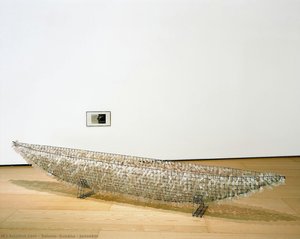
The brilliance of Solano’s technique lies in her ability to manipulate heavy, imposing materials to achieve a sense of weightlessness. Through the clever use of wire mesh and glass, she creates surfaces that appear both fragile and enduring. One can observe this duality in works such as Jaosokor, where an iron armature is draped in transparent plastic, creating a surface that mimics the shimmering properties of water. This mastery over contrast allows her to explore complex themes:
- Containment and Liberation: The tension between enclosed metal structures and the open space they frame.
- The Organic and the Industrial: Blending synthetic, modern materials with forms that suggest tribal or natural origins.
- Light as a Sculptural Element: Using transparency and mesh to allow ambient light to animate and transform the metal surfaces.
A Legacy of Presence and Permanence
The historical significance of Susana Solano lies in her ability to bridge the gap between the abstract traditions of Spanish masters like Julio González, Jorge Oteiza, and Eduardo Chillida and a more contemporary, personal narrative. While she shares their fascination with the philosophical implications of materiality, her work is uniquely marked by an emotional intimacy—a way of sculpting the "inner landscape" of the human psyche. Her sculptures do not just stand as objects; they act as thresholds, inviting the viewer to step into a space of contemplation and spiritual inquiry.
Throughout her prolific career, Solano’s work has been exhibited extensively across Europe, Spain, and the United States, earning her a place in prestigious collections such as the Guggenheim Museum and MACBA. As she continues to live and work in Barcelona, her legacy remains one of profound resilience. She has proven that even the coldest, most industrial materials can be imbued with the warmth of memory, the softness of light, and the eternal human search for meaning within the spaces we inhabit.
Întrebări și răspunsuri
De unde este Susana Solano?
Susana Solano s-a născut în Spain.
Există o relatare cronologică a carierei lui Susana Solano?
O relatare cronologică a creației lui Susana Solano este disponibilă pe pagina Cronologie a artistului, unde operele se succed în ordinea creației lor, capitol cu capitol.
Pot să explorez lucrările lui Susana Solano în funcție de starea de spirit?
Lucrările lui Susana Solano pot fi explorate în funcție de starea de spirit pe pagina Galerie pe stări de spirit a artistului, unde operele sunt organizate după stările lor de spirit.
Unde pot vedea profilul cromatic al lucrărilor lui Susana Solano?
Profilul cromatic al lucrărilor lui Susana Solano este prezentat în pagina Genoma Paletei a artistului.