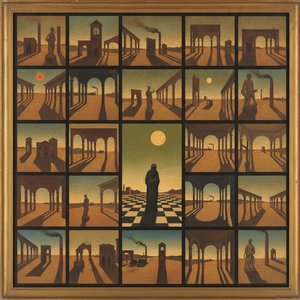
The Architecture of Pure Form
Born in 1978, Sébastien Garnier has emerged as a profound contemporary voice in the realm of digital abstraction. Based in the vibrant cultural landscape of Lyon, his practice is an intentional dialogue with the historical gaze of the De Stijl movement. Garnier does not merely replicate; he reinterprets the foundational principles of Piet Mondrian through a modern, digital lens, seeking to capture a luminous structure within every composition.
The Geometry of Light and Color
At the heart of Garnier's oeuvre lies the "Mondrian Grid," a rigorous system of vertical and horizontal black lines that serves as the skeletal framework for his explorations. By populating this strict grid with pure primary red, blue, and yellow, he creates a tension between mathematical precision and visual energy. Each rectangle becomes a vessel for color, stripped of all ornament to reveal a tactile silence that resonates within the digital medium.
A Legacy of Singular Vision
Garnier's work represents a masterful abstraction of space, where light is distilled into geometric planes. As part of the exclusive OriginalUniqueArt collection, each piece by Garnier is offered as a unique encounter—available only once as a high-fidelity digital image, fine art print, or hand-painted original, with select works also available as NFTs. His compositions invite the viewer to find peace within the ordered chaos of the modern age.
Întrebări și răspunsuri
Pot explora operele lui Sébastien Garnier pe baza unor cuvinte cheie?
Operele lui Sébastien Garnier pot fi explorate pe baza cuvintelor cheie, în pagina de După cuvinte cheie a artistului. Fiecare cuvânt cheie grupează operele aferente.
Unde pot vedea toate operele lui Sébastien Garnier?
Toate lucrările lui Sébastien Garnier de pe acest site web pot fi explorate în pagina Toate operele de artă a artistului.
Ce stări exprimă operele lui Sébastien Garnier?
Lucrările lui Sébastien Garnier pot fi explorate în funcție de starea de spirit pe pagina Galerie pe stări de spirit a artistului, unde operele sunt organizate după stările lor de spirit.