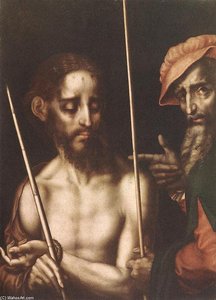
Portretul lui Luis De Morales

Cele 50 cele mai faimoase picturi ale lui Luis De Morales, fiecare unică în felul ei

Actualizat Noiembrie 2026 · clasat în funcție de scorul nostru de popularitate (căutări, vizite și comenzi pentru fiecare operă) · 51 lucrări ale lui Luis De Morales în catalogul nostru

Pe scurt

Virgin and Child with the Infant St John the Baptist (1550) este pictura lui Luis De Morales care atrage cele mai multe priviri; originalul aparține Muzeul Prado, Madrid. După aceasta, privirea se îndreaptă către The Crucifixion (1566) și The Annuncation (1565). Dintre cele 51 opere ale lui Luis De Morales din catalogul nostru, acestea 50 sunt cele mai celebre, fiecare fiind o piesă unică, prezentată împreună cu anul creării, muzeul deținător și motivul pentru care aceasta rămâne memorabilă.

1509 – 1586, Badajoz Spanish renaissance Cele mai multe lucrări: Muzeul Prado

Cele mai importante 10 picturi ale lui Luis De Morales, prin ochii galeriei

1
Virgin and Child with the Infant St John the Baptist (1550) de Luis De Morales

Virgin and Child with the Infant St John the Baptist

1550 · Oil On Canvas · Muzeul Prado, Madrid

In this 1550 portrait, the Virgin Mary holds the infant Jesus in a close, physical embrace. The child is depicted nursing, a detail that grounds the religious scene in a moment of biological necessity and maternal intimacy. To the left and right of the central figures, two winged beings—angels or saints—occupy the periphery of the frame. These figures are positioned against a backdrop of dense trees, which provides a sense…

2
The Crucifixion (1566) de Luis De Morales

The Crucifixion

1566 · Oil On Panel · Muzeul Prado, Madrid

The heavy silence of the scene is held within The Crucifixion, a profound work of religious art created by the Spanish painter Luis de Morales. Dating to 1566, this piece captures a moment of intense spiritual weight. The central focus remains fixed upon the Crucifixion of Jesus Christ, a subject that demands the viewer's immediate and solemn attention.

3
The Annuncation (1565) de Luis De Morales

The Annuncation

1565 · Oil On Panel · Muzeul Prado, Madrid

The Annunciation by Luis de Morales captures a moment of divine stillness. Painted about 1565, the work presents a quiet encounter between the celestial and the earthly. The Archangel Gabriel and the Virgin Mary occupy a shared, intimate space, separated by a single white lily in a slender vase. A white dove descends through soft light, marking the presence of the Holy Spirit above the figures.

4
The Resurrection of Christ (1566) de Luis De Morales

The Resurrection of Christ

1566 · Oil · Muzeul Prado, Madrid

A sudden, vertical force breaks the stillness of the tomb. Christ rises from the heavy stone sarcophagus, his body caught in a moment of divine momentum. The light is not merely a glow; it is a weightless, golden flood that carves the musculature of his torso out of the surrounding shadows. Behind him, a shroud of reddish-pink fabric billows like a sudden flame, tracing the path of his upward movement.…

5
The Birth of the Virgin (1562) de Luis De Morales

The Birth of the Virgin

1562 · Oil · Muzeul Prado, Madrid

The air in the room feels heavy, thick with the quiet gravity of a life beginning. Within this shallow, intimate space, four women gather, their forms tightly grouped as if to shield the profound miracle unfolding before them. A woman reclines in the bed, her presence marked by the soft contours of her face and the weight of the linens surrounding her. Nearby, another figure holds a newborn infant, the…

6
The Virgin and Child with a Spindle (1566) de Luis De Morales

The Virgin and Child with a Spindle

1566 · Oil · Muzeul Prado, Madrid

The composition is a vertical portrait set against a dark, undifferentiated background. In the center, the Virgin Mary holds the Christ Child. She wears a red gown beneath a heavy blue mantle, while a translucent veil rests upon her head. The skin of both figures appears pale and luminous against the deep shadows. The child holds a wooden spindle, its straight, thin lines cutting through the soft folds of the…

7
Saint John the Baptist (1566) de Luis De Morales

Saint John the Baptist

1566 · Oil On Panel · Muzeul Prado, Madrid

The portrait presents a close-up, bust-length view of Saint John the Baptist, positioned slightly off-center. He gazes toward the left with an expression defined by weariness and contemplation. The composition utilizes a chiaroscuro technique, where a strong directional light source illuminates one side of the face, carving out the hollows of the eyes and the texture of the beard against deep, shadowy recesses. This interplay of light and dark creates…

8
Virgin and Child-Morales (1586) de Luis De Morales

Virgin and Child-Morales

1586 · Oil On Canvas · Machado de Castro National Museum, Coimbra

The Virgin gently cradles her son within a space defined by shadow and soft light. A newborn hand tucks through the folds of a red gown, searching for milk. This small gesture anchors the composition, pulling the viewer into a quiet, domestic moment of care. The faces of mother and child lean toward one another, their gazes interlocking with a tender, silent weight. Behind them, a pitch-dark background swallows the…

9
Ecce Homo (1565) de Luis De Morales

Ecce Homo

1565 · Oil On Canvas · Muzeul Prado, Madrid

The shadows press closely against the figure, creating a void that seems to swallow everything but the man himself. In this vertical portrait, the upper torso and head of Jesus Christ emerge from a near-black background, caught in a heavy, dramatic chiaroscuro. A soft light descends from the upper left, catching the smooth, porcelain-like texture of his skin and casting gentle shadows across the musculature of his chest and arms.…

10
Pietà de Luis De Morales

Pietà

Oil On Panel · Muzeul Luvru, Paris

In the quiet, somber depths of Luis de Morales’s Pietà, one encounters more than just a religious scene; one enters a profound meditation on human suffering and divine grace. Executed between 1565 and 1570, this masterpiece serves as a cornerstone of the Spanish Renaissance, capturing the exact moment when the weight of mortality meets the infinite strength of maternal love. The painting depicts the Virgin Mary cradling the lifeless, broken…

Păiți celebrele picturi ale lui Luis De Morales, de la numărul 11 la 50

11Christ Justifying his Passion (1565) de Luis De MoralesChrist Justifying his Passion1565 · Muzeul Prado 12Christ, Man of Sorrows (1566) de Luis De MoralesChrist, Man of Sorrows1566 · Muzeul Prado 13Pietà (1567) de Luis De MoralesPietà1567 · Muzeul Prado 14Saint Juan de Ribera (1566) de Luis De MoralesSaint Juan de Ribera1566 · Muzeul Prado 15Ecce Homo (1547) de Luis De MoralesEcce Homo1547 · Staatliche Kunstsammlungen Dresden 16The Adoration of the Shepherds (1567) de Luis De MoralesThe Adoration of the Shepherds1567 · Muzeul Prado 17Man of Sorrows (1560) de Luis De MoralesMan of Sorrows1560 · Minneapolis Institute of Art 18The Lamentation (1560) de Luis De MoralesThe Lamentation1560 · Metropolitan Museum of Art 19The Purification of the Virgin or The Presentation in the Temple (1562) de Luis De MoralesThe Purification of the Virgin or The Presentation in the Temple1562 · Muzeul Prado 20Pietà (1560) de Luis De MoralesPietà1560 · Academia Regal de Bellas Artes de San Fernando 21Ecce Homo (1570) de Luis De MoralesEcce Homo1570 · Museu Nacional d'Art de Catalunya 22The Virgin and Child with the Infant Saint John the Baptist (1570) de Luis De MoralesThe Virgin and Child with the Infant Saint John the Baptist1570 · Muzeul Prado 23The Virgin Dolorosa (1565) de Luis De MoralesThe Virgin Dolorosa1565 · Muzeul Prado 24The Adoration of the Magi (1567) de Luis De MoralesThe Adoration of the Magi1567 · Muzeul Prado 25Christ Carrying the Cross (1547) de Luis De MoralesChrist Carrying the Cross1547 · Colecțiile Statale de Pictură din Bavaria 26Christ Carrying the Cro (1546) de Luis De MoralesChrist Carrying the Cro1546 · Yale University Art Gallery 27Triptych of the Pietà, St John and St Mary Magdalene (1567) de Luis De MoralesTriptych of the Pietà, St John and St Mary Magdalene1567 · Muzeul Prado 28Holy Family (1557) de Luis De MoralesHoly Family1557 · Hispanic Society Museum - Library 29Saint Jerome in the Wilderness (1570) de Luis De MoralesSaint Jerome in the Wilderness1570 · National Gallery of Ireland 30Ecce Homo (1565) de Luis De MoralesEcce Homo1565 · Fundación Banco Santander 31Christ before Pilate (1570) de Luis De MoralesChrist before Pilate1570 · Academia Regal de Bellas Artes de San Fernando 32Christ Carrying the Cross (1566) de Luis De MoralesChrist Carrying the Cross1566 · Museo del Patriarca 33The Agony in the Garden (1545) de Luis De MoralesThe Agony in the Garden1545 · Muzeul Prado 34Madonna and Child de Luis De MoralesMadonna and ChildBowes Museum 35The Virgin and Child (1567) de Luis De MoralesThe Virgin and Child1567 · Muzeul Ashmolean de Artă și Arheologie 36Virgin and Child (1520) de Luis De MoralesVirgin and Child1520 · Museu do Caramulo 37Virgin and Child with a Spindle (1567) de Luis De MoralesVirgin and Child with a Spindle1567 · Muzeele Statale din Berlin 38Christ at the Column de Luis De MoralesChrist at the ColumnMuzeul Național de Arte Fine din Buenos Aires 39Virgin and Child de Luis De MoralesVirgin and ChildMuzeul de Artă Plastică din Boston 40Madonna and Child de Luis De MoralesMadonna and ChildCampion Hall 41Pietà 1724 de Luis De MoralesPietà 1724 42Christ at the Column de Luis De MoralesChrist at the ColumnKingston Lacy 43Triptych of Bishop Juan de Ribera de Luis De MoralesTriptych of Bishop Juan de RiberaMuzeul din Cádiz 44The Virgin and Child de Luis De MoralesThe Virgin and ChildNational Gallery 45Ecce Homo de Luis De MoralesEcce HomoHispanic Society Museum - Library 46Christ as the Man of Sorrows de Luis De MoralesChrist as the Man of Sorrows 47St Stephen de Luis De MoralesSt StephenMuzeul Prado 48Madonna with the Child (1570) de Luis De MoralesMadonna with the Child1570 · Muzeul Prado 49Mater Dolorosa (1570) de Luis De MoralesMater Dolorosa1570 · Muzeul Ermitaj 50Madonna with the Child (1570) de Luis De MoralesMadonna with the Child1570 · Muzeul Ermitaj

Piesele celebre ale lui Luis De Morales, perioadă cu perioadă

Subiectele care i-au captivat privirea lui Luis De Morales

Cele patru teme care revin cel mai des în aceste opere originale, fiecare având cel mai sublim exemplu.

Muzeele care păstrează originalele lui Luis De Morales

Cele 8 muzee care dețin cele mai multe dintre picturile de pe această pagină.

Muzee Oraș Lucrări lui Luis De Morales Picturi din această listă
Muzeul Prado, MadridMuzeul Prado Madrid 21 Virgin and Child with the Infant St John the Baptist, The Crucifixion, The Annuncation
Academia Regal de Bellas Artes de San Fernando, MadridAcademia Regal de Bellas Artes de San Fernando Madrid 2 Pietà, Christ before Pilate
Hispanic Society Museum - Library, New YorkHispanic Society Museum - Library New York 2 Holy Family, Ecce Homo
Muzeul Ermitaj, Sankt PetersburgMuzeul Ermitaj Sankt Petersburg 2 Mater Dolorosa, Madonna with the Child
Machado de Castro National Museum, CoimbraMachado de Castro National Museum Coimbra 1 Virgin and Child-Morales
Muzeul Luvru, ParisMuzeul Luvru Paris 1 Pietà
Staatliche Kunstsammlungen Dresden, DresdaStaatliche Kunstsammlungen Dresden Dresda 1 Ecce Homo
Minneapolis Institute of Art, MinneapolisMinneapolis Institute of Art Minneapolis 1 Man of Sorrows

Luis De Morales de-a lungul deceniilor: o piesă unică pentru fiecare

Lucrări pe deceniu

Alege o deceniu pentru a descoperi opera originală care îl definește.

Picturile lui Luis De Morales: întrebări pentru galerie

Care este cea mai celebră operă a lui Luis De Morales?Află răspunsul

Virgin and Child with the Infant St John the Baptist (1550), Muzeul Prado, Madrid. Urmează The Crucifixion (1566) și The Annuncation (1565).

La ce vârstă a creat Luis De Morales Virgin and Child with the Infant St John the Baptist?Află răspunsul

41 ani: Virgin and Child with the Infant St John the Baptist datează din 1550, iar Luis De Morales s-a născut în 1509.

Care sunt cele mai celebre zece picturi ale lui Luis De Morales?Află răspunsul

Virgin and Child with the Infant St John the Baptist, The Crucifixion, The Annuncation, The Resurrection of Christ, The Birth of the Virgin, The Virgin and Child with a Spindle, Saint John the Baptist, Virgin and Child-Morales, Ecce Homo și Pietà. Clasamentul de mai sus indică anul și muzeul pentru fiecare piesă.

Câte lucrări ale lui Luis De Morales sunt cunoscute?Află răspunsul

Catalogul nostru cuprinde 51 lucrări ale lui Luis De Morales, datate între 1520 și 1586.

Unde pot fi vizualizate originalele celor mai faimoși Luis De Morales?Află răspunsul

În principal în Muzeul Prado (Madrid), Academia Regal de Bellas Artes de San Fernando (Madrid) și Hispanic Society Museum - Library (New York). Tabelul cu muzee de mai sus le enumeră pe toate.

În ce perioadă a creat Luis De Morales cele mai cunoscute picturi?Află răspunsul

În 1560s: 23 dintre cele 50 lucrări de pe această pagină au fost realizate atunci, fiind The Crucifixion dintre acestea.

Care este cea mai veche și care este cea mai recentă pictură a lui Luis De Morales?Află răspunsul

Pe această pagină, cea mai veche lucrare datează din Virgin and Child (1520), iar cea mai recentă este din Virgin and Child-Morales (1586).

Ce teme prefera Luis De Morales?Află răspunsul

Man (22), Woman (20) și Dark background (18), din cele 50 lucrări de pe această pagină.

Cu ce materiale a pictat cel mai des Luis De Morales?Află răspunsul

Oil On Panel, pentru 27 dintre cele 50 lucrări de pe această pagină.

Din ce curent artistic face parte opera lui Luis De Morales?Află răspunsul

Spanish renaissance, judecând după originalele de pe această pagină.

Ce originale de Luis De Morales pot vedea la Muzeul Prado?Află răspunsul

Virgin and Child with the Infant St John the Baptist, The Crucifixion și The Annuncation: Muzeul Prado, Madrid deține 21 dintre lucrările de pe această pagină.

Luis De Morales: un portret al artistului

Luis de Morales: Pictorul Divin din Badajoz

Luis de Morales (aprox. 1509 – 9 mai 1586), cunoscut cu afecțiune sub numele de „El Divino”, se ridică printre cele mai venerate figuri ale artei renascentiste spaniole—un pictor a cărui spiritualitate profundă și realism uluitor au captivat publicul pe parcursul întregii sale vieți și continuă să inspire admirație după secole. Născut în Badajoz, Extremadura, călătoria artistică a lui Morales s-a desfășulat pe fundalul idealurilor umaniste înfloritoare și al fervoarei religioase, modelându-l într-un maestru fără egal al imaginii devotionale și consolidându-i moștenirea ca artist esențial al epocii sale.
  • Primii ani și influențele: Puține lucruri se cunosc cu certitudine despre anii săi formativi, dincolo de înregistrările documentate care indică faptul că s-a născut în Badajoz în jurul anului 1509. Formarea sa artistică a început probabil sub îndrumarea lui Hernando Sturmio, un pictor flamand stabilit în Badajoz, și posibil sub cea a lui Pedro de Campaña, un artist prominent bazat în Sevilla—locuri renumite pentru tradițiile lor artistice vibrante în timpul Renașterii.
  • Școala Lombardă și ecourile florentine: Primele lucrări ale lui Morales poartă urme de neagadat ale școlii lombarde a lui Leonardo da Vinci – caracterizată prin subtilul sfumato (contururi difuze) și perspectivă atmosferică. În același timp, el a absorbit influențe de la Michelangelo, ale cărui sculpturi monumentale i-au insuflat o înțelegere magistrală a anatomiei și a gestului expresiv. Aceste experiențe formative și-au impactat profund sensibilitățile sale artistice.

O perioadă definită de precizia anatomică și profunzimea spirituală

Producția artistică a lui Morales poate fi împărțită, în linii mari, în două perioade distincte, reflectând tendințele stilistice și curentii intelectuali în evoluție. Prima fază, care s-a întins aproximativ din 1539 până în 1560, a fost martorul unui angajament continuu cu estetica florentină—în special cu rigoarea anatomică a lui Michelangelo—rezultând picturi îmbibate cu o emoție palpabilă și tensiune dramatică. Lucrări precum La Virgen del Pajarito exemplifică acest stil timpuriu, prezentând detalii meticuloase și transmitând o profundă contemplație spirituală.
  • A doua înflorire: În urma căsătoriei sale cu Leonor de Chaves și a mutării ulterioare la Alcántara, Morales a experimentat o remarcabilă renaștere artistică. Această perioadă l-a văzut producând capodopere care au împins limitele tehnicii renascentiste—în special în ceea ce privește acuratețea anatomică—trăgând inspirație de la pictorii germani și flamanzi care susțineau chiaroscuro (contrastul dintre lumină și întuneric) și observația meticuloasă a naturii.
  • Realizări notabile: Printre cele mai celebrate picturi ale sale se numără La Piedad (1560), păstrată în Catedrala din Badajoz, o reprezentare uluitoare a Maicii Domnului îndurerându-se pentru moartea lui Iisus—o dovadă a abilității fără egal a lui Morales de a transmite emoția durerii; San Juan de Ribera (1564), aflat în Muzeul Prado din Madrid; și Ecce Homo, expus la Hispanic Society of America. Aceste opere stau ca simboluri durabile ale pietatei renascentiste și ale excelenței artistice.

Moștenire și recunoaștere

Influența lui Luis de Morales s-a extins mult dincolo de propria sa existență, consacrându-l ca piatră de temelie a artei renascentiste spaniole și asigurându-și locul printre cei mai mari pictori ai generației sale. Devotamentul său neclintit față de temele religioase—exprimat cu un realism uluitor și îmbibat cu o emoție palpabilă—a rezonat profund cu publicul din întreaga Europă. Astăzi, picturile sale sunt păstrate în instituții prestigioase din întreaga lume—inclusiv în Muzeul Prado din Madrid și Kingston Lacy House din Dorset—atestând valoarea lor artistică durabilă și semnificația istorică. Moștenirea lui Morales continuă să inspire artiști și cercetători deopotrivă, asigurându-se că „El Divino” rămâne un far al artei spirituale pentru generațiile ce vor veni.

Lucrări selectate

  • La Virgen del Pajarito (Virgina cu păsărică) (1546), păstrată în biserica San Agustín, Madrid.
  • La Piedad (1560), păstrată în Catedrala din Badajoz.
  • San Juan de Ribera (1564), în Muzeul Prado, Madrid.
  • Ecce Homo, la Kingston Lacy House (National Trust), Dorset, Marea Britanie.
  • Virgen de la leche (Virgina care alăptează), în Muzeul Prado.
  • St. Jerome in the Wilderness (Sfântul Ieron în pustiu), în National Gallery of Ireland, Dublin.