Portretul lui Karl Pavlovich Bryullov

Cele 100 cele mai faimoase picturi ale lui Karl Pavlovich Bryullov, o selecție de galerie

Actualizat Noiembrie 2026 · clasat în funcție de scorul nostru de popularitate (căutări, vizite și comenzi pentru fiecare operă) · 407 lucrări ale lui Karl Pavlovich Bryullov în catalogul nostru

Pe scurt

Dintre toate originalele lăsate de Karl Pavlovich Bryullov, cea mai faimoasă este Ultima zi a Pompei (1833), din colecția Muzeul de Stat Rus, Sankt Petersburg. Imediat după acestea urmează Călărețul (1832) și Bathsheba (1832). Catalogul nostru cuprinde 407 lucrări ale lui Karl Pavlovich Bryullov; galeria a păstrat cele 100 pe care lumea le admiră cel mai mult, fiecare fiind prezentată împreună cu data, muzeul și povestea sa.

1799 – 1852, Sankt Petersburg Romantismul Cele mai multe lucrări: Galeria Tretyakov

Cele mai importante 10 picturi ale lui Karl Pavlovich Bryullov: selecția galeriei

1
Ultima zi a Pompei (1833) de Karl Pavlovich Bryullov

Ultima zi a Pompei

1833 · Ulei pe pânză · Muzeul de Stat Rus, Sankt Petersburg

Karl Bryullov a realizat Ultima zi a Pompei între anii 1830 și 1833. Această monumentală pânză istorică a fost comisionată de Anatoly Demidov, fiind o lucrare care surprinde erupția catastrofală a Muntelui Vezuviu din anul 79 d.Hr.

2
Călărețul (1832) de Karl Pavlovich Bryullov

Călărețul

1832 · Acrilic pe pânză întinsă · Galeria Tretyakov, Moscova

Tabloul „Călărețul” de Karl Pavlovich Bryullov, pictat în 1832, este mai mult decât un simplu portret; este un tableau meticulos construit al timpului liber aristocratic și al unui sentiment romantic în plină expansiune. Această operă captivantă, disponibilă acum sub formă de o reproducere spectaculoasă pictată manual de pe WahooArt.com, transportă privitorul într-o proprietate italiană scăldată în soare, surprinzând o scenă intimă a unei tinere femei – Giovanina și Amacilia Pacini,…

3
Bathsheba (1832) de Karl Pavlovich Bryullov

Bathsheba

1832 · Oil On Canvas · Galeria Tretyakov, Moscova

In the quiet, luminous depths of Karl Pavlovich Bryullov’s 1832 masterpiece, Bathsheba, we find ourselves transported to a moment where time itself seems to hold its breath. This monumental canvas is far more than a mere biblical illustration; it is a profound psychological study wrapped in the velvet textures of the Romantic era. The scene captures the biblical Bathsheba in a state of private contemplation, seated as she tends to…

4
Pilgrims at the Entrance of the Lateran Basilica (1825) de Karl Pavlovich Bryullov

Pilgrims at the Entrance of the Lateran Basilica

1825 · Oil On Canvas · Galeria Tretyakov, Moscova

To stand before Karl Pavlovich Brulloff's depiction of Pilgrims at the Entrance of the Lateran Basilica is to step across the threshold of time itself. This oil on canvas, executed in 1825, is far more than a mere historical scene; it is a profound meditation on faith, community, and the enduring human journey toward something sacred. Brulloff captures that exquisite moment when the weight of worldly experience meets the promise…

5
Portrait of F.A. Bruni (1828) de Karl Pavlovich Bryullov

Portrait of F.A. Bruni

1828 · Graphite Pencil

The artwork is titled Portrait of F.A. Bruni and was executed by the artist Karl Bryullov. This specific work is a monochromatic portrait sketch that focuses on the head and upper torso of a man. The subject is presented in a three-quarter view, with his gaze directed toward the viewer. Based on the title, the man depicted is likely F.A. Bruni.

6
Princess Yuliya Pavlovna Samoilova Leaving a Ball with Adopted Daughter Amacilia Pacini de Karl Pavlovich Bryullov

Princess Yuliya Pavlovna Samoilova Leaving a Ball with Adopted Daughter Amacilia Pacini

Oil On Canvas · Muzeul Rusului de Stat, Saint Petersburg

The canvas bears the title Princess Yuliya Pavlovna Samoilova Leaving a Ball with Adopted Daughter Amacilia Pacini. It is a work by the artist Karl Bryullov. Within the frame, the Countess Yuliya Pavlovna Samoilova and her adopted daughter Amacilia Pacini are captured in a moment of quiet transition. The portrait reflects the artist's specific skill in rendering the likeness and presence of his subjects.

7
Portrait of V. A. Perovsky (1837) de Karl Pavlovich Bryullov

Portrait of V. A. Perovsky

1837 · Oil On Canvas · Galeria Tretyakov, Moscova

The Portrait of V. A. Perovsky is an oil on canvas painting from 1837. The subject is a man positioned in a military uniform, standing upon a dirt road. He holds a flag, a detail that establishes a sense of authority within the scene. A horse is situated near the center of the composition, providing a sense of depth to the landscape. In the background, two additional figures are visible,…

8
Child in a Swimming Pool (Portrait of Prince A.G. Gagarin in Childhood) (1829) de Karl Pavlovich Bryullov

Child in a Swimming Pool (Portrait of Prince A.G. Gagarin in Childhood)

1829 · Acrylic On Canvas · Galeria Tretyakov, Moscova

Karl Pavlovich Bryullov's "Child in a Swimming Pool," painted in 1829, is more than just a charming pastoral scene; it’s a poignant meditation on innocence, fleeting beauty, and the ephemeral nature of childhood. This watercolor masterpiece, currently residing within the hallowed halls of the Tretyakov Gallery in Moscow, captures a young boy – widely believed to be Prince Alexander Gagarin, a future figure in Russian history – immersed in a…

9
Vespers (1825) de Karl Pavlovich Bryullov

Vespers

1825 · Oil On Canvas

The evening air settles heavily around the figures in Vespers, a genre painting by Karl Bryullov. Created in 1825, the work captures a quiet, communal moment of devotion. Here, the artist turns his gaze toward the simple, profound acts of faith that define a community. The scene unfolds as a gathering of souls, each caught in a private moment of prayer or reflection during an evening service.

10
Portrait of Countess Samoilova (1834) de Karl Pavlovich Bryullov

Portrait of Countess Samoilova

1834 · Oil On Canvas

In this portrait of Countess Samoilova by Karl Bryullov, the composition is anchored by the central figure of the woman. She is positioned prominently in the middle of the frame, wearing a blue dress and a crown upon her head. This central placement establishes her as the primary focus of the work. To her sides, two other figures complete the grouping. On one side, a person is dressed in a…

Selecția pentru Karl Pavlovich Bryullov continuă, de la 11 la 100

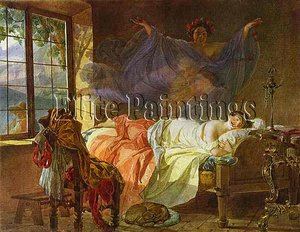
11Portrait of the Shishmariov Sisters (1839) de Karl Pavlovich BryullovPortrait of the Shishmariov Sisters1839 12Girl riding a horse de Karl Pavlovich BryullovGirl riding a horse 13Daphnis and Chloe (1850) de Karl Pavlovich BryullovDaphnis and Chloe1850 · Muzeul Ermitaj 14Portrait of Baroness Reinthal with her daughter. (1825) de Karl Pavlovich BryullovPortrait of Baroness Reinthal with her daughter.1825 · Muzeul Național din Varșovia 15Italian Morning (1823) de Karl Pavlovich BryullovItalian Morning1823 16Portrait of N. A. Okhotnikov (1827) de Karl Pavlovich BryullovPortrait of N. A. Okhotnikov1827 · Muzeul Ermitaj 17Portrait of U. M. Smirnova (1840) de Karl Pavlovich BryullovPortrait of U. M. Smirnova1840 18Portrait of Countess Yu. P. Samoilova and Her Ward Amacilia Pacini Leaving a Ball (1842) de Karl Pavlovich BryullovPortrait of Countess Yu. P. Samoilova and Her Ward Amacilia Pacini Leaving a Ball1842 19The head of Bacchus (1811) de Karl Pavlovich BryullovThe head of Bacchus1811 20Self-portrait (1816) de Karl Pavlovich BryullovSelf-portrait1816 21Portrait of the Actor A. N. Ramazanov (1821) de Karl Pavlovich BryullovPortrait of the Actor A. N. Ramazanov1821 22Kleobis and Biton (1827) de Karl Pavlovich BryullovKleobis and Biton1827 23Hylas, Carried Along by the Nymphs in Water (1827) de Karl Pavlovich BryullovHylas, Carried Along by the Nymphs in Water1827 24Portrait of F. D. Gverazzi (1830) de Karl Pavlovich BryullovPortrait of F. D. Gverazzi1830 25Portrait of Alexander Bruloff (1826) de Karl Pavlovich BryullovPortrait of Alexander Bruloff1826 26The Last Day of Pompeii (1830) de Karl Pavlovich BryullovThe Last Day of Pompeii1830 27Hylas and the Nymphs (1827) de Karl Pavlovich BryullovHylas and the Nymphs1827 28Alexander Ribeaupierre (1829) de Karl Pavlovich BryullovAlexander Ribeaupierre1829 29Portrait of V. A. Perovsky (1824) de Karl Pavlovich BryullovPortrait of V. A. Perovsky1824 30Portrait of A. N. Lvov (1824) de Karl Pavlovich BryullovPortrait of A. N. Lvov1824 31Portrait of the Poet and Playwrigh Nestor Kukolnic (1836) de Karl Pavlovich BryullovPortrait of the Poet and Playwrigh Nestor Kukolnic1836 · Galeria Tretyakov 32Portrait of the Artist Prince G. G. Gagarin (1829) de Karl Pavlovich BryullovPortrait of the Artist Prince G. G. Gagarin1829 33Aleksandr Turgenev (1833) de Karl Pavlovich BryullovAleksandr Turgenev1833 34Portrait of a Young Woman Embroidering (1832) de Karl Pavlovich BryullovPortrait of a Young Woman Embroidering1832 35Innocence, leaving the Earth (1839) de Karl Pavlovich BryullovInnocence, leaving the Earth1839 36Portrait of V. A. Zhukovsky (1837) de Karl Pavlovich BryullovPortrait of V. A. Zhukovsky1837 · Taras Shevchenko National Museum 37Portrait of I. A. Krylov (1839) de Karl Pavlovich BryullovPortrait of I. A. Krylov1839 38Sketch on the Subject of the Trinity Beneath the Oak of Mambre (1821) de Karl Pavlovich BryullovSketch on the Subject of the Trinity Beneath the Oak of Mambre1821 · Muzeul Ermitaj 39Portrait of a woman (1841) de Karl Pavlovich BryullovPortrait of a woman1841 · Finnish National Gallery 40M.P. Volkonskaia (1840) de Karl Pavlovich BryullovM.P. Volkonskaia1840 41Portrait of the architect A. Bolotov (1843) de Karl Pavlovich BryullovPortrait of the architect A. Bolotov1843 42The Return of Pope Pius IX to Rome from Basillica Santa Maria Maggiore (1850) de Karl Pavlovich BryullovThe Return of Pope Pius IX to Rome from Basillica Santa Maria Maggiore1850 43Flying Angel Mourning Victims of the Inquisition (1850) de Karl Pavlovich BryullovFlying Angel Mourning Victims of the Inquisition1850 44Portrait of Countess O.I.Orlova-Davydova and Her Daughter (1834) de Karl Pavlovich BryullovPortrait of Countess O.I.Orlova-Davydova and Her Daughter1834 · Galeria Tretyakov 45Portrait of Sculptor I. P. Vitaly (1836) de Karl Pavlovich BryullovPortrait of Sculptor I. P. Vitaly1836 · Galeria Tretyakov 46Portrait of Georg Kleberg (1833) de Karl Pavlovich BryullovPortrait of Georg Kleberg1833 · The Art Museum RIGA BOURSE 47Portrait of the Poet and Playwright Alexey Tolstoy as a Youth (1836) de Karl Pavlovich BryullovPortrait of the Poet and Playwright Alexey Tolstoy as a Youth1836 48Portrait of Children of Volkonsky (1843) de Karl Pavlovich BryullovPortrait of Children of Volkonsky1843 · Galeria Tretyakov 49Girl in a Forest (1851) de Karl Pavlovich BryullovGirl in a Forest1851 50Greek lying on a rock (1835) de Karl Pavlovich BryullovGreek lying on a rock1835 51Greek Morning in Myraca (1835) de Karl Pavlovich BryullovGreek Morning in Myraca1835 · Muzeul de Artă Fine Pushkin 52Erminia and the Shepherds. (Unfinished) (1824) de Karl Pavlovich BryullovErminia and the Shepherds. (Unfinished)1824 · Galeria Tretyakov 53Genserich's Invasion of Rome. Study (1833) de Karl Pavlovich BryullovGenserich's Invasion of Rome. Study1833 · Galeria Tretyakov 54Siege of Pskov (1843) de Karl Pavlovich BryullovSiege of Pskov1843 · Galeria Tretyakov 55Portrait of Ye. I. Durnova (1836) de Karl Pavlovich BryullovPortrait of Ye. I. Durnova1836 · Galeria Tretyakov 56Portrait of Ye. Mussart and E. Mussart. (Riders) (1849) de Karl Pavlovich BryullovPortrait of Ye. Mussart and E. Mussart. (Riders)1849 57Grape Harvest Celebration (1827) de Karl Pavlovich BryullovGrape Harvest Celebration1827 · Galeria Tretyakov 58Portrait of Grand Duchess Elena Pavlovna (1829) de Karl Pavlovich BryullovPortrait of Grand Duchess Elena Pavlovna1829 · Galeria Tretyakov 59Temple of Apollo in Phigalia (1835) de Karl Pavlovich BryullovTemple of Apollo in Phigalia1835 · Muzeul de Artă Fine Pushkin 60Genserich's Invasion of Rome (1835) de Karl Pavlovich BryullovGenserich's Invasion of Rome1835 61A Dream of a Girl Before a Sunrise (1833) de Karl Pavlovich BryullovA Dream of a Girl Before a Sunrise1833 62Nuns of the Nunnery of Saint Heart in Rome (1849) de Karl Pavlovich BryullovNuns of the Nunnery of Saint Heart in Rome1849 · Galeria Tretyakov 63Girl Gathering Grapes in a Suburb of Naples (1827) de Karl Pavlovich BryullovGirl Gathering Grapes in a Suburb of Naples1827 64Forced to Swim (1852) de Karl Pavlovich BryullovForced to Swim1852 65Portrait of P. V. Kukolnic (1837) de Karl Pavlovich BryullovPortrait of P. V. Kukolnic1837 · Galeria Tretyakov 66Self Portrait (1813) de Karl Pavlovich BryullovSelf Portrait1813 · Galeria Tretyakov 67Male Portrait (1829) de Karl Pavlovich BryullovMale Portrait1829 68The Narcissus (1819) de Karl Pavlovich BryullovThe Narcissus1819 69Genius of Art (1820) de Karl Pavlovich BryullovGenius of Art1820 70Portrait of Maria Kikina as a Child (1817) de Karl Pavlovich BryullovPortrait of Maria Kikina as a Child1817 · Galeria Tretyakov 71Portrait of the Secretary of State Piotr Kikin (1822) de Karl Pavlovich BryullovPortrait of the Secretary of State Piotr Kikin1822 72Portrait of the Actor A.N.Ramazanov (1821) de Karl Pavlovich BryullovPortrait of the Actor A.N.Ramazanov1821 · Galeria Tretyakov 73Portrait of Maria Kikina as a Child (1821) de Karl Pavlovich BryullovPortrait of Maria Kikina as a Child1821 74Portrait of Maria Kikina as a Child (1820) de Karl Pavlovich BryullovPortrait of Maria Kikina as a Child1820 75Portrait of M. A. Kikina (1821) de Karl Pavlovich BryullovPortrait of M. A. Kikina1821 · Galeria Tretyakov 76The Model (1822) de Karl Pavlovich BryullovThe Model1822 77The Nymph (1828) de Karl Pavlovich BryullovThe Nymph1828 78Ascension Baron Shieling (1824) de Karl Pavlovich BryullovAscension Baron Shieling1824 79Bivouac on a Crater, Vesuvius (1824) de Karl Pavlovich BryullovBivouac on a Crater, Vesuvius1824 80Participants of the expedition to Mount Vesuvius (1824) de Karl Pavlovich BryullovParticipants of the expedition to Mount Vesuvius1824 81Italian morning (1823) de Karl Pavlovich BryullovItalian morning1823 82Voltigeur (1830) de Karl Pavlovich BryullovVoltigeur1830 83Italian Midday (1827) de Karl Pavlovich BryullovItalian Midday1827 · Galeria Tretyakov 84Italian Midday (1825) de Karl Pavlovich BryullovItalian Midday1825 85Portrait of V. A. Perovsky on column capitals (1824) de Karl Pavlovich BryullovPortrait of V. A. Perovsky on column capitals1824 86The Last Day of Pompeii (1830) de Karl Pavlovich BryullovThe Last Day of Pompeii1830 87The Last Day of Pompeii (detail 2) (1830) de Karl Pavlovich BryullovThe Last Day of Pompeii (detail 2)1830 88Portrait of the Architect K. A. Ton (1827) de Karl Pavlovich BryullovPortrait of the Architect K. A. Ton1827 89Satyr and Bacchante (Bacchanalia) (1824) de Karl Pavlovich BryullovSatyr and Bacchante (Bacchanalia)1824 90Portrait of Alexander Bruloff (1827) de Karl Pavlovich BryullovPortrait of Alexander Bruloff1827 91Scene at the Entrance of a Cathedral (1827) de Karl Pavlovich BryullovScene at the Entrance of a Cathedral1827 92Mother Awoken by Her Crying Child (1831) de Karl Pavlovich BryullovMother Awoken by Her Crying Child1831 93The Last Day of Pompeii (1828) de Karl Pavlovich BryullovThe Last Day of Pompeii1828 94Nun's Dream (1831) de Karl Pavlovich BryullovNun's Dream1831 95Vespers (1825) de Karl Pavlovich BryullovVespers1825 · Galeria Tretyakov 96The Last Day of Pompeii (detail 4) (1830) de Karl Pavlovich BryullovThe Last Day of Pompeii (detail 4)1830 97Portrait of A. N. Demidov, Prince of San-Donato (1831) de Karl Pavlovich BryullovPortrait of A. N. Demidov, Prince of San-Donato1831 98Portrait of the Artist Sylvester Shchedrin (1824) de Karl Pavlovich BryullovPortrait of the Artist Sylvester Shchedrin1824 99Confession of an Italian Woman (1830) de Karl Pavlovich BryullovConfession of an Italian Woman1830 100A Merry Return (1830) de Karl Pavlovich BryullovA Merry Return1830

Piesele celebre ale lui Karl Pavlovich Bryullov, perioadă cu perioadă

Subiectele care i-au captivat privirea lui Karl Pavlovich Bryullov

Cele patru teme care revin cel mai des în aceste opere originale, fiecare având cel mai sublim exemplu.

Muzeele care păstrează originalele lui Karl Pavlovich Bryullov

Cele 8 muzee care dețin cele mai multe dintre picturile de pe această pagină.

Muzee Oraș Lucrări lui Karl Pavlovich Bryullov Picturi din această listă
Galeria Tretyakov, MoscovaGaleria Tretyakov Moscova 32 Călărețul, Bathsheba, Pilgrims at the Entrance of the Lateran Basilica
Muzeul Ermitaj, Sankt PetersburgMuzeul Ermitaj Sankt Petersburg 5 Daphnis and Chloe, Portrait of N. A. Okhotnikov, Sketch on the Subject of the Trinity Beneath the Oak of Mambre
Muzeul de Artă Fine Pushkin, MoscovaMuzeul de Artă Fine Pushkin Moscova 6 Greek Morning in Myraca, Temple of Apollo in Phigalia
Muzeul Rusului de Stat, Saint PetersburgMuzeul Rusului de Stat Saint Petersburg 3 Princess Yuliya Pavlovna Samoilova Leaving a Ball with Adopted Daughter Amacilia Pacini
Muzeul de Stat Rus, Sankt PetersburgMuzeul de Stat Rus Sankt Petersburg 2 Ultima zi a Pompei
Finnish National Gallery, HelsinkiFinnish National Gallery Helsinki 2 Portrait of a woman
Muzeul Național din Varșovia, VarșoviaMuzeul Național din Varșovia Varșovia 1 Portrait of Baroness Reinthal with her daughter.
Taras Shevchenko National Museum, KievTaras Shevchenko National Museum Kiev 1 Portrait of V. A. Zhukovsky

Karl Pavlovich Bryullov deceniu cu deceniu: originalul care definește fiecare

Lucrări pe deceniu

Alege o deceniu pentru a descoperi opera originală care îl definește.

Întrebări ale colecționarilor despre picturile lui Karl Pavlovich Bryullov

Pentru ce operă este cel mai cunoscut Karl Pavlovich Bryullov?Află răspunsul

Ultima zi a Pompei (1833), Muzeul de Stat Rus, Sankt Petersburg. Urmează Călărețul (1832) și Bathsheba (1832).

Ce vârstă avea Karl Pavlovich Bryullov când a fost creată Ultima zi a Pompei?Află răspunsul

34 ani: Ultima zi a Pompei datează din 1833, iar Karl Pavlovich Bryullov s-a născut în 1799.

Care sunt cele mai celebre zece picturi ale lui Karl Pavlovich Bryullov?Află răspunsul

Ultima zi a Pompei, Călărețul, Bathsheba, Pilgrims at the Entrance of the Lateran Basilica, Portrait of F.A. Bruni, Princess Yuliya Pavlovna Samoilova Leaving a Ball with Adopted Daughter Amacilia Pacini, Portrait of V. A. Perovsky, Child in a Swimming Pool (Portrait of Prince A.G. Gagarin in Childhood), Vespers și Portrait of Countess Samoilova. Clasamentul de mai sus indică anul și muzeul pentru fiecare piesă.

Câte picturi a lăsat Karl Pavlovich Bryullov?Află răspunsul

Catalogul nostru cuprinde 407 lucrări ale lui Karl Pavlovich Bryullov, datate între 1811 și 1852.

În ce muzee sunt expuse capodoperele lui Karl Pavlovich Bryullov?Află răspunsul

În principal în Galeria Tretyakov (Moscova), Muzeul Ermitaj (Sankt Petersburg) și Muzeul de Artă Fine Pushkin (Moscova). Tabelul cu muzee de mai sus le enumeră pe toate.

În ce ani a pictat Karl Pavlovich Bryullov cele mai cunoscute opere?Află răspunsul

În 1820s: 44 dintre cele 100 lucrări de pe această pagină au fost realizate atunci, fiind Pilgrims at the Entrance of the Lateran Basilica dintre acestea.

Care sunt prima și ultima pictură originală celebră a lui Karl Pavlovich Bryullov?Află răspunsul

Pe această pagină, cea mai veche lucrare datează din The head of Bacchus (1811), iar cea mai recentă este din Forced to Swim (1852).

Ce subiecte a ales cel mai des Karl Pavlovich Bryullov?Află răspunsul

Man (32), Woman (28) și Portrait (27), din cele 100 lucrări de pe această pagină.

Ce tehnică a folosit cel mai des Karl Pavlovich Bryullov?Află răspunsul

Oil On Canvas, pentru 50 dintre cele 100 lucrări de pe această pagină.

Din ce mișcare artistică face parte Karl Pavlovich Bryullov?Află răspunsul

Romantismul și Neo-classicism, judecând după originalele de pe această pagină.

Ce lucrări ale lui Karl Pavlovich Bryullov sunt expuse la Galeria Tretyakov?Află răspunsul

Călărețul, Bathsheba și Pilgrims at the Entrance of the Lateran Basilica: Galeria Tretyakov, Moscova deține 23 dintre lucrările de pe această pagină.

Karl Pavlovich Bryullov: viață și operă

Karl Pavlovich Bryullov: A Life in Romanticism

Karl Pavlovich Bryullov (born Karl Briullo) was a Russian painter who combined technical proficiency and classical academic training with a Romantic spontaneity to produce some of the liveliest examples of Russian art of the period. Bryullov descended from French Huguenots, and his father was a sculptor. (The **Imperial School for the Arts** in St. Petersburg nurtured his early talent.)

Early Life and Training

Bryullov’s artistic journey began under his father's guidance before he formally enrolled at the Imperial School for the Arts in St. Petersburg in 1809. His father, Pavel Ivanovich Briullo, instilled in young Karl a love for the arts – a passion that would define his entire life and career. Bryullov’s formative years were marked by exposure to sculpture and artistic traditions, shaping his understanding of visual expression from its earliest stages.

Artistic Development and Influences

Though educated within a classical framework, Bryullov never fully embraced its rigid constraints. He felt a strong pull towards Italy from an early age, and his artistic development was significantly shaped by Italian Renaissance masters. He admired artists like Raphael, whose harmonious compositions and idealized figures served as inspiration for Bryullov’s own stylistic choices. Similarly, Michelangelo's monumental sculptures instilled in him a reverence for anatomical accuracy and dramatic grandeur—elements that would become hallmarks of his oeuvre. Furthermore, Caravaggio’s masterful use of chiaroscuro – the interplay of light and shadow – profoundly impacted Bryullov’s technique, encouraging him to explore expressive tonal ranges within his paintings.

Major Achievements and Notable Works

Bryullov’s breakthrough came with “The Last Day of Pompeii” (1830-1833), a monumental historical painting that catapulted him to international fame. The work, depicting the chaotic eruption of Mount Vesuvius, was lauded for its dramatic composition, emotional intensity, and technical brilliance. It garnered immense praise from contemporaries like Pushkin and Gogol—artists who recognized Bryullov’s unparalleled ability to convey both visual spectacle and profound psychological depth. Beyond Pompeii, Bryullov produced several other significant works, including “The Taking of the Life of a Tsar” (1827), demonstrating his skill in portraying historical narratives with meticulous detail; “The Defense of the Sepulchre” (1846), which skillfully balanced emotional resonance and factual accuracy; and "Princess Yuliya Pavlovna Samoilova Leaving a Ball with Adopted Daughter Amacilia Pacini" (1832)—a portrait that exemplifies Bryullov’s refined aesthetic sensibilities. He also undertook the ambitious project of decorating St Isaac's Cathedral, creating a monumental plafond that showcased his artistic vision and cemented his reputation as one of Russia’s foremost painters.

Legacy and Influence

Bryullov is considered a pivotal figure in Russian Romanticism. His work marked a shift towards greater emotional expression and dramatic storytelling within Russian art—a departure from the restrained formalism of Neoclassicism. He bridged the gap between classical academic training and the burgeoning Romantic movement, influencing subsequent generations of artists, including Gavriil Gorelov. Bryullov’s legacy extends beyond his paintings; he was a respected teacher who fostered innovation and encouraged students to explore new artistic horizons—leaving an enduring mark on the nation's cultural heritage. He died on June 23, 1852, near Rome and is buried at the Cimitero Acattolico.