Jonas Lie: A Pioneer of Norwegian Expressionism
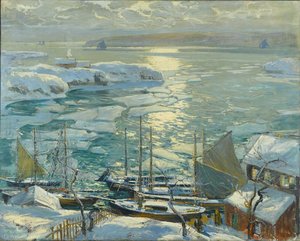
Jonas Lie (April 29, 1880 – January 18, 1940) stands as a pivotal figure in the history of Norwegian art and a significant contributor to American Impressionism. Born in Moss, Norway, Lie’s artistic journey spanned continents, culminating in a distinguished career marked by landscapes imbued with emotional depth and technical innovation. His work embodies the spirit of Expressionism while simultaneously reflecting the influence of Impressionistic principles—a unique blend that cemented his place among the foremost artists of his era. Early Life & Artistic Training: Lie’s formative years were shaped by a devout Christian upbringing and instilled in him a profound appreciation for nature. He pursued formal artistic training at the Art Students League of New York, immersing himself in the burgeoning Impressionist movement led by artists like Claude Monet and Camille Pissarro. This exposure proved instrumental in shaping his stylistic sensibilities and establishing a foundation for his future endeavors. His father Sverre Lie, was a Norwegian civil engineer, and his mother Helen Augusta Steele, was an American from Hartford, Connecticut. He had already received drawing instruction from Christian Skredsvig in Norway, and Lie attended a small private art school in Paris. The following year he traveled to the United States, where he joined his mother and sisters in New York City. Return to Norway & Landscape Painting: Upon returning to Norway, Lie dedicated himself primarily to landscape painting—a medium he championed with unwavering conviction. He sought to capture not merely visual appearances but also the emotional resonance of the Norwegian countryside, particularly coastal scenes and birch forests. His canvases pulsated with vibrant colors and visible brushstrokes, reflecting a deliberate rejection of academic conventions in favor of subjective experience. Recurring motifs included birch trees, reflecting the tranquility and spiritual significance of Norwegian forests, and depictions of ships returning home, symbolizing themes of homecoming and nostalgia. He meticulously observed atmospheric conditions—misty mornings, turbulent seascapes—translating them into powerful visual representations that conveyed profound emotion. Major Achievements & Artistic Style: Lie’s artistic style distinguished itself through its masterful execution of Impressionistic techniques combined with Expressionist sensibilities. He employed loose brushwork and layering of colors to convey atmospheric conditions—misty mornings, turbulent seascapes—and to infuse his paintings with palpable emotion. His meticulous attention to detail ensured that every element contributed to the overall expressive impact of his compositions. He explored themes of solitude and contemplation within the natural world, mirroring the introspective spirit characteristic of Expressionism. Lie’s canvases captured the beauty of Norwegian birch forests during autumn, conveying a sense of melancholy alongside serene visual splendor. His paintings were characterized by bold color palettes and dynamic brushstrokes—a testament to his innovative approach to artistic expression. Notable Works: Several paintings exemplify Lie’s artistic prowess and stylistic vision. “The Old Ships Draw to Home Again” portrays a dramatic seascape under stormy skies, capturing the raw energy of the ocean with masterful brushwork and evocative color palettes. Similarly, “Birches” presents a serene depiction of birch trees bathed in autumnal light—a testament to Lie's stylistic fusion of Expressionism and Impressionism. "Path of Gold" showcases his exploration of coastal landscapes during sunset hours. These works stand as enduring symbols of Norwegian landscape art and demonstrate Lie’s ability to convey both beauty and emotion simultaneously. Historical Significance: Jonas Lie’s legacy extends beyond his artistic achievements; he represents a pivotal moment in the development of Norwegian modernism. His embrace of Expressionist principles challenged prevailing academic traditions, paving the way for subsequent generations of Norwegian artists to explore new avenues of creative expression. Furthermore, Lie's transatlantic journey—from Paris to New York—illustrates the interconnectedness of European and American artistic movements during the early 20th century. He achieved recognition as one of America’s leading landscape artists during his lifetime, demonstrating that artistic innovation transcends national boundaries. His enduring influence underscores the importance of capturing subjective experience and conveying profound feelings through visual representation – a contribution that continues to inspire artists today.Întrebări și răspunsuri
Unde pot găsi statistici despre operele lui Jonas Lie?
Statistici despre lucrările lui Jonas Lie sunt disponibile pe pagina de Statistici a artistului.
What aliases or alternate names does Jonas Lie have?
Jonas Lie appears under the alternate names Jonas Lauritz Idemil Lie, Jonas Lied.
Câte opere de artă ale lui Jonas Lie pot fi vizualizate?
Puteți vizualiza 18 opere de artă de opere ale lui Jonas Lie pe pagina Toate operele de artă.
Unde pot vedea toate operele lui Jonas Lie?
Toate lucrările lui Jonas Lie de pe acest site pot fi vizualizate în pagina Toate operele de artă a artistului.
Cum pot găsi lucrările lui Jonas Lie pe o temă specifică?
Operele lui Jonas Lie pot fi explorate pe baza cuvintelor cheie, în pagina de După cuvinte cheie a artistului. Fiecare cuvânt cheie grupează operele aferente.
Unde pot vedea profilul cromatic al lucrărilor lui Jonas Lie?
Profilul cromatic al lucrărilor lui Jonas Lie este prezentat în pagina Genoma Paletei a artistului.
În ce perioadă istorică a activat Jonas Lie?
Jonas Lie a activat în perioada Era modernă. Această perioadă situează activitatea artistului în istorie.
Unde pot vizualiza operele lui Jonas Lie într-o galerie 3D?
Pagina Muzeu 3D a lui Jonas Lie este o pagină care prezintă operele de artă ale artistului într-o galerie virtuală tridimensională.