The Quiet Presence of Faenza
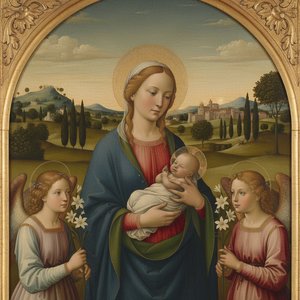
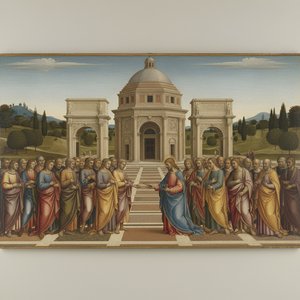
In the early sixteenth century, the streets of Faenza held a painter who moved through the shadows of the great masters. Giovanni Battista Bertucci lived and worked in this Italian city, leaving behind a trail of pigment and prayer. His hands worked in a style that echoed the soft, rhythmic grace of Perugino and Pinturicchio, capturing a specific kind of devotion that defined the era. He was a man of his time, a practitioner of the Umbrian tradition, finding his place within the local workshops of Faenza.
His life was tied to the local landscape and the religious needs of his community. We see him most clearly in the works that remain, where the brushwork reveals a steady, deliberate hand. He did not seek to disrupt the established order but rather to refine it, bringing the grace of the Umbrian school to the heart of his home.
A Hand in the Workshop
The work of Bertucci often blurs the lines between individual identity and the collective output of a busy studio. His paintings have been studied closely by those who look for the subtle differences in how a figure is draped or how a landscape recedes into the distance. Some of his pieces have been attributed to others, a common fate for artists working in the shadow of giants.
His output includes several notable subjects that reflect the spiritual preoccupations of the early 1500s:
- A Majesty, signed and dated 1506, currently held in the Pinacoteca of Faenza.
- An Adoration of the Magi, once linked to the style of Pinturicchio.
- A Glorification of the Virgin, which has been associated with the circle of Lo Spagna.
- The Virgin and Child in Glory, a work held in the National Gallery, London.
The Legacy of the Brush
By the time of his death in 1516, Bertucci had established a presence that would influence the local artistic lineage. He was part of a family of painters, a lineage that continued through the generations in Faenza. His existence is recorded not just in the paint on wood, but in the legalities of his final will and testament, which was collected in later years. He remains a figure of the early Renaissance, a painter who helped shape the visual language of his city through a quiet, consistent devotion to his craft.
Întrebări și răspunsuri
Unde pot fi găsite lucrările lui Giovanni Battista Bertucci, grupate pe tehnici?
Pagina Toate tehnicile grupează operele lui Giovanni Battista Bertucci pe tehnici.
În ce perioade este împărțită cariera lui Giovanni Battista Bertucci?
O relatare cronologică a creației lui Giovanni Battista Bertucci este disponibilă pe pagina Cronologie a artistului, unde operele se succed în ordinea creației lor, capitol cu capitol.
Unde pot vedea toate operele create de Giovanni Battista Bertucci?
Toate lucrările lui Giovanni Battista Bertucci de pe acest site web pot fi explorate în pagina Toate operele de artă a artistului.