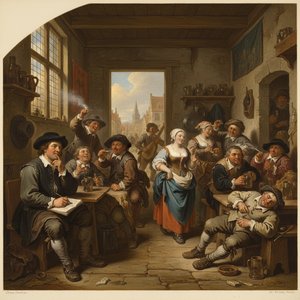
Frans Francken III (1607–1667): Flemish Baroque Master of Genre Scenes, Opulent Gallery Paintings & Portraits
Frans Francken III, born in Antwerp in 1607, stands as a pivotal figure within the Flemish Baroque tradition—a legacy forged amidst the artistic dynamism of his era and inextricably linked to the illustrious lineage of the Francken family. His life unfolded against the backdrop of Antwerp’s resurgence from religious upheaval, transforming it into a beacon for artistic innovation and commercial prosperity during the Spanish Netherlands period; an environment where observation, meticulous technique, and profound understanding of prevailing stylistic currents nurtured his creative spirit from its earliest days. The Francken family's influence extended across generations, establishing a bedrock upon which Frans III would build his distinguished career—a testament to familial dedication and artistic heritage.Early Life and Artistic Education
Frans Francken III’s formative years were spent within the nurturing embrace of his father’s workshop – a crucible where he absorbed not merely technical skills but also the very essence of Baroque aesthetics. Under Frans Francken II's guidance, he honed draughtsmanship with unwavering precision, mastered color theory—capturing the luminous vibrancy characteristic of Rubensian painting—and internalized compositional principles that would define his artistic vision for decades to come. This immersive training wasn’t merely inherited; it was an upbringing steeped in artistic tradition and fueled by a palpable passion for visual expression. The Guild of Saint Luke recognized Frans III's burgeoning talent, granting him admittance in 1639—a formal acknowledgment of his mastery and readiness to embark upon independent commissions and oversee his own workshop.The Rubensian Influence and Artistic Style
Francken III’s artistic style swiftly crystallized into a recognizable idiom – one profoundly shaped by the monumental presence of Peter Paul Rubens. While he eschewed slavish imitation, he skillfully assimilated Rubens’ dramatic lighting effects, energetic figures imbued with movement and emotion, and opulent color palettes—transforming these elements into integral components of his own distinctive aesthetic. This masterful integration cemented his reputation as “Rubensian Francken,” a moniker earned not for mere stylistic borrowing but for an astute grasp of Rubens' artistic philosophy and execution. His oeuvre is predominantly characterized by genre scenes – depictions of everyday life rendered with remarkable detail and imbued with subtle moralizing undertones—portraits capturing the likenesses of prominent citizens with nuanced psychological insight, and above all, his groundbreaking gallery paintings. These smaller-scale canvases served as intimate explorations of art collecting habits and artistic tastes—offering viewers a glimpse into the opulent interiors of aristocratic homes and celebrating the connoisseur’s discerning eye.Notable Works and Legacy
Francken III produced an impressive body of work that continues to captivate scholars and admirers alike. Among his most celebrated creations are:- Arcadia – The Golden Age: A lavish feast scene embodying Rubensian grandeur, showcasing dynamic figures bathed in dramatic light—a masterpiece demonstrating Francken’s unparalleled command of composition and color.
- The Interior of a Picture Gallery (1640): An exquisitely rendered depiction of an art collector's surroundings—illuminated by candlelight and populated by richly adorned artworks—providing invaluable insight into the cultural milieu of 17th-century Antwerp.
- The Worship Of The Golden Calf: A monumental biblical tableau executed with meticulous realism and imbued with symbolic resonance—a testament to Francken’s artistic ambition and technical prowess.
- The Adoration Of The Magi: An evocative Renaissance masterpiece characterized by luminous color palettes and intricate detail—reflecting the humanist ideals prevalent during Francken's time.
- A Young Lady And A Cavalier Holding A Letter: A captivating Baroque portrait brimming with intrigue, rich colors, and masterful execution—capturing a moment of aristocratic elegance and conveying subtle psychological nuances.
Întrebări și răspunsuri
Cum pot urmări creațiile lui Frans Francken Iii an de an?
Operele lui Frans Francken Iii pot fi vizualizate în ordine cronologică pe pagina Cronologia operelor de artă a artistului.
Există o prezentare generală a tuturor subiectelor pictate de Frans Francken Iii?
Operele lui Frans Francken Iii pot fi explorate pe temă pe pagina Atlas pe subiecte a artistului.
Câte opere de artă ale lui Frans Francken Iii pot fi vizualizate?
Puteți vizualiza 24 opere de artă de opere ale lui Frans Francken Iii pe pagina Toate operele de artă.