Portretul lui David Cox

Cele 100 cele mai faimoase picturi ale lui David Cox, o selecție de galerie

Actualizat Noiembrie 2026 · clasat în funcție de scorul nostru de popularitate (căutări, vizite și comenzi pentru fiecare operă) · 498 lucrări ale lui David Cox în catalogul nostru

Pe scurt

Dintre toate originalele lăsate de David Cox, cea mai faimoasă este Going to the Hayfield (1850). Imediat după acestea urmează George IV Embarking for Scotland at Greenwich (1823) și Going to the Hayfield (1849). Catalogul nostru cuprinde 498 lucrări ale lui David Cox; galeria a păstrat cele 100 pe care lumea le admiră cel mai mult, fiecare fiind prezentată împreună cu data, muzeul și povestea sa.

1783 – 1859, Birmingham Romanticism Cele mai multe lucrări: Birmingham Museum and Art Gallery

Cele mai importante 10 picturi ale lui David Cox: selecția galeriei

1
Going to the Hayfield (1850) de David Cox

Going to the Hayfield

1850 · Watercolor

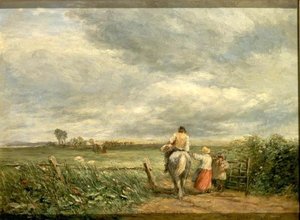
The scene unfolds in "Going to the Hayfield," a work created by the artist David Cox. In this 1849 composition, the quiet rhythms of rural life take center stage. Figures move through the landscape, their presence tied to the seasonal tasks of the countryside. The air feels heavy with the atmosphere of a specific afternoon, capturing a moment of simple, everyday activity within the English landscape.

2
George IV Embarking for Scotland at Greenwich (1823) de David Cox

George IV Embarking for Scotland at Greenwich

1823 · Watercolor

The watercolor depicts a bustling maritime scene at Greenwich, centered on the ceremonial embarkation of George IV for Scotland. Numerous vessels occupy the water, some positioned near the shore and others further out. These boats carry various figures, and several are adorned with flags. On the banks, crowds of people gather to observe the event, some standing near the water's edge while others remain further back. A horse is visible…

3
Going to the Hayfield (1849) de David Cox

Going to the Hayfield

1849 · Oil On Canvas · Birmingham Museum and Art Gallery, Birmingham

David Cox's "Going to the Hayfield," painted in 1849, isn’t merely a landscape; it’s a carefully constructed distillation of Romantic sensibility and a profound connection to the English countryside. This evocative piece, now beautifully reproduced, transports us to a specific moment – a quiet afternoon as figures journey towards a hayfield bathed in the diffused light of an overcast sky. Cox, a pivotal figure bridging the gap between earlier landscape…

4
Rhyl Sands (1854) de David Cox

Rhyl Sands

1854 · Oil On Canvas · Tate Gallery, Londra

David Cox’s “Rhyl Sands,” painted in 1854, isn't merely a depiction of a beach; it’s a carefully constructed evocation of the Romantic spirit – a yearning for the sublime beauty and untamed power of nature. Cox, a pivotal figure within the Birmingham School of watercolourists, masterfully captures a fleeting moment along the Welsh coast, imbuing the scene with an atmosphere of both tranquility and dramatic intensity. The painting transports us…

5
Study of a Dog (1840) de David Cox

Study of a Dog

1840 · Watercolor

In this intimate watercolor study, titled Study of a Dog, the viewer encounters a quiet moment of observation. The subject is a single dog, an animal captured in a state of repose. David Cox, a British artist who lived from 1783 to 1859, brings a sense of immediacy to this piece. The work emerges from the 1840s, a period when the artist's hand moved with increasing freedom. It belongs to…

6
The Skylark (1849) de David Cox

The Skylark

1849 · Oil On Canvas · Birmingham Museum and Art Gallery, Birmingham

In the vast tapestry of English landscape painting, few works capture the ephemeral beauty of the countryside with as much soul as David Cox’s The Skylark. Created in 1849, this masterpiece serves as a profound window into a serene, pastoral era, inviting the viewer to pause and breathe in the quietude of the rural landscape. The painting presents a sprawling field of grass that stretches toward a distant, hazy horizon,…

7
Storm off the Coast, Hastings (1813) de David Cox

Storm off the Coast, Hastings

1813 · Oil · Birmingham Museum and Art Gallery, Birmingham

There is a certain gravity in how the sky meets the sea in this 1813 work. The composition draws the eye along a diagonal path, moving from the heavy, dark presence of the cliffs in the foreground toward a lighter, mist-filled horizon. It is a scene of movement and tension, where the elements of sea, sky, and stone are caught in a moment of profound unrest. The palette relies on…

8
The Old Bridge at Bridgnorth, Shropshire (1809) de David Cox

The Old Bridge at Bridgnorth, Shropshire

1809 · Watercolor

The watercolor painting titled The Old Bridge at Bridgnorth, Shropshire, captures a quiet moment in the English countryside. Created by David Cox in 1809, the work presents a view of a small town nestled along the curves of a river. The scene focuses on the architecture of the bridge as it spans the water, anchoring the landscape within its natural setting.

9
Cornfield (1814) de David Cox

Cornfield

1814 · Watercolor

The air feels heavy and damp, thick with the scent of wet earth and the promise of rain. In this hazy landscape, a vast cornfield stretches toward a soft, clouded horizon, its breadth emphasized by long, horizontal strokes of ochre and muted green. Figures move through the middle ground, their forms softened by the mist, tending to a cart pulled by horses. There is a rhythmic, slow quality to their…

10
Near the Pont d'Arcole, Paris (1829) de David Cox

Near the Pont d'Arcole, Paris

1829 · Watercolor

The scene unfolds in the heart of a bustling Parisian street, captured in the work titled Near the Pont d'Arcole, Paris. This watercolor painting brings us into a moment of urban life, where the architecture of the city meets the movement of its people. The artist, David Cox, directs our gaze toward the structures and the atmosphere of the streets near the Pont d'Arcole.

Selecția pentru David Cox continuă, de la 11 la 100

11Pont Neuf from the Quai de l'Ecole, Paris (1829) de David CoxPont Neuf from the Quai de l'Ecole, Paris1829 12Place du Palais Royal, Paris (1829) de David CoxPlace du Palais Royal, Paris1829 · Birmingham Museum and Art Gallery 13The Welsh Funeral (1848) de David CoxThe Welsh Funeral1848 · Birmingham Museum and Art Gallery 14Untitled (AQTKGL) (1853) de David CoxUntitled (AQTKGL)1853 15The Cross Roads (1850) de David CoxThe Cross Roads1850 · Birmingham Museum and Art Gallery 16Rhyl Sands (1854) de David CoxRhyl Sands1854 · Birmingham Museum and Art Gallery 17Scene in a Lane (1858) de David CoxScene in a Lane1858 18Beach Scene Sunrise (1820) de David CoxBeach Scene Sunrise1820 · Yale Center for British Art 19Fishing off Hastings (1810) de David CoxFishing off Hastings1810 · Yale Center for British Art 20The Junction of the Severn and the Wye with Chepstow in the Distance (1830) de David CoxThe Junction of the Severn and the Wye with Chepstow in the Distance1830 · Yale Center for British Art 21The Wyndcliff, River Wye (1842) de David CoxThe Wyndcliff, River Wye1842 · Birmingham Museum and Art Gallery 22German Der Strand von Rhyl (1854) de David CoxGerman Der Strand von Rhyl1854 · Muzeul de Artă Manchester 23Left at a Girls' School (1812) de David CoxLeft at a Girls' School1812 · Birmingham Museum and Art Gallery 24Lake Scene, North Wales (1811) de David CoxLake Scene, North Wales1811 · Birmingham Museum and Art Gallery 25A View of Westminster Bridge, Looking West towards Lambeth Palace and Westminster Abbey (1811) de David CoxA View of Westminster Bridge, Looking West towards Lambeth Palace and Westminster Abbey1811 26In Windsor Park (1807) de David CoxIn Windsor Park1807 27Westminster from Lambeth (1813) de David CoxWestminster from Lambeth1813 28Sunset, Hastings: Beached Fishing Vessels (1811) de David CoxSunset, Hastings: Beached Fishing Vessels1811 29Gipsies on Dulwich Common (1808) de David CoxGipsies on Dulwich Common1808 · Birmingham Museum and Art Gallery 30Pastoral Scene in Herefordshire (1820) de David CoxPastoral Scene in Herefordshire1820 31Lugg Meadows, near Hereford (1817) de David CoxLugg Meadows, near Hereford1817 32Tour d'Horloge, Rouen (1829) de David CoxTour d'Horloge, Rouen1829 33The Opening of the New London Bridge (1831) de David CoxThe Opening of the New London Bridge1831 34St. Mary's Church and the Shire Hall, Warwick (1828) de David CoxSt. Mary's Church and the Shire Hall, Warwick1828 35Place St. Barthélemy, Rouen (1829) de David CoxPlace St. Barthélemy, Rouen1829 36Carthage: Aeneas and Achates (1825) de David CoxCarthage: Aeneas and Achates1825 37Junction of the Severn and the Wye with a Rainbow (1827) de David CoxJunction of the Severn and the Wye with a Rainbow1827 38Dockyard - Building a Sloop (1823) de David CoxDockyard - Building a Sloop1823 39Still LIfe: Basket, Foxgloves, Clothes and Other Objects (1823) de David CoxStill LIfe: Basket, Foxgloves, Clothes and Other Objects1823 · Birmingham Museum and Art Gallery 40A View of the Pavillon de Flore and the Tuileries from the Seine, Notre Dame, Paris (1829) de David CoxA View of the Pavillon de Flore and the Tuileries from the Seine, Notre Dame, Paris1829 41Hay on Wye (1824) de David CoxHay on Wye1824 42Porte St. Denis, Paris (1829) de David CoxPorte St. Denis, Paris1829 43Pirates' Isle (1826) de David CoxPirates' Isle1826 44Pavillon de Flore, Tuileries, Paris (1830) de David CoxPavillon de Flore, Tuileries, Paris1830 45St. Eustache, Paris (1829) de David CoxSt. Eustache, Paris1829 46Handsworth Old Church, Birmingham (1828) de David CoxHandsworth Old Church, Birmingham1828 47Ulverston Sands (1835) de David CoxUlverston Sands1835 · Birmingham Museum and Art Gallery 48Crossing Lancaster Sands (1835) de David CoxCrossing Lancaster Sands1835 49Street in Beauvais (1832) de David CoxStreet in Beauvais1832 50The Pont des Arts with the Louvre and Tuileries from the Quai Conti (1838) de David CoxThe Pont des Arts with the Louvre and Tuileries from the Quai Conti1838 51The Long Gallery, Hardwick Hall, Derbyshire (1839) de David CoxThe Long Gallery, Hardwick Hall, Derbyshire1839 52The Poplar Avenue, after Hobbema (1835) de David CoxThe Poplar Avenue, after Hobbema1835 53The Long Gallery, Hardwick Hall, Derbyshire (1839) de David CoxThe Long Gallery, Hardwick Hall, Derbyshire1839 54Going Out Hawking (1838) de David CoxGoing Out Hawking1838 55Peace and War: Lympne Church and Castle (1838) de David CoxPeace and War: Lympne Church and Castle1838 · Birmingham Museum and Art Gallery 56A Terrace, with Figures, Haddon Hall (1834) de David CoxA Terrace, with Figures, Haddon Hall1834 · Birmingham Museum and Art Gallery 57Windermere during the Regatta (1832) de David CoxWindermere during the Regatta1832 58Rhaiadr Cwm, North Wales (1836) de David CoxRhaiadr Cwm, North Wales1836 59Pass of Llanberis, Caernarvonshire, Wales (1836) de David CoxPass of Llanberis, Caernarvonshire, Wales1836 60The Long Gallery, Hardwick Hall, Derbyshire (1839) de David CoxThe Long Gallery, Hardwick Hall, Derbyshire1839 · Chatsworth House 61Crossing Lancaster Sands (1840) de David CoxCrossing Lancaster Sands1840 62View near Bettws-y-Coed (1846) de David CoxView near Bettws-y-Coed1846 · Birmingham Museum and Art Gallery 63On Lancaster Sands, Low Tide (1840) de David CoxOn Lancaster Sands, Low Tide1840 64Vale of Clwyd (1848) de David CoxVale of Clwyd1848 65Near Knaresborough (1844) de David CoxNear Knaresborough1844 66A Welsh Road (1846) de David CoxA Welsh Road1846 67The Vale of Dolwyddelan (1846) de David CoxThe Vale of Dolwyddelan1846 68A Country Track Leading to Harlech Castle (1842) de David CoxA Country Track Leading to Harlech Castle1842 69Carreg Cennan Castle (1844) de David CoxCarreg Cennan Castle1844 70Cottage Interior (1840) de David CoxCottage Interior1840 · Birmingham Museum and Art Gallery 71Outskirts of a Wood, with Gypsies (1843) de David CoxOutskirts of a Wood, with Gypsies1843 72Vale of Clwyd (1846) de David CoxVale of Clwyd1846 73Going to the Hayfield (1853) de David CoxGoing to the Hayfield1853 · Yale Center for British Art 74On the Medway (1850) de David CoxOn the Medway1850 75Horses Drinking (1855) de David CoxHorses Drinking1855 76A Mountain Torrent (1850) de David CoxA Mountain Torrent1850 77Flying the Kite (1853) de David CoxFlying the Kite1853 78On Carrington Moss, Cheshire (1851) de David CoxOn Carrington Moss, Cheshire1851 79Mountain Heights, Cader Idris (1850) de David CoxMountain Heights, Cader Idris1850 80Penman Bach (1852) de David CoxPenman Bach1852 81The Night Train (1849) de David CoxThe Night Train1849 82Vale of Clwyd (1849) de David CoxVale of Clwyd1849 83The Challange (1853) de David CoxThe Challange1853 84Peat Gatherers (1850) de David CoxPeat Gatherers1850 85Kenilworth Castle (1857) de David CoxKenilworth Castle1857 · Birmingham Museum and Art Gallery 86Darley Churchyard (1858) de David CoxDarley Churchyard1858 87On the Moors, near Bettws-y-Coed (1856) de David CoxOn the Moors, near Bettws-y-Coed1856 88Crossing the Moor (1858) de David CoxCrossing the Moor1858 89Stepping Stones, Bettws-y-Coed (1857) de David CoxStepping Stones, Bettws-y-Coed1857 90Clouds (1857) de David CoxClouds1857 91Moonlight Landscape (1850) de David CoxMoonlight Landscape1850 · Yale Center for British Art 92The Night Train (1849) de David CoxThe Night Train1849 · City Art Gallery 93Midday Rest de David CoxMidday Rest 94The Thames At Battersea de David CoxThe Thames At Battersea 95Returning Home de David CoxReturning Home 96Lancaster Sands 1 de David CoxLancaster Sands 1 97A Child With A Dog, Outside A Cottage de David CoxA Child With A Dog, Outside A Cottage 98The Jetty, Calais de David CoxThe Jetty, Calais 99Young Welsh Girl de David CoxYoung Welsh Girl 100In The Hayfield 1 de David CoxIn The Hayfield 1

Piesele celebre ale lui David Cox, perioadă cu perioadă

Subiectele care i-au captivat privirea lui David Cox

Cele patru teme care revin cel mai des în aceste opere originale, fiecare având cel mai sublim exemplu.

Muzeele care păstrează originalele lui David Cox

Cele 6 muzee care dețin cele mai multe dintre picturile de pe această pagină.

Muzee Oraș Lucrări lui David Cox Picturi din această listă
Birmingham Museum and Art Gallery, BirminghamBirmingham Museum and Art Gallery Birmingham 54 Going to the Hayfield, The Skylark, Storm off the Coast, Hastings
Yale Center for British Art, New HavenYale Center for British Art New Haven 6 Beach Scene Sunrise, Fishing off Hastings, The Junction of the Severn and the Wye with Chepstow in the Distance
Tate Gallery, LondraTate Gallery Londra 1 Rhyl Sands
Muzeul de Artă Manchester, ManchesterMuzeul de Artă Manchester Manchester 1 German Der Strand von Rhyl
Chatsworth House, BakewellChatsworth House Bakewell 1 The Long Gallery, Hardwick Hall, Derbyshire
City Art Gallery, BirminghamCity Art Gallery Birmingham 1 The Night Train

David Cox deceniu cu deceniu: originalul care definește fiecare

Lucrări pe deceniu

Alege o deceniu pentru a descoperi opera originală care îl definește.

Întrebări ale colecționarilor despre picturile lui David Cox

Pentru ce operă este cel mai cunoscut David Cox?Află răspunsul

Going to the Hayfield (1850). Urmează George IV Embarking for Scotland at Greenwich (1823) și Going to the Hayfield (1849).

Ce vârstă avea David Cox când a fost creată Going to the Hayfield?Află răspunsul

67 ani: Going to the Hayfield datează din 1850, iar David Cox s-a născut în 1783.

Care sunt cele mai celebre zece picturi ale lui David Cox?Află răspunsul

Going to the Hayfield, George IV Embarking for Scotland at Greenwich, Going to the Hayfield, Rhyl Sands, Study of a Dog, The Skylark, Storm off the Coast, Hastings, The Old Bridge at Bridgnorth, Shropshire, Cornfield și Near the Pont d'Arcole, Paris. Clasamentul de mai sus indică anul și muzeul pentru fiecare piesă.

Câte picturi a lăsat David Cox?Află răspunsul

Catalogul nostru cuprinde 498 lucrări ale lui David Cox, datate între 1807 și 1858.

În ce muzee sunt expuse capodoperele lui David Cox?Află răspunsul

În principal în Birmingham Museum and Art Gallery (Birmingham), Yale Center for British Art (New Haven) și Tate Gallery (Londra). Tabelul cu muzee de mai sus le enumeră pe toate.

În ce ani a pictat David Cox cele mai cunoscute opere?Află răspunsul

În 1850s: 24 dintre cele 100 lucrări de pe această pagină au fost realizate atunci, fiind Going to the Hayfield dintre acestea.

Care sunt prima și ultima pictură originală celebră a lui David Cox?Află răspunsul

Pe această pagină, cea mai veche lucrare datează din In Windsor Park (1807), iar cea mai recentă este din Scene in a Lane (1858).

Ce subiecte a ales cel mai des David Cox?Află răspunsul

Landscape (13), Sky (10) și British countryside (8), din cele 100 lucrări de pe această pagină.

Ce tehnică a folosit cel mai des David Cox?Află răspunsul

Watercolor, pentru 13 dintre cele 100 lucrări de pe această pagină.

Din ce mișcare artistică face parte David Cox?Află răspunsul

Romanticism, judecând după originalele de pe această pagină.

Ce lucrări ale lui David Cox sunt expuse la Birmingham Museum and Art Gallery?Află răspunsul

Going to the Hayfield, The Skylark și Storm off the Coast, Hastings: Birmingham Museum and Art Gallery, Birmingham deține 18 dintre lucrările de pe această pagină.

David Cox: viață și operă

David Cox: O viață în peisaj

Primele ani și formarea artistică

  • Naștere: 29 aprilie 1783, în Deritend, Birmingham, Regatul Unit.
  • Tatăl lui David Cox a fost fierar și șlefuitor de metal, furnizând componente industriei de arme din Birmingham. Mama sa, originară dintr-o familie de fermieri, poseda o educație superioata și un caracter puternic.
  • La început, acesta s-a înscris la academia lui Joseph Barber din Great Charles Street, unde a cunoscut colegii de studii, Charles Barber și William Radclyffe.
  • La vârsta de 15 ani, Cox a devenit ucenic la Albert Fielder, un pictor din Birmingham specializat în miniaturi de portret și picturi decorative pentru obiecte precum cutiile de tutun. Această formare timpurie i-a oferit abilitățile fundamentale necesare dezvoltării sale ulterioare.

Evoluția carierei și călătoria artistică

  • În 1804, Cox s-a mutat la Londra și s-a căsătorit cu fiica proprietarului casei în care locuia, Mary Ragg.
  • O călătorie esențială în Țara Galilor, realizată în 1805 împreună cu Charles Barber, a marcat începutul numeroaselor expediții de schițat ce vor continua pe parcursul întregii sale vieți. Aceste călătorii au influențat profund stilul său artistic.
  • Din 1805, a expus regulat la Royal Academy, câștigându-și inițial meiosul de subzistență ca profesor de desen. Colonelul Hon. H. Windsor a devenit unul dintre primii săi elevi în anul 1808.
  • Primele lucrări ale lui Cox s-au concentrat pe peisaje detaliate realizate în acuarelă, reprezentând adesea scene rurale și subiecte arhitecturale.

Stilul artistic și influențele

    Stilul lui Cox a evoluat odată cu trecerea timpului, migrând de la reprezentări topografice precise către o abordare mult mai expresivă și atmosferică.
  • Influențe: Deși influențele specifice fac obiectul unor dezbateri, opera sa demonstrează o afinitate pentru pictorii de peisaj olandezi din secolul al XVII-lea și o observație agută a naturii, ce amintește de stilul lui Constable.
  • A devenit cunoscut pentru pinceta liberă, culorile vibrante și capacitatea sa de a surprinde efectele luminii și ale vremii. Picturile sale ulterioare în ulei au fost deosebit de inovatoare.

Realizări majore și moștenire

  • Cox a pictat peste 300 de lucrări în ulei spre sfârșitul carierei sale, fiind recunoscut astăzi drept „una dintre cele mai mari, dar mai puțin recunoscute, realizări ale oricărui pictor britanic”.
  • Este considerat unul dintre cei mai mari pictori de peisaj englezi și o figură majoră a Epocii de Aur a acuamelei engleze.
  • Opera sa a influențat semnificativ generațiile ulterioare de artiști de peisaj.
  • Lucrări notabile: The Wind on the Heath, Cottage in Herefordshire, Junction of the Severn and the Wye with Chepstow in the distance și Moonlight Landscape sunt printre cele mai celebrate picturi ale sale.

Semnificația istorică

  • David Cox este recunoscut ca un precursor timpuriu al Impresionismului. Accentul său pus pe capturarea efectelor atmosferice trecătoare și pinceta sa liberă au anticipat multe dintre tehnicile adoptate ulterior de impresioniști.
  • El a jucat un rol crucial în stabilirea picturii de peisaj britanică ca un gen distinct, îndepărtându-se de reprezentările pur topografice către interpretări mai expresive și emoționale ale naturii.
  • Opera sa continuă să fie admirată pentru frumusețea, sensibilitatea și atractivitatea sa atemporală.