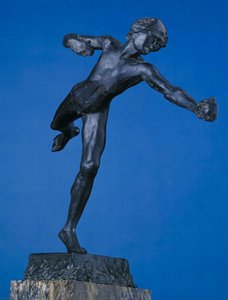
Sir Alfred Gilbert: A Victorian Sculptor of Myth and Modernity
Alfred Gilbert (1854-1934) stands as a pivotal figure in the transition between traditional sculpture and the burgeoning New Sculpture movement of the late 19th and early 20th centuries. Born into a musical family in London, his artistic journey began not with formal training but through a deep fascination with craftsmanship and a yearning to capture the idealized forms he encountered in classical art. Gilbert’s career was marked by both immense success – culminating in iconic works like Eros – and periods of personal and professional struggle, ultimately shaping him into one of Britain's most distinctive sculptors.
Gilbert’s early artistic development was profoundly influenced by his surroundings. He initially attended William Kemshead’s Academy near Portsmouth before transferring to Aldenham School in Hertfordshire, where he honed his skills under his father, a music teacher. This grounding in practical arts, combined with a keen eye for detail and an appreciation for classical aesthetics, laid the foundation for his future work. Crucially, Gilbert's artistic education wasn’t confined to formal institutions; he apprenticed himself to established sculptors like Joseph Boehm, Matthew Noble, and Édouard Lantéri, absorbing their techniques and philosophies while simultaneously forging his own unique style. His time in Paris at the École des Beaux-Arts further broadened his horizons, exposing him to a vibrant artistic community and refining his understanding of sculptural form.
The Rise of New Sculpture
Gilbert’s most significant contribution lies in his pioneering role within the “New Sculpture” movement. Rejecting the rigid academic traditions that still dominated the art world, Gilbert sought to create sculptures that were more dynamic, expressive, and accessible. He drew inspiration from classical mythology and allegory, but approached these subjects with a distinctly modern sensibility. Unlike the static, idealized figures of earlier sculptors, Gilbert’s works possessed a sense of movement, emotion, and psychological depth. His use of bronze was revolutionary; he experimented with new casting techniques to achieve greater detail and realism, pushing the boundaries of what was possible in sculpture.
Gilbert's breakthrough came with *The Kiss of Victory* (1888), a monumental equestrian statue commissioned for the International Exhibition at Melbourne. This ambitious project showcased his technical skill and artistic vision, establishing him as a leading sculptor. However, it was his creation of *Eros*, the god of love, for Piccadilly Circus’s Shaftesbury Memorial Fountain in 1893, that cemented his place in popular culture and solidified his reputation. The iconic statue, with its playful yet sensual pose, quickly became a beloved symbol of London and remains one of the city's most recognizable landmarks.
Major Works and Artistic Techniques
Gilbert’s oeuvre encompasses a remarkable range of subjects and styles. Beyond *Eros*, he produced numerous portraits, often capturing the elegance and sophistication of the Victorian elite. His work for the Golden Jubilee memorial in Winchester demonstrated his mastery of monumental scale and intricate detail. He also explored decorative arts, creating elaborate bronze screens and furniture panels adorned with mythological figures and allegorical scenes. Gilbert’s innovative use of materials extended beyond bronze; he was among the first British sculptors to experiment with aluminium casting, achieving a remarkable level of surface finish and textural complexity.
A particularly fascinating aspect of Gilbert's work is his meticulous modeling process. He frequently created detailed wax models before committing to bronze, allowing him to refine his designs and ensure accuracy. His understanding of anatomy was exceptional, evident in the graceful curves and dynamic poses of his figures. Furthermore, Gilbert’s ability to capture subtle nuances of expression – a hint of melancholy in a portrait, a surge of passion in *Eros* – demonstrated a profound sensitivity to human psychology.
Later Years and Legacy
Despite his artistic achievements, Gilbert's later life was marked by personal and professional difficulties. A series of ambitious commissions, coupled with financial mismanagement, led to bankruptcy and disgrace in the 1900s. He retreated to Bruges, Belgium, where he attempted to establish an art school but ultimately failed to regain his former prominence. However, a resurgence of interest in his work occurred in the 1920s, thanks to the efforts of journalist Isabel McAllister, who championed his artistic legacy. Gilbert was reinstated as a Royal Academician and knighted in 1932, recognizing his enduring contribution to British sculpture.
Alfred Gilbert’s influence on subsequent generations of sculptors is undeniable. His embrace of dynamic composition, expressive figures, and innovative techniques paved the way for the New Sculpture movement and inspired artists like Henry Moore and Barbara Hepworth. Today, *Eros* continues to captivate visitors from around the world, a testament to Gilbert's enduring artistic vision and his remarkable ability to blend classical ideals with modern sensibilities. His sculptures remain powerful symbols of love, beauty, and the human spirit.