

 Trimite
 Distribuie
 Detalii
 Ghidul

 Descarcă
 Produse similare
 Diaporama
 Statistici
Floare de Gălbănuță


 Citește mai mult
Giclée / Imprimare artistică
Printuri giclée sau pe canvas de calitate muzeală, cu proces de producție rapid și opțiuni flexibile de finisare. ( Comandă pictură realizată manual Treci la imagine digitală)




































Alegeți dintre dimensiunile noastre prestabilite, care respectă proporțiile originale ale operei de artă.

Introduceți lățimea și înălțimea de care aveți nevoie, pentru a se potrivi ramei sau peretelui dumneavoastră. O printare poate fi doar tăiată, niciodată extinsă dincolo de dimensiunea imaginii originale, astfel încât o dimensiune cu o formă diferită va pierde o parte din imagine. Vă trimitem o simulare digitală pentru aprobare înainte de a imprima orice. Imaginea afișată pe această pagină nu prezintă tăierea reală — doar simularea arată acest lucru.
Livrare în întreaga lume () în 2 săptămâni, în loc de cele 4/5 săptămâni standard. (23 Octombrie)

Livrare expres gratuită la nivel mondial

Pânză de in premium

Asigurare completă pentru transport

Garanție de rambursare a taxelor vamale

Garanția fidelității culorilor

Politica de retur în 100 de zile (doar pentru defecte)

Garanție de rambursare 100%

Reducere pentru comenzi multiple
 Opțiunea cu sticlă este disponibilă doar pentru dimensiuni de sub 110 cm

Floare de Gălbănuță
Giclée / Imprimare artistică
Dimensiune reproducere
-


Preț total
lei 371
William Morris’s Rose: A Floral Emblem of Victorian Romanticism
The textile known as “Rose,” created by William Morris between 1862 and 1863, stands as an enduring testament to the Arts and Crafts movement's fascination with natural beauty and its rejection of industrial uniformity. More than just a decorative pattern—it’s a carefully considered visual statement reflecting Morris’s profound belief in the moral superiority of organic forms over manufactured ones. Examining this exquisite piece reveals layers of artistic innovation, historical significance, and symbolic resonance that continue to captivate audiences today.A Synthesis of Inspiration: Nature's Influence
Morris’s artistic philosophy stemmed directly from his deep connection with the English countryside. He envisioned a world where art served as a conduit for experiencing the sublime—the awe-inspiring grandeur of nature—rather than merely imitating it superficially. The “Rose” textile embodies this ethos perfectly. Its design draws heavily upon botanical observation, meticulously capturing the delicate curves and textures of rose petals. Morris’s collaborators at Merton Abbey Studios painstakingly recreated the appearance of roses using a technique known as *kataegis*, where individual florets are printed in multiple colors to achieve a realistic depiction of their natural coloration. This painstaking process underscores Morris's commitment to accuracy and his desire to convey the essence of the flower itself.Technique and Craftsmanship: The Arts and Crafts Legacy
The textile’s execution exemplifies the core principles of the Arts and Crafts movement. It utilizes hand-printing techniques—a deliberate rejection of mechanized production—to ensure exceptional quality and artistic control. The color palette is restrained yet harmonious, favoring muted shades of pink, yellow, and cream to evoke a sense of tranquility and understated elegance. Morris’s meticulous attention to detail extends beyond the floral motif; subtle variations in weave and texture contribute to the overall visual richness. This craftsmanship speaks volumes about the movement's belief that beauty should be achieved through skilled labor—a radical departure from the mass-produced aesthetic of Victorian society.Symbolism: Roses as Representations of Love and Remembrance
The rose has held symbolic significance throughout Western culture for centuries, representing love, passion, beauty, and remembrance. In Victorian England, where Morris flourished, roses were frequently used in mourning jewelry and funerary art—a poignant reminder of the ephemeral nature of life and the enduring power of affection. Within the “Rose” textile, however, the symbolism transcends mere sentimentality. The repetition of rose blossoms symbolizes wholeness and perfection—reflecting Morris’s conviction that nature possesses inherent moral virtue. Furthermore, the inclusion of a stylized bird adds another layer of meaning, representing freedom and aspiration – mirroring Morris's idealistic vision for humanity’s relationship with the natural world.Emotional Impact: A Retreat from Industrialization
Looking upon “Rose” is akin to stepping back into a bygone era—a moment of respite from the anxieties of industrial progress. Its serene palette and organic forms invite contemplation, fostering a feeling of calm beauty and connection to the natural order. The textile’s enduring appeal lies in its ability to evoke nostalgia for a simpler time—when craftsmanship reigned supreme and artistic expression prioritized ethical considerations alongside aesthetic pleasure. It serves as a powerful reminder that true beauty resides not merely in novelty but also in honoring tradition and embracing the profound wisdom of the natural world – values that continue to resonate powerfully with contemporary audiences.Întrebări și răspunsuri
Ce dimensiune de tipar pentru "Floare de Gălbănuță" de William Morris se potrivește cu camera recomandată?
Combinația recomandată pentru "Floare de Gălbănuță" de William Morris: o printare de dimensiunea Mărime medie, ideală pentru o Living Room.
Opera "Floare de Gălbănuță" se află în țara creatorului său?
Nu - opera de artă este păstrată în străinătate. William Morris s-a născut în Regatul Unit al Marii Britanii și Irlandei, iar originalul „Floare de Gălbănuță” este păstrat într-un muzeu din Statele Unite ale Americii.
Ce culoare iese cel mai mult în evidență în "Floare de Gălbănuță"?
Brun rozovat (#b1ae99) este culoarea dominantă a operei "Floare de Gălbănuță" de William Morris.
Biografie artist
A Life Rooted in Nature and Romance
William Morris, born on March 24, 1834, in Walthamstow, Essex, emerged from a comfortably affluent middle-class background—a circumstance that afforded him the freedom to pursue passions rather than professions. His father’s success as a financier provided not only security but also an environment where aesthetic sensibilities could flourish. Morris's childhood was deeply shaped by the English countryside surrounding his home and a fascination with tales of medieval chivalry, laying the groundwork for a lifelong devotion to both natural beauty and romantic narratives. These early influences weren’t merely sentimental; they formed the core of his artistic philosophy. He wasn’t simply *inspired* by nature or the past—he believed in their inherent moral and aesthetic superiority to the rapidly industrializing present. His formal education at Oxford University initially steered him toward a clerical path, but it was within the vibrant intellectual circles of the university that his true calling began to take shape. He joined “The Set,” a group of students who shared an intense interest in art, literature, and medieval history, forging friendships—most notably with Edward Burne-Jones—that would profoundly impact his artistic trajectory. It was during this period that he encountered the writings of John Ruskin, whose critique of industrial society and advocacy for craftsmanship resonated deeply with Morris’s burgeoning beliefs.The Arts & Crafts Revolution
Following Oxford, a brief foray into architecture quickly gave way to painting, as Morris collaborated with Dante Gabriel Rossetti on mural projects. However, it was the founding of Morris, Marshall, Faulkner & Co. in 1861—later known simply as Morris & Co.—that marked a pivotal moment, not just in his career but in the history of design. This wasn’t merely a business venture; it was an attempt to create a new way of life, one where art permeated every aspect of daily existence and craftsmanship was valued above all else. Alongside Burne-Jones, Rossetti, Philip Webb, and others, Morris sought to revive traditional techniques and produce beautiful, well-made objects for the home. The firm’s early work was profoundly influenced by Red House, a home Morris commissioned from Webb—a structure that embodied the Arts & Crafts ideal of creating a unified aesthetic environment through handcrafted furnishings and decoration. Morris became a leading voice in the burgeoning Arts & Crafts movement, championing handmade craftsmanship as an antidote to the perceived dehumanizing effects of mass production. He believed passionately that art should be accessible to all, not just the wealthy elite, and that it should be integrated into everyday life—a radical notion at a time when design was often seen as separate from function. This wasn’t simply about aesthetics; it was rooted in a deep social conscience and a desire to improve the lives of working people. He envisioned a society where beauty and utility coexisted harmoniously, rejecting the utilitarian dogma that dominated Victorian thought.A Legacy Woven in Textiles, Poetry, and Print
Morris's artistic output spanned diverse mediums—painting, sculpture, illustration, poetry, and prose—each reflecting his unwavering commitment to naturalism and romantic idealism. His paintings often depicted landscapes imbued with symbolic meaning, drawing inspiration from medieval romances and folklore. Notable works include *Sun and moon angels*, *Oak leaves in All Saints*, and *Judas Maccabaeus*, demonstrating his mastery of color and composition. However, it was Morris’s textile designs that cemented his reputation as one of the most influential figures in Victorian decorative arts. These weren't merely patterns; they were intricate narratives woven with flowing floral motifs, lush foliage, and rich, evocative colors—a deliberate rejection of the repetitive geometric designs favored by industrial manufacturers. He meticulously researched traditional weaving techniques and employed natural dyes to achieve stunning hues that captured the essence of the English countryside. His wallpapers, similarly, moved away from sterile imitation toward nature-inspired creations that were both beautiful and functional. The firm Morris & Co., established in 1861, became synonymous with Arts & Crafts excellence, shaping interior design trends for decades to come.Socialism, Conservation, and Enduring Influence
Morris’s artistic vision was inextricably linked to his political convictions—specifically, a fervent belief in socialism. Influenced by Friedrich Engels and deeply moved by the plight of working-class communities, he advocated for social reform and championed the dignity of labor. He saw industrial capitalism as fundamentally corrupting human nature and undermining moral values, arguing that true progress could only be achieved through collective action and a commitment to ethical principles. This conviction fueled his involvement in various socialist organizations and informed his writings on social justice. Furthermore, Morris recognized the importance of preserving historic buildings and landscapes for future generations—a stance that foreshadowed the growing environmental awareness of the 20th century. He understood that these structures weren’t merely relics of the past but vital links to cultural heritage and artistic inspiration. His dedication to craftsmanship, natural beauty, and social responsibility continues to resonate today, securing his place as a pivotal figure in Victorian art and culture—a testament to the enduring power of an artist who dared to challenge prevailing orthodoxies and envision a more humane world. His unwavering belief in the transformative potential of art and design remains as relevant now as it was during his lifetime, inspiring artists and designers alike to strive for excellence while upholding ethical values.
William Morris
1834 - 1896 , Regatul Unit al Marii Britanii și Irlandei
Informații rapide
- Artistic Movement Or Style: Arts & Crafts
- Artists Who Influenced This Artist:
- John Ruskin
- Edward Burne-Jones
- Date Of Birth: 24 martie 1834
- Date Of Death: 3 octombrie 1896
- Full Name: William Morris
- Nationality: British
- Notable Artworks:
- Sun and moon angels
- Oak leaves in All Saints
- Judas Maccabaeus
- Place Of Birth (City And Country): Walthamstow, UK
Articole conexe
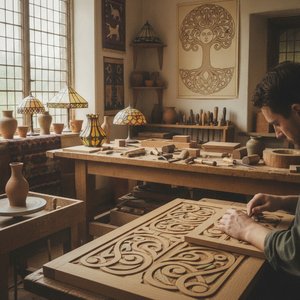
The Arts and Crafts Movement: Rediscovering the Soul of Handcrafted Artistry and Timeless Design
Explore the profound beauty of the Arts and Crafts Movement. Discover how the legacy of William Morris and handcrafted artistry offers a timeless antidote to mass production, inspiring soulful, luxury interiors through organic integrity and masterful craftsmanship.

Beyond the Canvas: Unveiling the Timeless Grandeur and Tactile Artistry of Textile Masterpieces
Embark on a sophisticated journey through the tactile realm of textile art. Unveil the historical evolution from utilitarian craft to museum-grade masterpieces, exploring the intricate textures and legendary artists that redefine the boundaries of fine art.

Sir William Blake Richmond: A Visionary of Aestheticism & Symbolism
Explore the life & art of Sir William Blake Richmond, a pivotal figure bridging Pre-Raphaelitism and Aestheticism. Discover his stunning portraits, mosaics at St Paul's Cathedral, and lasting influence on Victorian art.
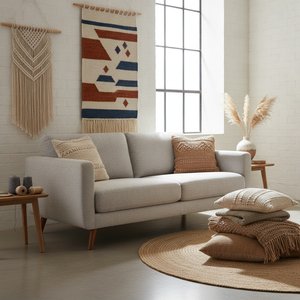
Woven Wonders: A Beginner's Guide to Elevating Your New Home with Timeless Textile Art
Discover how to transform your new home with the warmth of textile art. Our expert guide for newlyweds explores handwoven tapestries, tactile fibers, and timeless ways to curate a soulful, sophisticated interior through beautiful woven wonders.

Crimson Threads of Narrative: Exploring Symbolism & Representation in Artworks Featuring the Red Dress
Explore the rich symbolism of the red dress in art history! From ancient power displays to iconic portraits like Cézanne’s 'Madame Cezanne', discover the cultural and artistic significance behind this captivating color. Expert analysis & insights.


