Comută pe versiunea Print
 Vezi mai mult







































 Pentru opere de artă sau reproduceri care depășesc 105 cm (aproximativ 41 de inch) pe oricare dintre laturi, cadrul va fi livrat demontat, sub formă de kit. Această metodă asigură o livrare sigură și previne deteriorarea în timpul transportului.


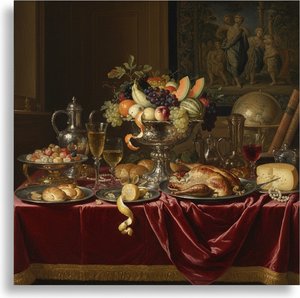
A Window into Dutch Domesticity: Willem van Aelst’s *Breakfast Piece*
Willem van Aelst's *Breakfast Piece*, painted in 1671, is more than just a still life; it’s a meticulously crafted snapshot of 17th-century Dutch life, brimming with the quiet luxury and observant detail that defined the Golden Age. Measuring a modest 49 x 41 cm, this oil on canvas work, currently housed in the Academy of Fine Arts Vienna, offers a captivating glimpse into a world where even the most commonplace objects – a bowl of fruit, a loaf of bread, onions, and a glass vase – were elevated to subjects of profound artistic consideration. Van Aelst’s mastery lies not merely in his technical skill but in his ability to imbue these everyday items with a sense of palpable presence, inviting the viewer into an intimate moment of domestic tranquility.
Chiaroscuro and the Illusion of Depth
The painting's impact is immediately drawn from Van Aelst’s masterful use of chiaroscuro – the dramatic interplay of light and shadow. This technique isn’t simply decorative; it’s fundamental to creating a convincing illusion of three-dimensionality, allowing each object to appear almost tangible. The artist meticulously renders textures with astonishing accuracy: the rough skin of the onions contrasts sharply with the smooth surface of the glass vase, while the glistening fish reflects light in a way that suggests freshness and vitality. The dark tablecloth, acting as a stage backdrop, further emphasizes the luminous quality of the food items, drawing the eye towards their intricate details.
A Reflection of Dutch Society – Symbolism and Context
*Breakfast Piece* provides a valuable window into the social and cultural values of 17th-century Holland. The abundance of food—a symbol of prosperity and good fortune—reflects the economic strength of the Dutch Republic at the time. The composition, with its triangular arrangement, echoes classical principles of harmony and balance, reflecting the influence of Renaissance art on the Dutch Golden Age. While seemingly a simple still life, it subtly engages with the *vanitas* theme – a reminder of mortality and the fleeting nature of earthly pleasures – a common motif in Dutch Baroque painting. The artist’s meticulous attention to detail speaks to the importance placed on material possessions and the appreciation for beauty within the domestic sphere.
The Artistry of Willem van Aelst
Willem van Aelst was a true innovator in the field of still life painting. Born in Delft in 1626, he dedicated his career to capturing the nuances of everyday objects with unparalleled precision and artistry. His work exemplifies the meticulous realism that characterized the Dutch Golden Age, showcasing a deep understanding of light, texture, and composition. Van Aelst’s legacy rests on his ability to transform ordinary subjects into extraordinary works of art, solidifying his place as one of the most important still life painters of his era. This piece is a testament to his dedication to detail and his profound appreciation for the beauty found in the simplest of things.
Întrebări și răspunsuri
Ce dimensiune de reproducere se recomandă pentru "Breakfast Piece" de Willem Van Aelst?
Pentru "Breakfast Piece", se recomandă o dimensiune de imprimare de Large. Sunt disponibile și alte dimensiuni, păstrând aceleași proporții.
Ce atmosferă ar aduce într-o încăpere o reproducere a operei "Breakfast Piece" de Willem Van Aelst?
"Breakfast Piece" de Willem Van Aelst emană o atmosferă Classic și este recomandată pentru o Dining Room. Întreaga dispoziție este ceea ce lucrarea aduce în spațiul din jurul său.
Din ce epocă datează "Breakfast Piece"?
"Breakfast Piece" de Willem Van Aelst datează din perioada Renaissance. Această epocă oferă contextul istoric al lucrării.
Mai multe detalii despre această pictură
 Previzualizare
 Trimite prin felicitare
 Distribuie
 Detalii despre lucrare
 Ghid
Ghid

 Descarcă imaginea
 Produse similare
 Radiografie
 Galerie foto
 Întrebări și răspunsuri
 Statistici