Comută pe versiunea Print
 Vezi mai mult







































 Pentru opere de artă sau reproduceri care depășesc 105 cm (aproximativ 41 de inch) pe oricare dintre laturi, cadrul va fi livrat demontat, sub formă de kit. Această metodă asigură o livrare sigură și previne deteriorarea în timpul transportului.


The Genesis of a Visual Symphony
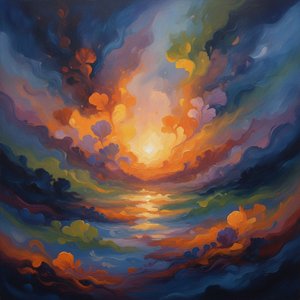
Wassily Kandinsky's "Untitled," painted in 1940, isn’t merely a depiction of an image; it’s the embodiment of a nascent visual language. Emerging from a period of intense personal and artistic transformation, this work represents a pivotal moment in the history of art – the deliberate abandonment of representational imagery in favor of pure emotional expression. Kandinsky, already wrestling with the burgeoning possibilities of abstraction, sought to create paintings that would directly resonate with the viewer’s inner world, bypassing the need for recognizable forms and instead communicating through color, shape, and composition alone. The painting's genesis lies within a period of profound introspection, fueled by his experiences witnessing Wagnerian opera and encountering the vibrant hues of Monet’s landscapes – events that fundamentally shifted his perception of art’s potential.

A Dance of Circles and Time
The composition of "Untitled" is immediately arresting, dominated by a swirling interplay of circles – large, vibrant discs that command attention and seem to pulse with an internal energy. These aren't simply decorative elements; they are imbued with symbolic weight. Kandinsky himself described color as the “keyboard” of his art, and each circle vibrates with a distinct emotional quality. The larger circles radiate outwards, suggesting expansion, growth, and perhaps even spiritual awakening, while smaller, more contained circles hint at introspection and inner focus. Crucially, nestled within this dynamic arrangement is a clock face – a deliberate inclusion that introduces an element of temporal awareness. This juxtaposition of abstract form and concrete time suggests the passage of experience, the fleeting nature of moments, and the artist’s attempt to capture not just a single visual impression but the very essence of feeling in relation to time itself. The color palette—primarily deep purples and blacks punctuated by bursts of brighter hues—contributes significantly to this sense of emotional depth, evoking feelings of mystery, contemplation, and perhaps even melancholy.
Roots in Symbolism and Early 20th Century Influences
To fully appreciate "Untitled," it’s essential to consider the artistic currents that shaped Kandinsky's vision. He was deeply influenced by the Symbolist movement, particularly its emphasis on subjective experience and the use of evocative imagery to convey emotional states. Furthermore, his exposure to Russian folk art – with its bold colors and simplified forms – provided a foundational aesthetic vocabulary. However, unlike the Symbolists, who often employed recognizable figures and narratives, Kandinsky sought to transcend representation altogether, believing that pure abstraction could more effectively communicate universal emotions and spiritual truths. The painting’s style aligns closely with early Expressionism, sharing a focus on conveying inner feelings rather than depicting external reality. The deliberate distortion of shapes and the intense use of color are hallmarks of this approach.
Beyond Representation: A Portal to Inner Space
“Untitled” isn't about *seeing* something; it’s about *feeling*. Kandinsky aimed to create paintings that would act as portals, transporting the viewer directly into their own emotional landscape. The painting invites contemplation and encourages a personal interpretation – there is no single “correct” reading. The deliberate ambiguity of the forms and colors allows each individual to project their own experiences and associations onto the canvas. This emphasis on subjective experience remains remarkably relevant today, as we continue to seek art that can connect us to our deepest selves. Reproductions of this work offer a tangible connection to Kandinsky’s revolutionary vision, allowing viewers to engage with his abstract explorations in a meaningful way.
Întrebări și răspunsuri
Care sunt tehnica și dimensiunile lucrării "Untitled" de Wassily Wassilyevich Kandinsky?
"Untitled" a fost realizat în Acrylic On Canvas și măsoară 5 x 32 cm în forma sa originală.
Ce ton emoțional transmite stilul Expressionism din "Untitled"?
Emoția Reflective din "Untitled" însoțește stilul său Expressionism.
Sub ce alte nume sau pseudonime este cunoscut Wassily Wassilyevich Kandinsky?
Alte nume înregistrate pentru Wassily Wassilyevich Kandinsky, creatorul operei „Untitled”, includ Wassily Wassilyevich Kandinsky, Kandinsky, Wassily.
Mai multe detalii despre această pictură
 Previzualizare
 Trimite prin felicitare
 Distribuie
 Detalii despre lucrare
 Ghid
Ghid

 Descarcă imaginea
 Produse similare
 Radiografie
 Galerie foto
 Întrebări și răspunsuri
 Statistici