Vezi în context
 Trimite
 Distribuie
 Detalii
 Ghidul

 Descarcă
 Produse similare
 Radiografie
 Diaporama
 Statistici
Ensemble Colorat
 Ulei pe pânză
- Artă de perete
- Expresionism
 1938
1938- Modern
 116.0 x 89.0 cm
 Citește mai mult
Giclée / Imprimare artistică
Printuri giclée sau pe canvas de calitate muzeală, cu proces de producție rapid și opțiuni flexibile de finisare. ( Comandă pictură realizată manual Treci la imagine digitală)




P118B lei10

P118H lei10

P118W lei10

P438Z lei10

P508JH lei12

P508YH lei12

P805H lei10

P805Z lei10

P919BZ lei10

P919G lei10

P919XJ lei10

P959ZH lei10

P968JZ lei12

W106C lei8

W218G lei10

W218JH lei8

W218Y lei10

W307PJ lei10

W316G lei10

W316PJ lei8

W316Y lei10

W398PJ lei8

W4111J lei10

W500HY lei15

W500JH lei15

W692G lei12

W849H lei8

W940BG lei15

W953PJ lei8




Alegeți dintre dimensiunile noastre prestabilite, care respectă proporțiile originale ale operei de artă.

Introduceți lățimea și înălțimea de care aveți nevoie, pentru a se potrivi ramei sau peretelui dumneavoastră. O printare poate fi doar tăiată, niciodată extinsă dincolo de dimensiunea imaginii originale, astfel încât o dimensiune cu o formă diferită va pierde o parte din imagine. Vă trimitem o simulare digitală pentru aprobare înainte de a imprima orice. Imaginea afișată pe această pagină nu prezintă tăierea reală — doar simularea arată acest lucru.
Livrare în întreaga lume () în 2 săptămâni, în loc de cele 4/5 săptămâni standard. (24 Octombrie)

Livrare expres gratuită la nivel mondial

Pânză de in premium

Asigurare completă pentru transport

Garanție de rambursare a taxelor vamale

Garanția fidelității culorilor

Politica de retur în 100 de zile (doar pentru defecte)

Garanție de rambursare 100%

Reducere pentru comenzi multiple
 Opțiunea cu sticlă este disponibilă doar pentru dimensiuni de sub 110 cm

Ensemble Colorat
Giclée / Imprimare artistică
Dimensiune reproducere
-


Preț total
lei 370
Colourful Ensemble: A Symphony of Geometric Forms by Wassily Kandinsky
Wassily Wassilyevich Kandinsky, a titan amongst modernist painters, irrevocably reshaped our understanding of artistic expression. His journey began humbly – studying law and economics at Moscow University – but was swiftly propelled toward greatness by an encounter with Claude Monet’s “Haystacks” and the transformative experience of witnessing Wagner's opera "Lohengrin." Around age thirty, Kandinsky experienced a profound epiphany that would forever alter his creative trajectory: he abandoned formal academic pursuits for a passionate dedication to art. This pivotal moment ignited within him a fervent desire to transcend conventional boundaries, leading him to Munich where he enrolled at the Academy of Fine Arts and studied under Franz von Stuck – though even amidst structured training, Kandinsky’s spirit remained restless, yearning for exploration beyond established conventions. Early influences included Russian folk art, which instilled in him an appreciation for vibrant color palettes and intuitive visual storytelling. However, it was his immersion into Impressionism that truly cemented his artistic vision, demonstrating the power of capturing fleeting moments of light and emotion. This formative period profoundly impacted Kandinsky’s subsequent stylistic choices, shaping his approach to abstraction and establishing a cornerstone for his groundbreaking contributions to art history.Composition and Elements: A Geometric Dance
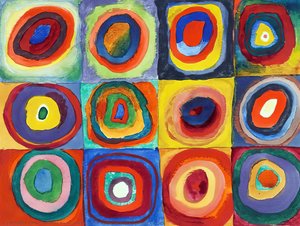
“Colourful Ensemble,” painted in 1938, stands as a testament to Kandinsky's masterful manipulation of geometric forms and color theory. Measuring 116 x 89 cm and executed on canvas with oil paint, the artwork embodies the core tenets of Expressionism while simultaneously pioneering abstract art’s exploration of nonobjective visual language. The painting’s composition is dominated by circles – scattered strategically across the upper left quadrant and concentrated in the middle and lower right sections – creating a dynamic interplay of shapes and hues. Beyond circles, Kandinsky incorporated other forms: notably, a heart shape positioned centrally on the right side, symbolizing love and emotion; and numerous triangles dispersed throughout the scene, adding structural stability and visual complexity.Expressionist Roots and Spiritual Resonance
Kandinsky’s artistic endeavors were inextricably linked to Expressionism, a movement that prioritized emotional experience and subjective interpretation above representational accuracy. As a member of Der Blaue Reiter alongside Paul Klee, Franz Marc, and Gabriele Münter, Kandinsky participated in a collective striving for artistic innovation rooted in spiritual contemplation. The vibrant colors and energetic shapes within “Colourful Ensemble” powerfully convey the Expressionist ethos – capturing feelings and sensations rather than depicting external reality. This deliberate departure from traditional aesthetics reflects Kandinsky’s belief that art could serve as a conduit for accessing inner states of consciousness and communicating profound emotional truths.Symbolism and Emotional Impact: Beyond Representation
“Colourful Ensemble” transcends mere visual depiction; it operates on a symbolic level, inviting viewers to contemplate themes of harmony, balance, and spiritual awakening. Kandinsky’s meticulous attention to color—ranging from deep blues and reds to luminous yellows—is not arbitrary but carefully considered, aiming to evoke specific emotional responses. As Kandinsky himself eloquently articulated, “A white horse or a white goose cause two quite different reactions.” He sought to liberate art from the constraints of objective observation, prioritizing instead the expressive potential of pure color and form. The artwork’s enduring appeal lies in its ability to resonate with audiences on an intuitive level—inspiring contemplation and fostering a deeper appreciation for the transformative power of visual art.- Artist: Wassily Kandinsky
- Year: 1938
- Medium: Oil on Canvas
- Dimensions: 116 x 89 cm
- Location: Georges Pompidou Center, Paris, France
Întrebări și răspunsuri
Ce sentiment creează culorile din "Ensemble Colorat" de Wassily Wassilyevich Kandinsky?
"Ensemble Colorat" de Wassily Wassilyevich Kandinsky combină o paletă Culori pastelate cu un ton Tranchil.
Care este atmosfera generală a operei "Ensemble Colorat" de Wassily Wassilyevich Kandinsky?
Ambianta generală a operei "Ensemble Colorat" de Wassily Wassilyevich Kandinsky este Serenitate. Această stare descrie atmosfera generală a lucrării.
Care sunt dimensiunile originalului "Ensemble Colorat" de Wassily Wassilyevich Kandinsky?
Originalul "Ensemble Colorat" de Wassily Wassilyevich Kandinsky are dimensiunile de 116 x 89 cm.
Biografie artist
A Life Immersed in Color and Spirit
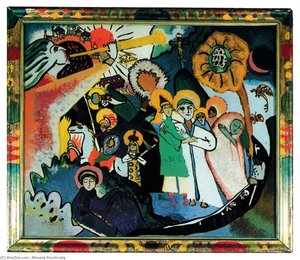
Wassily Wassilyevich Kandinsky, born in Moscow in 1866, was a revolutionary figure who irrevocably altered the course of modern art. His journey wasn’t one of immediate artistic calling; initially destined for a career in law and economics at the University of Moscow, it was a profound encounter with Impressionist painting – specifically Claude Monet's “Haystacks” – and a deeply moving experience witnessing Wagner’s opera "Lohengrin" that ignited within him an irrepressible desire to pursue art. This pivotal moment, occurring around age thirty, marked not merely a career change but a complete transformation of perspective, setting him on a path toward pioneering abstraction. He soon relocated to Munich, enrolling at the prestigious Academy of Fine Arts and studying under Franz von Stuck, though even within formal training, Kandinsky’s spirit yearned for exploration beyond conventional boundaries. Early influences included Russian folk art, gleaned from an ethnographic expedition to the Vologda region in 1889, which instilled a fascination with vibrant color palettes and symbolic imagery. This foundation would prove crucial as he began to develop his unique artistic language. These early explorations weren’t simply about aesthetic preference; they were rooted in a deep cultural connection and a burgeoning understanding of how art could communicate beyond the literal. He was particularly drawn to the rich symbolism embedded within Russian icons, which informed his initial approach to color and composition.The Dawn of Abstraction: From Expressionism to Inner Necessity
Kandinsky’s early works reveal a strong expressionistic bent, characterized by bold colors and emotional intensity – pieces like “Papeln (Poplars)” from 1902 exemplify this period. These canvases are imbued with a sense of dynamism and raw feeling, reflecting the artist's personal experiences and emotions. However, he wasn’t content with merely representing the external world; he sought to express inner realities, spiritual truths that transcended mere visual depiction. This quest led him gradually away from representational art and toward a revolutionary exploration of color, form, and their emotional resonance. He believed that art should not simply mirror reality but rather act as a conduit for accessing deeper levels of consciousness. He began to believe that colors possessed inherent psychological effects, capable of evoking specific feelings and sensations in the viewer. This conviction was deeply intertwined with his burgeoning interest in Theosophy, a spiritual movement emphasizing esoteric knowledge and universal brotherhood. As he delved deeper into these ideas, Kandinsky’s paintings became increasingly non-objective, shedding recognizable forms in favor of abstract compositions driven by an “inner necessity.” This wasn't simply about abandoning representation; it was about discovering a new visual language capable of expressing the intangible realms of emotion and spirituality. He sought to create a visual equivalent of music, where color and form harmonized to evoke profound emotional responses.Geometric Harmony and Spiritual Resonance
The period following his involvement with the influential artist group Der Blaue Reiter (The Blue Rider), which he co-founded in Munich in 1911, saw a further evolution in Kandinsky’s style. While earlier works often featured fluid, organic shapes, he began to explore geometric abstraction, focusing on the interplay of circles, triangles, and squares. “Several Circles” (140 x 140 cm) stands as a prime example of this phase – a dynamic composition where color and form interact in a harmonious yet energetic dance. These works represent a shift towards a more intellectual and conceptual approach to art-making, reflecting Kandinsky’s growing interest in mathematics and the underlying order of the universe. He believed that geometric forms possessed inherent symbolic meaning, and their arrangement within the canvas could evoke specific emotional responses. His theoretical writings, most notably “Concerning the Spiritual in Art” (1911), articulated these beliefs, laying the groundwork for a new understanding of abstract art as a vehicle for expressing profound spiritual truths. He argued that art should not aim to imitate nature but rather to reveal the artist’s inner world and connect with the viewer on a deeper, more intuitive level. The use of primary colors – red, blue, and yellow – was central to his philosophy, representing fundamental forces of nature and human emotion.Bauhaus Influence and Lasting Legacy
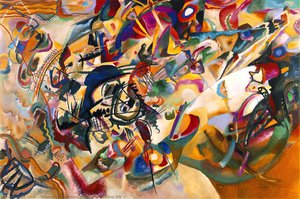
The outbreak of World War I forced Kandinsky’s return to Russia in 1914, but following the Russian Revolution, he found himself increasingly at odds with the prevailing artistic climate. In 1920, he accepted a teaching position at the Bauhaus school in Germany, where he profoundly influenced generations of artists with his theories on color, form, and abstraction. The Bauhaus provided an ideal environment for Kandinsky to further develop his ideas and explore new creative avenues. He emphasized the importance of intuitive feeling alongside rational design principles, advocating for a holistic approach to art education. He continued to experiment with geometric forms and vibrant colors, often incorporating layered impasto techniques to create textured surfaces that added depth and complexity to his compositions – as seen in later works like “An Intimate Party” (1942). After the closure of the Bauhaus by the Nazi regime in 1933, Kandinsky moved to France, where he remained for the rest of his life. His impact on modern art is immeasurable; he is widely recognized as a pioneer of abstract expressionism and a key figure in the development of non-representational painting. His works are held in major museums worldwide, including the Tretyakov Gallery in Moscow, which houses his monumental “Composition VII,” a testament to his artistic vision and enduring legacy. Kandinsky’s exploration of color, form, and spirituality continues to inspire artists today, solidifying his place as one of the most important figures in 20th-century art history. He didn't just paint pictures; he painted emotions, ideas, and the very essence of the human spirit.
Wassily Wassilyevich Kandinsky
1866 - 1944 , Русия
Informații rapide
- Artistic Movement Or Style: Abstract, Expresionism
- Artists Or Movements Influenced By This Artist:
- Bauhaus
- Der Blaue Reiter
- Artists Who Influenced This Artist:
- Monet
- Wagner
- Date Of Birth: 1866
- Date Of Death: 1944
- Full Name: Wassily Wassilyevich Kandinsky
- Nationality: Rus, France
- Notable Artworks:
- Comp. VII
- Papeln
- Succesiune
- Place Of Birth: Moscu, Rusia
Articole conexe

Cele mai importante 10 capodopere ale abstracției geometrice | Artă & Decor de lux pe OriginalUniqueArt.com
Descoperă cele mai importante 10 capodopere ale abstracției geometrice! Explorează istoria, artiștii (Mondrian, Kandinsky) și culorile vibrante care au definit arta modernă. Reproduceri de tablouri de lux pe OriginalUniqueArt.com pentru un decor interior rafinat. Explorează colecția online!

Wassily Kandinsky: Cele Mai Iconice 25 De Opere – Artă Abstractă pentru Decor Rafinat
Descoperă cele mai emblematice 25 de opere ale lui Wassily Kandinsky, pionierul artei abstracte! Explorează culorile vibrante, compozițiile unice și istoria fascinantă din spatele fiecărei picturi. Reproduceri de calitate muzeală pe OriginalUniqueArt.com – inspiră-ți decorul cu artă modernă!

Top 10 Capodopere ale Expresionismului Abstract: Artă, Artiști și Decorațiuni de Lux | OriginalUniqueArt.ro
Descoperă Top 10 capodopere ale Expresionismului Abstract! Explorează poveștile lui Pollock, Rothko și De Kooning. Reproduceri de artă de lux & inspirație decor pe OriginalUniqueArt.ro. Găsește pictura perfectă pentru spațiul tău!

Neo-Abstract Art: The High-Impact Evolution of Modern Visual Energy and Geometric Sophistication
Discover the power of Neo-Abstract art. Explore how bold geometric forms and high-impact visual energy are redefining modern design. Learn to curate sophisticated, high-energy spaces with the latest trends in contemporary abstraction and structural color.
The Soul of Color: A Journey into the Emotional Resonance of Lyrical Abstraction
Embark on a cultural journey through Lyrical Abstraction. Explore how masters like Kandinsky used color and motion to translate emotion into visual poetry. Discover the profound beauty of abstract expressionism and learn to curate emotional resonance in your own art collection.